

Better drafts, especially for junior lawyers
Two-thirds of the participants received access to InFlow; the rest worked without AI. In two patent-claim drafting tasks, only the AI group could use the assistant. After 10 and 90 days, that group outperformed the control group across all five measures: patentability, technical accuracy, strategic ambiguity, completeness and clarity. Low scores became less common and middle scores more common, while top scores barely changed.
The gains were much larger for lawyers with fewer than seven years of experience than for senior lawyers. The researchers say that fits a wider pattern: AI can narrow performance gaps between less- and more-experienced workers, as seen in writing, customer service and software development.
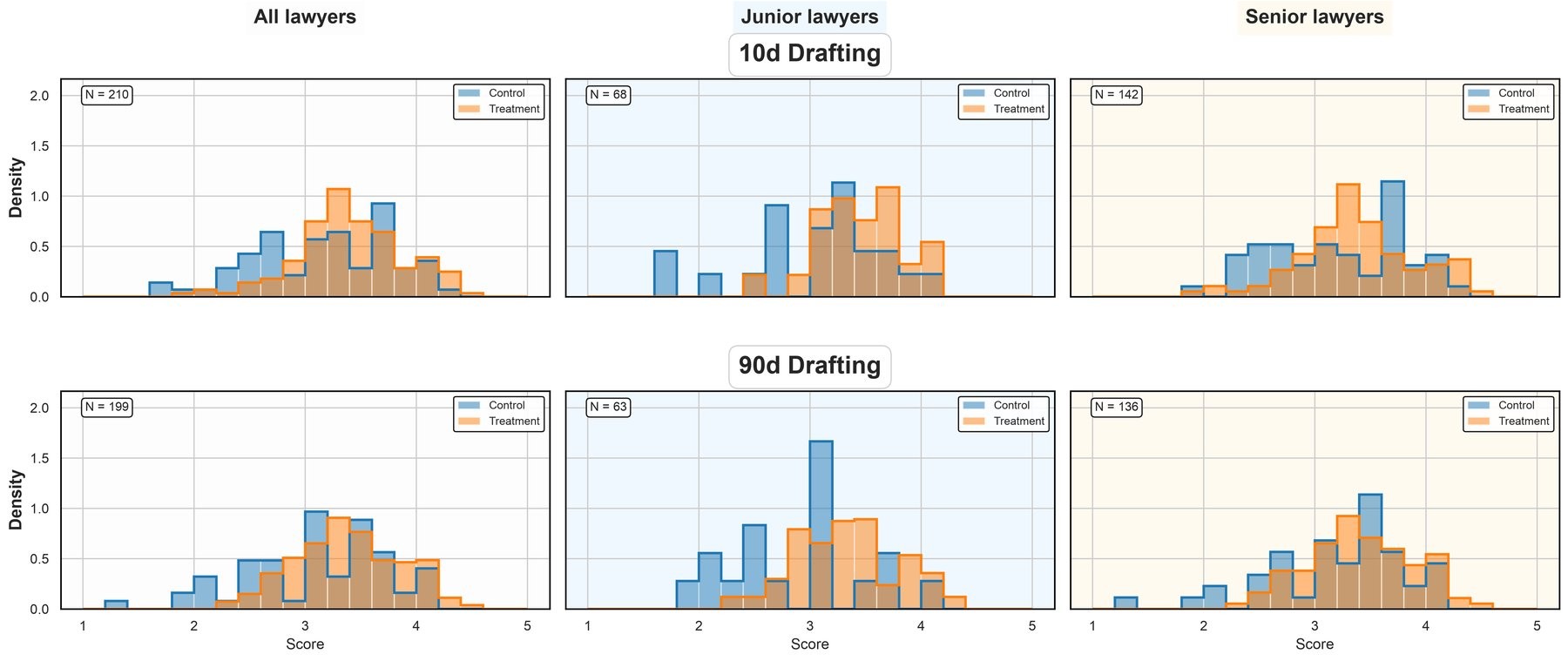
With AI access, junior attorneys received far fewer low scores on their patent drafts. | Image: NBER
Source: the-decoder.com
The advantage did not carry over
In a third task, every participant had to review and edit a draft patent document without AI. The overall AI group scored better, but senior lawyers accounted for all of that advantage. Junior lawyers showed no benefit, despite having gained the most in the drafting tasks.
Their results spread out: middle scores fell, while low and high scores rose. The number of top scores did not increase. The researchers suggest AI may have accelerated skill development for some junior lawyers while substituting for it for others, but the experiment cannot explain why outcomes differed.
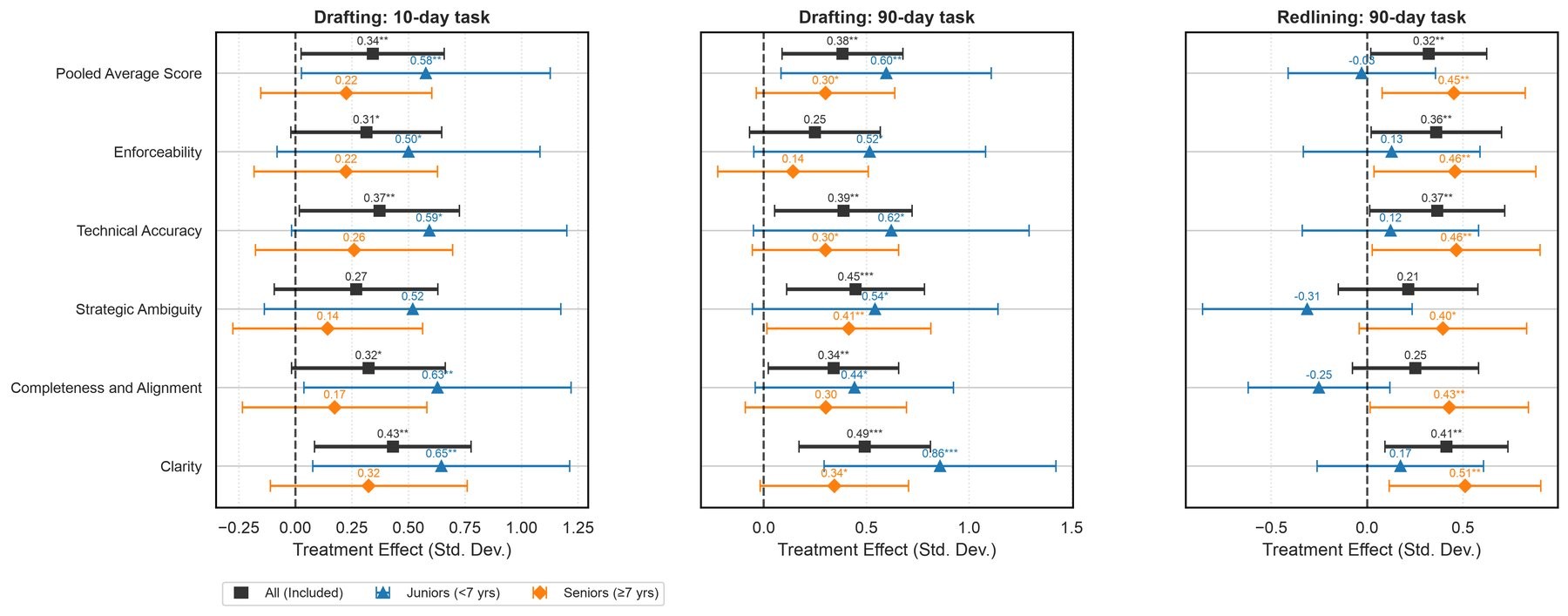
During AI-assisted drafting, juniors benefit most. In redlining without AI, only seniors retain an advantage. | Image: NBER
Source: the-decoder.com
The lawyers who gained most from AI were also the least likely to retain their skills over the longer term. The researchers therefore suggest that a baseline level of expertise may be needed for practice with AI to become durable skill.
An analysis of the edits offers one possible clue. Senior lawyers were more likely to restructure a flawed draft and justify their changes with legal principles. Junior lawyers often spotted serious problems but left comments resembling instructions for an AI assistant rather than fixing the draft themselves. This pattern also appeared in the control group, so the authors do not attribute it to habits formed through AI use. They see it instead as a pre-existing skills gap that AI did not close.
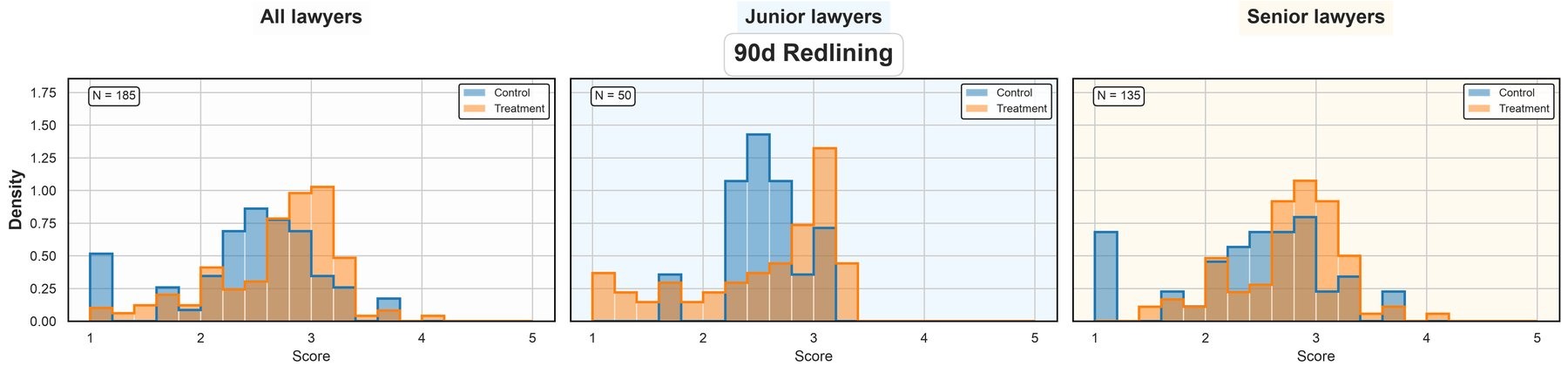
IIn redlining without AI, treatment-group juniors show wider score spread, with more low and more high ratings. | Image: NBER
Source: the-decoder.com
The gap between output and expertise
The study has limits: its sample was small, the firms do not represent professional services as a whole, and researchers did not measure participants’ skills at the outset. Three months is also a short window for expertise that takes years to develop.
I think the most important finding is not that AI helps junior lawyers draft better. It is that the largest immediate gains did not translate into stronger unaided judgment. That matters in work where lawyers still need to make decisions without AI, including client meetings and litigation, when the stakes are high and decisions cannot wait.
The pattern echoes findings elsewhere:
Stanford researchers have linked declining entry-level roles across industries to AI’s ability to replace knowledge typically acquired through textbooks and university courses—the kind of knowledge that often makes up much of a new worker’s contribution. Experienced workers also bring practical expertise that is harder to replace.
This patent-law trial adds evidence from real professional work to a broader debate about the loss of expertise, sometimes called a “tragedy of the commons of cognition.” A firm can benefit from automating work today while the cost of slower development among junior staff is borne by the profession as a whole. Anthropic recently reported that junior employees’ share of its engineering teams fell from 21 percent to 14 percent since the beginning of 2025.
Daily AI news
Every day we pick what actually matters in AI and explain it plainly — no hype, no filler. Subscribe if you want to follow where the industry is going.
Only what matters — every day
Follow on X