
Alibaba has released Qwen4-Max, a flagship model for professional work in industry, science and finance. It scored 43 points on the Artificial Analysis Intelligence Index, trailing only Kimi K3.1 Pro, at 46 points, among Chinese models. The cost per task on the index is $3.27 — about a third of the previous model’s price. A new architecture cuts the cost of processing long contexts, while Live Delivery lets users see an AI agent’s intermediate results and change its course before it finishes.
Alibaba introduces Qwen4-Max with lower prices and a new agent mode
Architecture for long texts
Qwen4-Max is a mixture-of-experts model with 2.4 trillion parameters, of which 71 billion are activated for each token. It works with images natively and supports a context window of one million tokens.
Qwen4-Max is built on an updated Qwen4-series architecture. Rather than processing every part of the context with equal attention, the model uses four successive layers: the first three compress the preceding context into a compact state, and the fourth selects the relevant parts from it. This approach reduces compute costs for long inputs.
The architecture also adds four parallel connections between layers, with dynamic switches intended to stabilize information transfer. An embedding layer for token sequences, with 328 billion parameters, provides common sequences as ready-made building blocks. Alibaba says training the 2.4-trillion-parameter configuration was stable: training loss declined steadily, without sharp jumps.
Alibaba’s internal tests measure model quality in bits per byte across knowledge, coding, question answering and science tasks. Of the five checkpoints tested, Qwen4-Max-Base performed best. It outperformed Qwen3.8-Max-Base by 5–13%, while activating 25% fewer parameters per token.
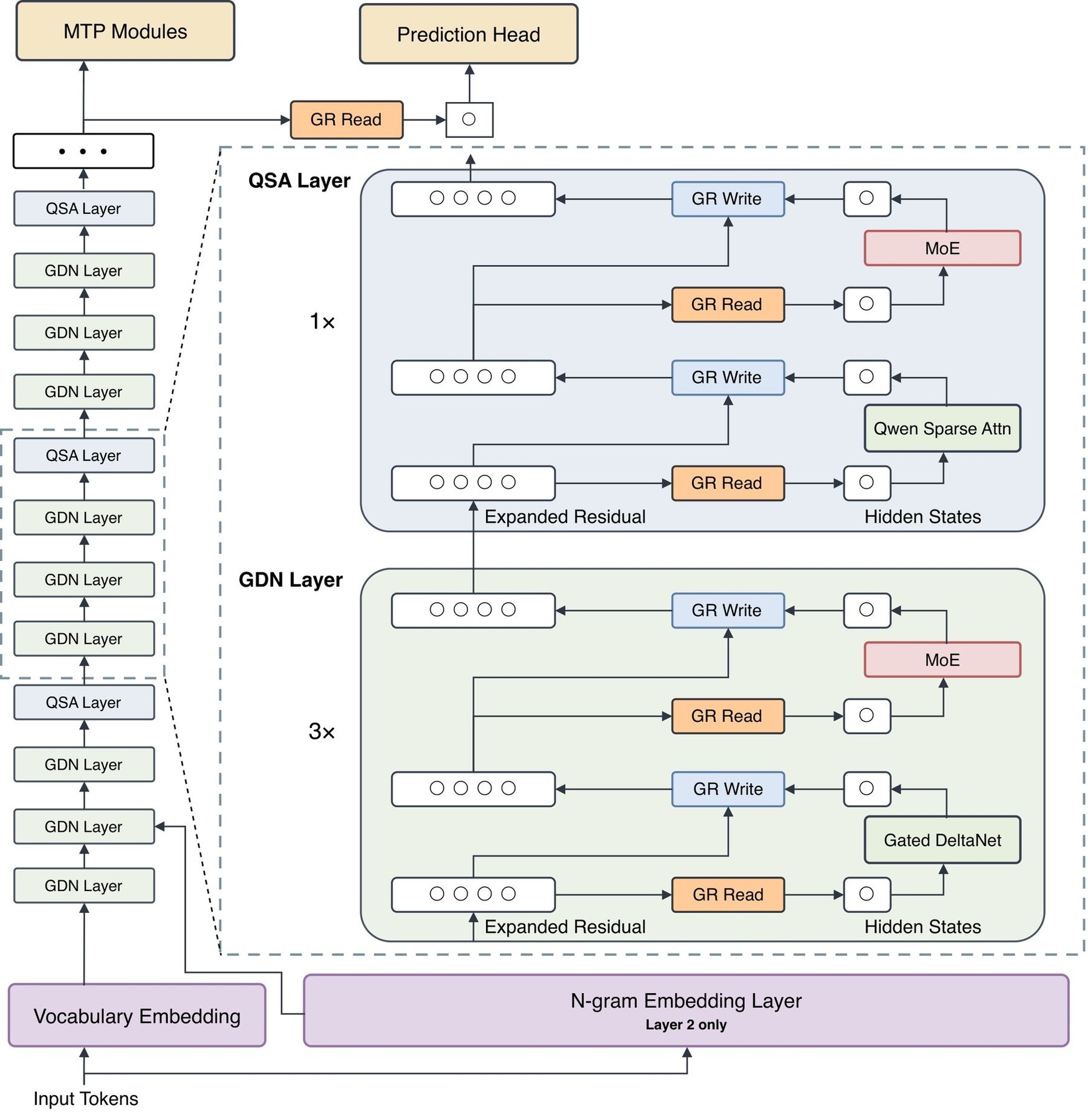
Qwen4-Max compresses prior text across three layers before a fourth layer takes a closer look at only the important sections. | Image: Alibaba
Source: the-decoder.com
Fewer tokens, lower task costs
On Work360, an industry benchmark covering 721 specialized fields, Qwen4-Max uses roughly a quarter to a third fewer tokens than its predecessor for the same tasks. On the Terminal-Bench 4.0 benchmark for AI agents, token use fell by almost half.
Alibaba says the average cost of a Work360 task fell by 62%, from $4.43 to $1.67. The model’s score on the benchmark also rose, from 47.74 to 52.69.
External benchmarks paint a mixed picture. On long-running AI agent tasks, including Agents’ Last Exam v1.1, Qwen4-Max scored 46.7, the best result among the models compared. It trailed Opus 5.5 and GPT models on Humanity’s Last Exam. On HealthBench Professional, it fell behind GPT but edged out Opus 5.5.
Price and benchmark results
On the current version of the Artificial Analysis Intelligence Index, at the highest reasoning level, Qwen4-Max scored 43 points. That is nine points more than Qwen3.8-Max and three fewer than Kimi K3.1 Pro, the leading Chinese model with 46 points. Its largest gains over its predecessor were on HLE-Diamond, up 21 points to 45%; AA-Omniscience, up 18; and AutomationBench-AA, up 17.
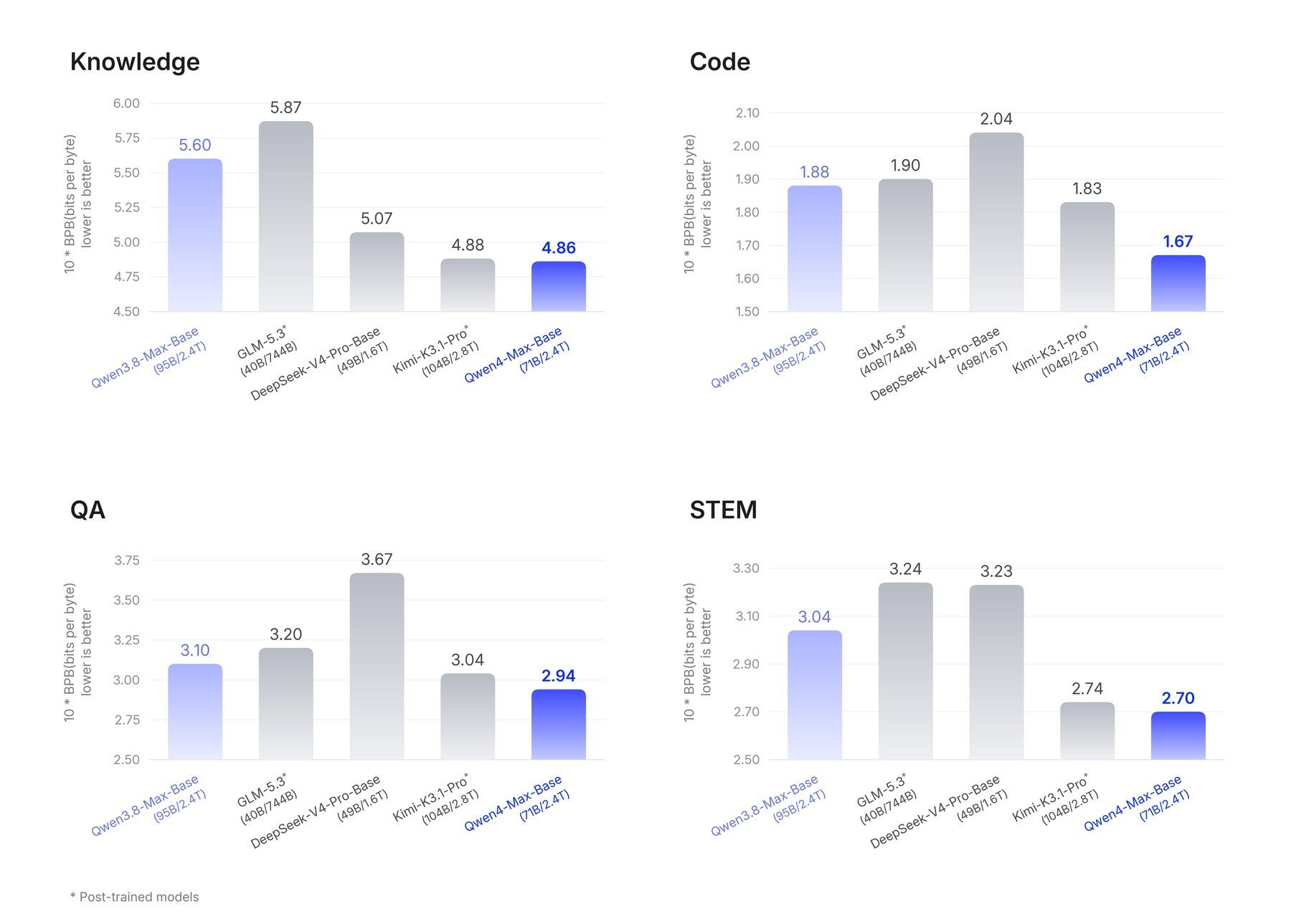
Qwen4-Max-Base posts the lowest, and therefore best, values in all four categories. | Image: Alibaba
Source: the-decoder.com
Artificial Analysis estimates the cost of a task on the index at $3.27 for Qwen4-Max. For Qwen3.8-Max, it is $10.02, and for Kimi K3.1 Pro, $3.68. The savings come from three factors: token prices are 25% lower than for the predecessor, cache hits cost 70% less, and the model uses fewer tokens. It needs about 105,000 output tokens per benchmark task, compared with 171,000 for Qwen3.8-Max.
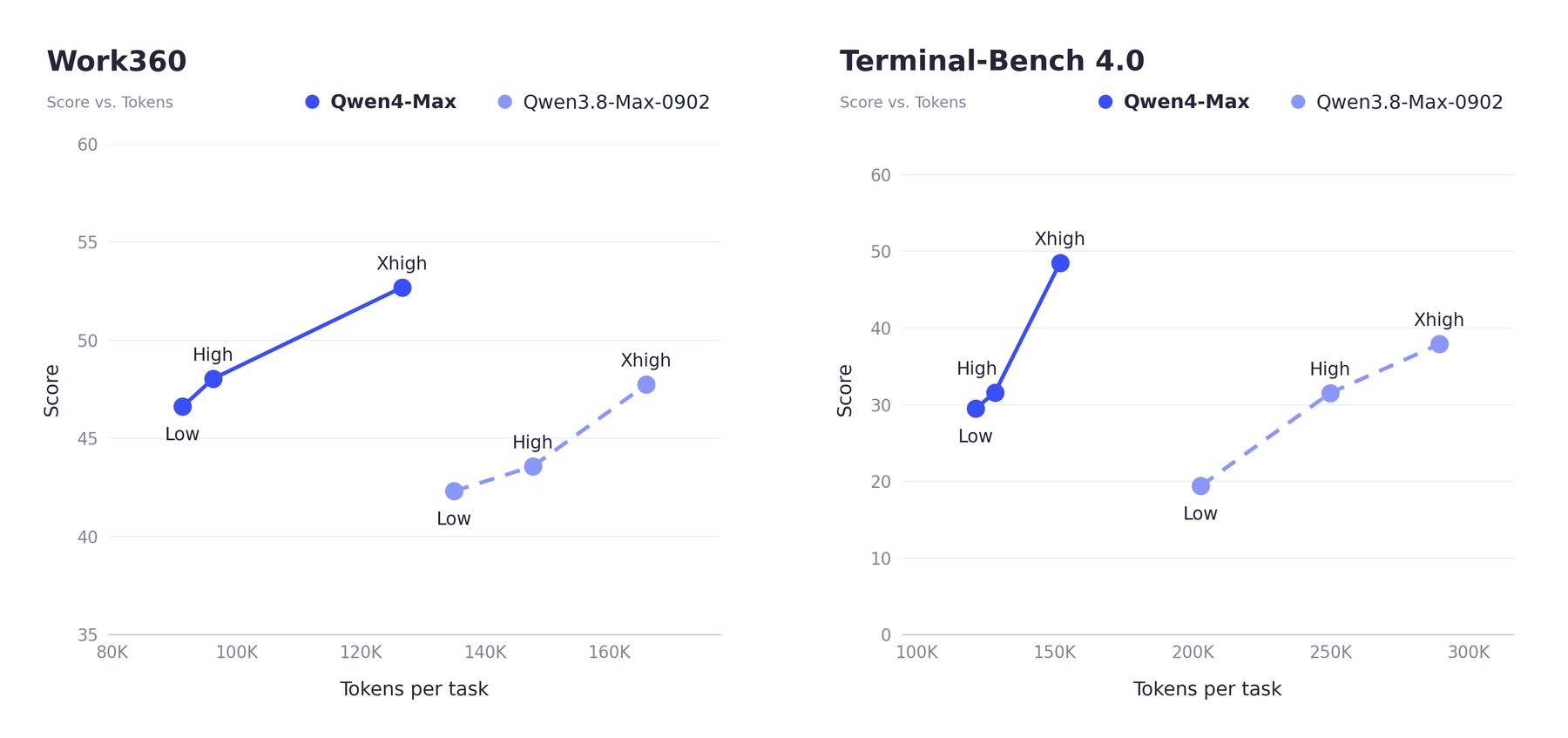
Qwen4-Max beats its predecessor on both benchmarks while using far fewer tokens. | Image: Alibaba
Source: the-decoder.com
Tencent Hy4 costs less — $1.03 per task — but scores eight points lower on the index. On Terminal-Bench 4.0, Qwen4-Max scores 48%, compared with 67% for Kimi K3.1 Pro. On Cognition’s FrontierCode 2.0 coding benchmark, Qwen4-Max and Kimi each scored 26%, while Tencent Hy4 scored 31%.
Alibaba’s own API charges $1.50 per million input tokens and $4.50 per million output tokens. Cache hits cost $0.075.
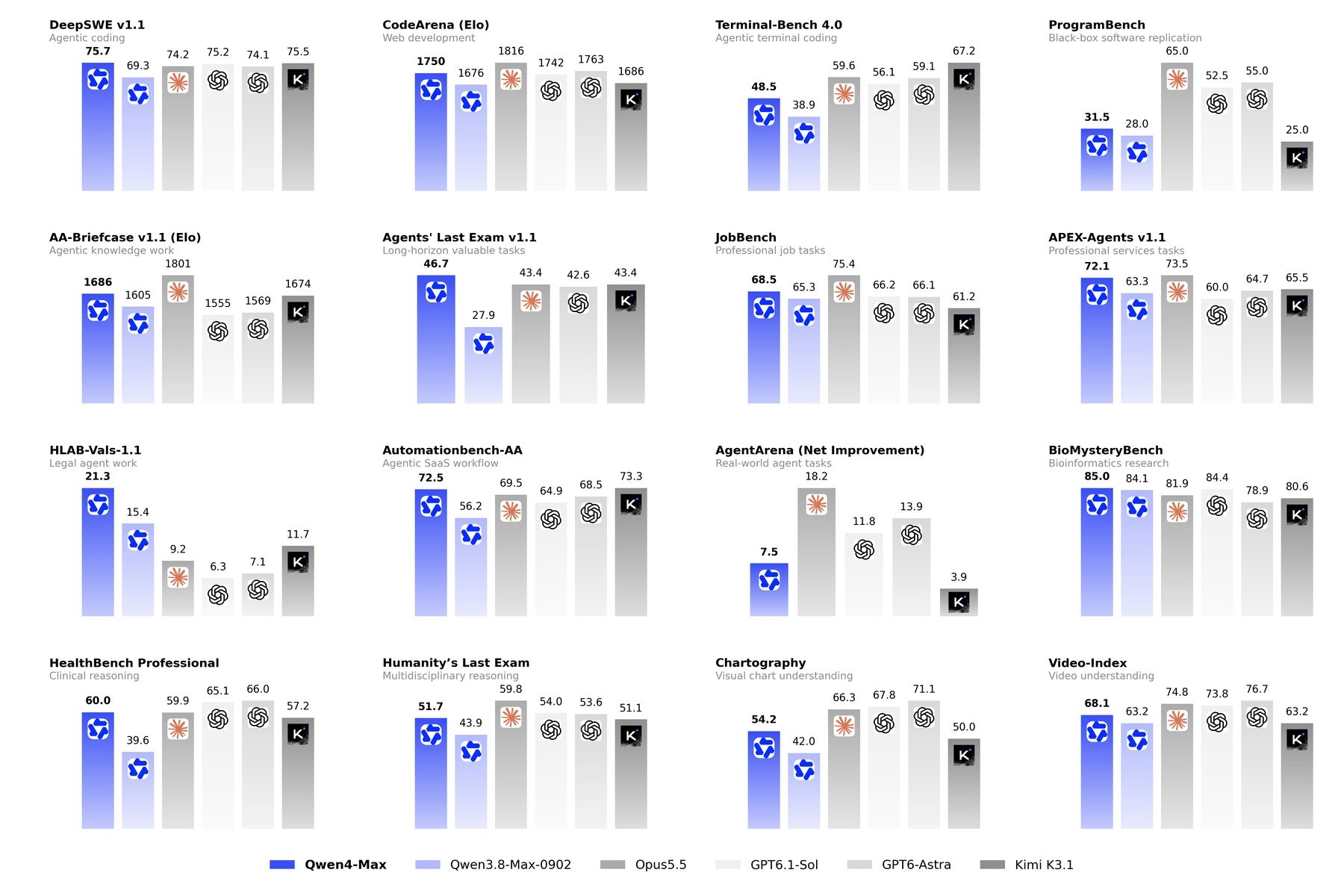
Alibaba says Qwen4-Max leads on agent and work tasks, while Opus 5.5 and the GPT models come out ahead on Humanity's Last Exam. | Image: Alibaba
Source: the-decoder.com
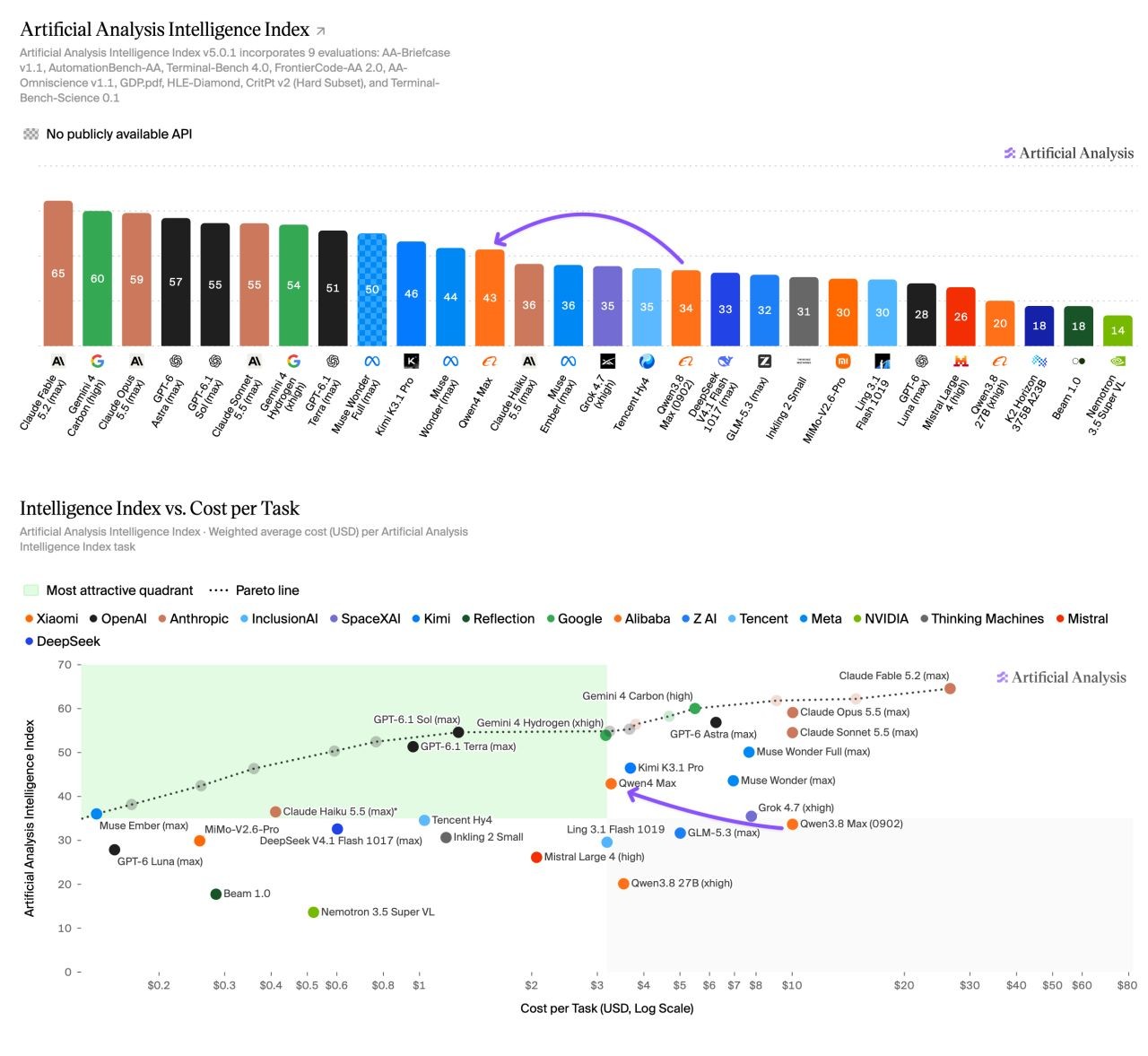
Qwen4-Max gains nine points on the Artificial Analysis Intelligence Index and costs only about a third as much per task as its predecessor. | Image: Artificial Analysis
Source: the-decoder.com
Live Delivery lets users intervene while an agent works
Alibaba is positioning the release around AI agents that handle long-running tasks autonomously. If users see the result only at the end, it is almost impossible to correct mistakes along the way. Live Delivery is designed to address that problem: the model produces a usable first version early, then refines it over several passes. Users can intervene at any point and change the direction of the work. Alibaba has made the companion Qwen-Live-Delivery-Plugin available to everyone.
The company points to partner projects as examples of how the feature can be used. According to Alibaba, automotive companies SANF and Pacific Union cut the time spent manually programming a single part from about 475 minutes to 24.
In finance, the model uses 90 MCP tools to gather market data from multiple sources. It turns the results into verifiable Excel and PowerPoint files, with each number linked to its source.
Alibaba also uses the model in its own cloud infrastructure. Together with its in-house MindOpt solver, Qwen4-Max reduced the average cost of allocating compute tasks for data labeling by 10.42%, the company says. When assigning tasks to processors in data centers, the model found optimal solutions more than 14 times faster than the comparison method.
The model runs laboratory experiments
Alibaba demonstrated Qwen4 in physical laboratories. Working with Mira, a system from startup Deep Principle, the model operated autonomously for 48 hours, according to the company. During that time, it designed, synthesized and tested a new coolant for powerful data center chips. The system explored 2.7 million molecular variants, controlled an automated laboratory and completed four full design, synthesis and measurement cycles.
A second project paired Qwen4-Max with PharmMaster, a platform from Beijing-based startup DP Technology, which uses AI to discover drugs. The goal was to create a compound that affects the inflammatory response associated with Alzheimer’s disease. After several rounds of literature review, design and computation, the model optimized 24 candidate molecules. Alibaba says the final candidate binds to the target protein about 3.6 times better than a known starting compound from a patent. Experts at DP Technology considered the result promising enough for further laboratory testing.
Creating games from text descriptions
Alibaba also demonstrated Qwen4-Max working with the Unity, Unreal Engine and Godot game engines. Given a natural-language description, the model is expected to handle the entire development process: setting up the scene and game logic, selecting external assets, and creating materials, a user interface and visual effects to produce a finished, playable version.
During development, the model launches the game itself and uses visual and interactive feedback to adjust the camera, character animation, hit reactions and lighting. Alibaba cited “Meow of Magic” as an example: an Unreal Engine adventure game about a wizard cat fighting waves of enemies with spells. The company says Qwen4-Max can also create 3D models in Blender for use in games and 3D printing.
Anthropic previously restricted the capabilities of its Claude Code programming assistant after unofficial copies of Halo and GTA: Vice City appeared. The company prohibited the tool from recreating existing games.
Code security and limits on dangerous capabilities
According to Alibaba, the share of code that both works and is secure rose from 22% to 31.8% on the Last Secure Code Bench benchmark. The share of code judged secure at all three levels of review nearly doubled, from 8% to 14.7%.
The company also tested the model for risks related to chemical, biological, radiological and nuclear threats. Alibaba says its internal reviewers examined the model’s full reasoning chains and found no genuine innovative capabilities that would give users a substantial boost in capability.
Qwen4-Max is available through QwenCloud, as well as in QwenWork, Qoder and QwenStudio. Alibaba plans to release smaller open-weight Qwen4 models later.
Alibaba’s previous models and competitors
In August, Alibaba released Qwen3.8-Max, the first Max-series model designed for autonomous tasks lasting several days. Like Qwen4-Max, it has 2.4 trillion parameters, but activates 95 billion for each token. At the time, Artificial Analysis found that the model needed 64 steps to complete a task, compared with 14 for Qwen3.7-Max, and that the cost per task was more than twice as high.
In late August, Alibaba introduced the Qwen4 architecture in a preview version, Qwen3.8-Flash-Next. It already included a token-sequence embedding layer, but with 51 billion parameters. In mid-August, the company released the weights for Qwen3.8-Max. For Qwen4, open weights are currently planned only for smaller models.
In October, Moonshot AI introduced Kimi K3.1 Pro. It has 2.8 trillion parameters; Moonshot says it trails only Claude Opus 5.5 on Terminal-Bench 4.0. Like Alibaba, DeepSeek uses a hybrid attention architecture: in V4-Pro, sparse attention reduces the cost of processing long contexts. Zhipu AI has taken a different approach, attributing GLM-5.3’s improvements entirely to additional post-training.
Dataist’s take: Qwen4-Max combines low costs with strong results on some long-running and practical tasks, but does not lead across all evaluations: it trails GPT on two of the benchmarks cited and Kimi on Terminal-Bench 4.0. Claims about laboratory experiments, savings and safety are based on Alibaba’s data; the company has only said it plans to make smaller open-weight models available.
Source: the-decoder.com
Daily AI news
Every day we pick what actually matters in AI and explain it plainly — no hype, no filler. Subscribe if you want to follow where the industry is going.
Only what matters — every day
Follow on X