What former students describe
Riley’s latest reporting collected accounts from graduates of Alpha Schools, a private network marketed to wealthy families seeking an alternative to what they see as a fundamentally broken public education system.
According to the former students, the school:
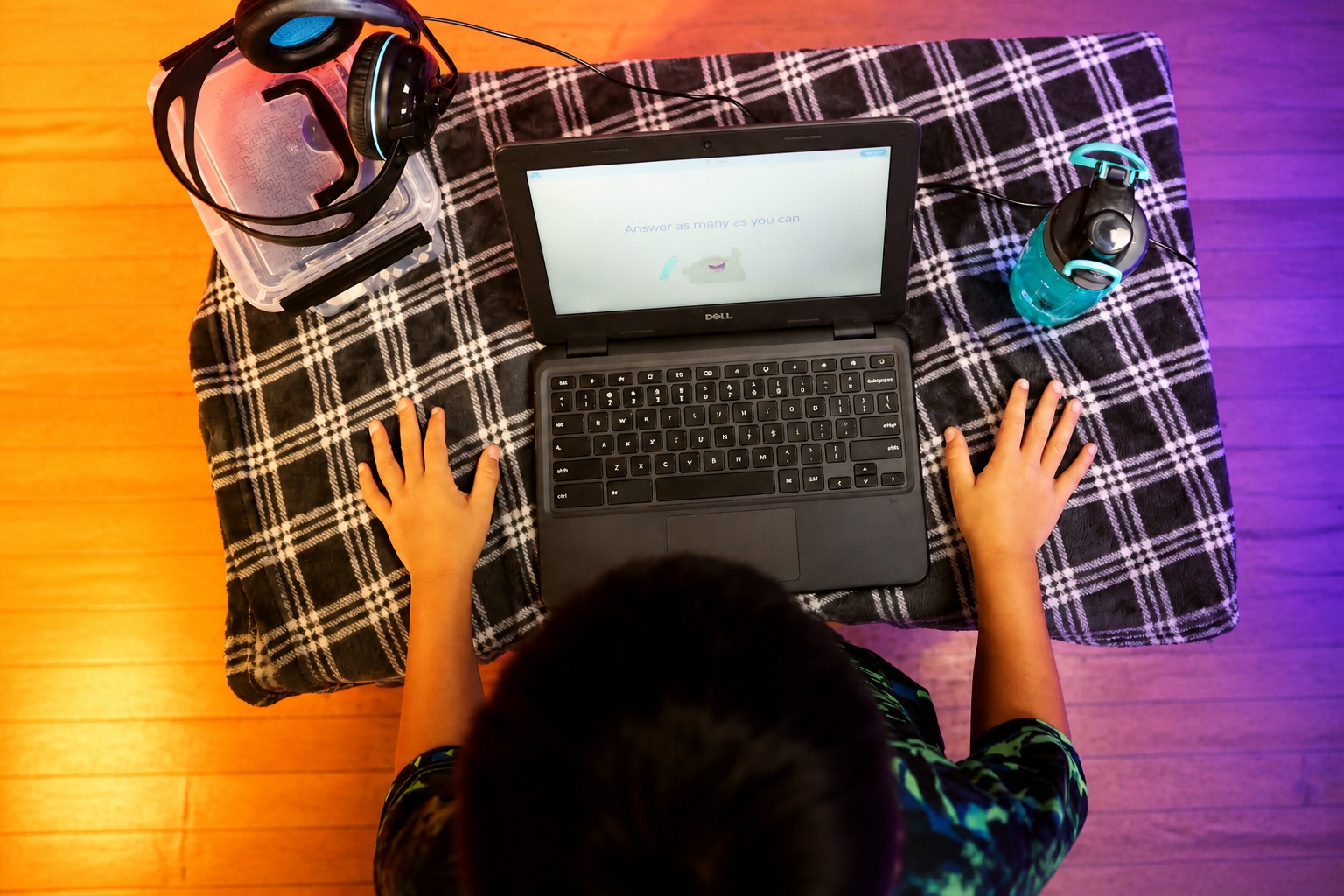
One student told Riley that he and several others were made to take standardized math tests almost every day. After each wrong answer, they had to join a Zoom call with an unfamiliar person, usually from India, and explain exactly where they had gone wrong and why.
“I hated it,” the student said.
The students recalled being watched through their computers “like laboratory rats.” The monitoring, they said, was apparently carried out not by AI but by relatively inexpensive workers in other countries.
That gap between the product label and the labor behind it is the central issue here. Matt Seibolt, director of media studies at Elmira College, described the pattern in a Bluesky post as a “mechanical Turk”: systems presented as artificial intelligence that in practice depend on human labor from countries in the Global South.
404 Media reported the same week that people in call centers were also behind Meta’s claims that its AI tool Muse could call companies on users’ behalf. The comparison does not prove the two systems are identical, but it makes Alpha’s “AI school” branding harder to take at face value.
The school’s internal tracks
Riley’s materials describe several “internal programs” used to sort students. One was called “Rocket Ship,” which a former student characterized as a club for smart children whose members were allowed to do almost anything.
Another former student said the school moved him to sixth-grade math while he was in ninth grade. The school also damaged his credits. He believed that was deliberate: incorrectly recorded credits could prevent students from receiving a diploma when transferring elsewhere.
“We were just robots,” he added.
That account points to a second problem beyond surveillance. A system that controls both the student’s daily experience and the records needed to leave can make the school difficult to exit, whether or not that restriction was intentional. The source provides the student’s belief, not proof of the school’s motive.
When the computer gets “nuked”
Former students also described an incident they called “getting nuked.” If a child failed to reach a set threshold on a computer test, the system effectively disabled the entire machine, leaving access only to the school’s proprietary learning application.
A joking screen showed a nuclear explosion and told the student they had been “blown up.” Students said the lockout could happen even when the tracking program was wrong.
Administrators reportedly had to contact the software development team to restore access. Much of that team was outsourced to other countries, and communication was so convoluted that fixing a problem could take several days.
My read is that the most damaging part of these accounts is not any single piece of technology. It is the combination: opaque scoring, human surveillance presented as AI, emotional monitoring and a computer system that could punish students for missing a threshold. In a school charging $75,000 a year, that looks less like personalization than an unusually expensive compliance system.
The announcement is also quiet about the safeguards that would matter most: who could see the webcam and biometric data, how long it was retained, how students could challenge an incorrect assessment, and how families could correct or transfer their credits. Those details are absent from the material described by Riley.
Alpha School has not answered Riley’s new questions. Riley wrote that the former students’ accounts best show the dystopian character of what was happening at Alpha School, and said the school’s public image had been irreversibly destroyed. He also said he would continue until the full scale of the alleged educational and psychological violations involving children was exposed.
The technology was supposed to make the school more responsive. Instead, the allegations suggest a system where the people being measured had less visibility and control than the people measuring them.
Daily AI news
Every day we pick what actually matters in AI and explain it plainly — no hype, no filler. Subscribe if you want to follow where the industry is going.
Only what matters — every day
Follow on X