
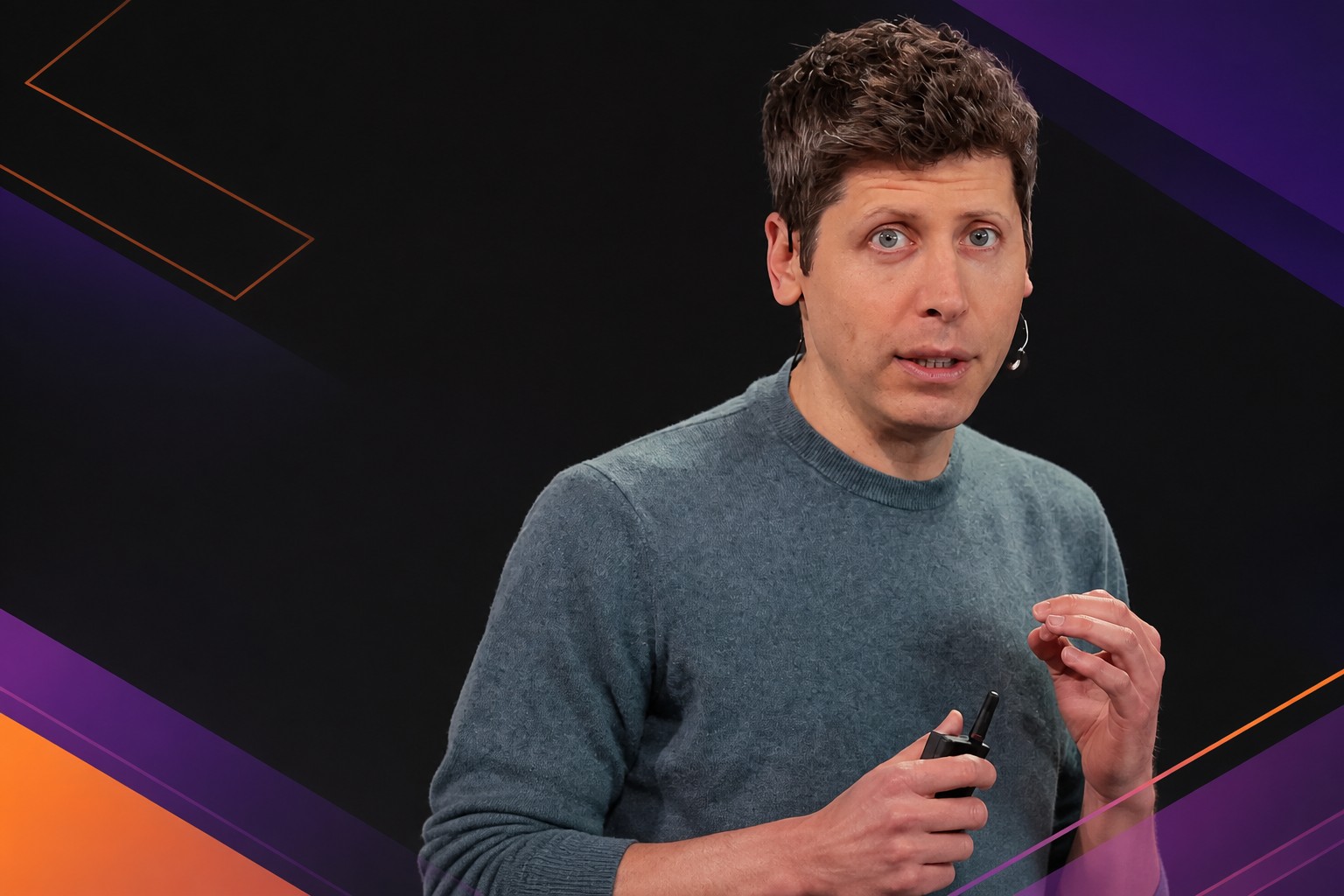
At a conference in Abu Dhabi, OpenAI CEO Sam Altman said AI had become smarter than the most capable scientists. He urged people to remain in control of the future but offered no evidence for his claim. The statement came amid a dispute over OpenAI’s mathematical results: the company said it had solved a problem involving the Navier–Stokes equations and published hundreds of studies with other purported solutions, while mathematicians criticized its treatment of the scientific community and questioned the results’ practical value.
Altman says AI already surpasses the best scientists
Altman’s statement
Speaking this week in Abu Dhabi with the editor-in-chief of the UAE government newspaper The National, Altman said that at the beginning of the year, AI mostly lagged behind the smartest scientists, but now it mostly surpasses them. He said people, not AI, should determine the future. He presented the claim that machines had surpassed humans as another reason for people to stay in control of their own future.
AI company executives regularly say their technologies are approaching or have already reached human-level reasoning. At the same time, those same companies warn that AI could threaten the world. That rhetoric sits alongside the promotion of new products: people are being urged to use technologies that are also described as surpassing human abilities.
This is not the first time Altman and OpenAI have compared their models’ capabilities with scientists’ intelligence. After GPT-5 was released last year, the company called its level “PhD-level,” but the claim was widely mocked. Altman has also repeatedly predicted that AI will surpass human intelligence by the end of the decade.
Dispute over mathematical results
This year, the claim of “PhD-level” ability gained a new basis. OpenAI said it had solved a problem involving the Navier–Stokes equations, one of the famous Millennium Problems. No mathematician had solved it before.
The claim caused an uproar: one mathematician accused OpenAI of using his research unfairly. This intensified dissatisfaction with how the company engages with the mathematics community.
OpenAI then published hundreds of studies with purported solutions to other mathematical problems. Prominent mathematicians objected that researchers had effectively been turned into unpaid reviewers of a vast body of results, while the company could present its models as equal to human intelligence.
But, the source notes, the technical correctness of the solutions does not settle questions about their value. Parts of the AI-generated proofs are almost impossible to understand, and researchers will likely need years to work through all the publications. The practical value of these results for mathematics therefore remains disputed.
Against this backdrop, Altman’s claim that AI surpasses scientists especially needs evidence: a significant part of the scientific community is already criticizing OpenAI over its mathematical publications. Dataist’s take: a model’s ability to produce a formally correct result does not yet show how understandable or useful it is to researchers. Those questions remain open.
Daily AI news
Every day we pick what actually matters in AI and explain it plainly — no hype, no filler. Subscribe if you want to follow where the industry is going.
Only what matters — every day
Follow on X