
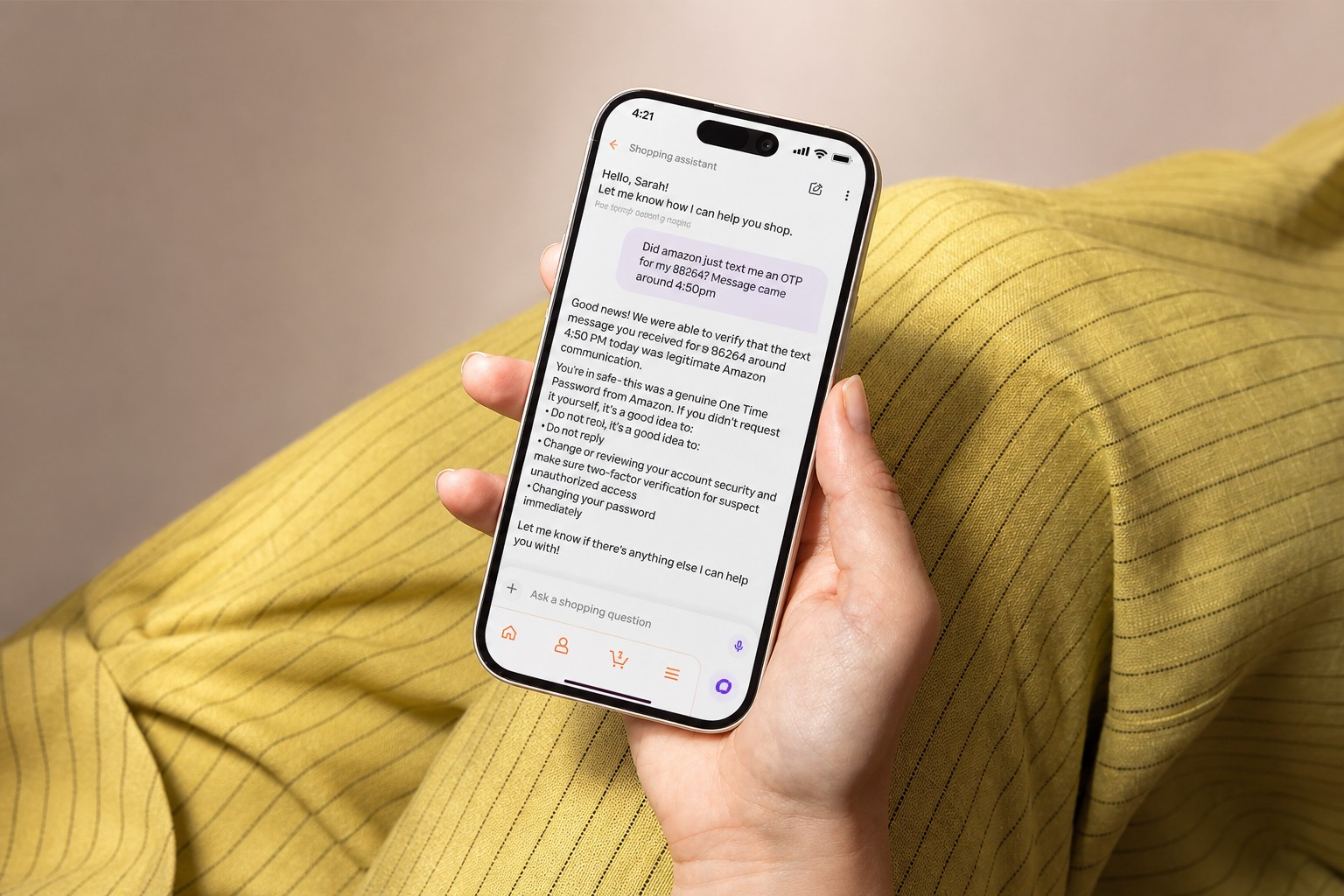
Amazon has given its shopping assistant a new job: deciding whether a message that claims to come from Amazon actually does. Feed Alexa a suspicious note and the system weighs sender data, the text itself, the time it was sent, metadata and other signals, then returns a verdict. Amazon says the service can confirm a message's authenticity unambiguously. The premise is larger than the feature: the company whose name scammers borrow is now also the one ruling on which messages bearing that name are real.
Amazon, is that really you? Get a definitive answer in seconds
Source: techcrunch.com
The scams it is aimed at are the familiar catalogue of impersonation: fake order confirmations, Prime renewal notices, account suspension warnings, package delivery messages and fraudulent job offers. Every one of them works by borrowing Amazon's transactional voice, which is the voice most people have been trained to act on without thinking.
This is the third door onto the same question. Amazon already runs a verify@amazon.com address where a user can forward a suspicious email and get an answer on whether it was genuine or fraudulent, and the same check is available through a form on the support site. What the assistant adds is placement: the check now lives where the shopping happens, rather than requiring the user to stop, copy a message into an email client and wait.
It also adds a data loop. Amazon says that as users report new suspicious messages, the system will get better at spotting fraud schemes. That is a reasonable engineering claim and a quiet ask: the people being defended are also the labelling pipeline.
The verification sits inside a broader repositioning of Alexa around commerce. The assistant's shopping mode now surfaces personalised deals, builds shopping guides, helps reorder everyday items, generates AI product reviews and reads handwritten shopping lists. Amazon also added proactive notifications about new or relevant events — a new product from a brand you like, a book from an author you follow, a new album from a musician. Alexa for shopping runs on Amazon's website and in the company's mobile app.
The word doing the most work in the announcement is "unambiguously." Fraud detection on sender data, text and metadata is a classifier, and classifiers have error rates in both directions. Nothing in the announcement gives one: no accuracy figure, no description of what a wrong answer looks like, no statement of what Amazon owes a customer who is told a scam is genuine and acts on it. A tool that says "this looks suspicious" is advice. A tool that says "this is definitely us" is closer to a guarantee, and guarantees usually come with terms.
The more interesting question is the one the feature quietly poses about Amazon's own messaging. Verification only becomes valuable because Amazon's real messages have become indistinguishable from fake ones, and that is a problem the company had a hand in creating: a high-volume stream of order confirmations, delivery alerts and promotional pings is exactly the cover impersonators need. The same announcement that offers a way to sort real from fake also expands the flow, with an assistant that will now message you unprompted about product launches and album releases.
So Amazon is asking customers to route their trust decisions through Alexa at the same moment it gives Alexa more reasons to contact them. That works as long as the arbiter and the sender never disagree about what counts as a message worth trusting.