
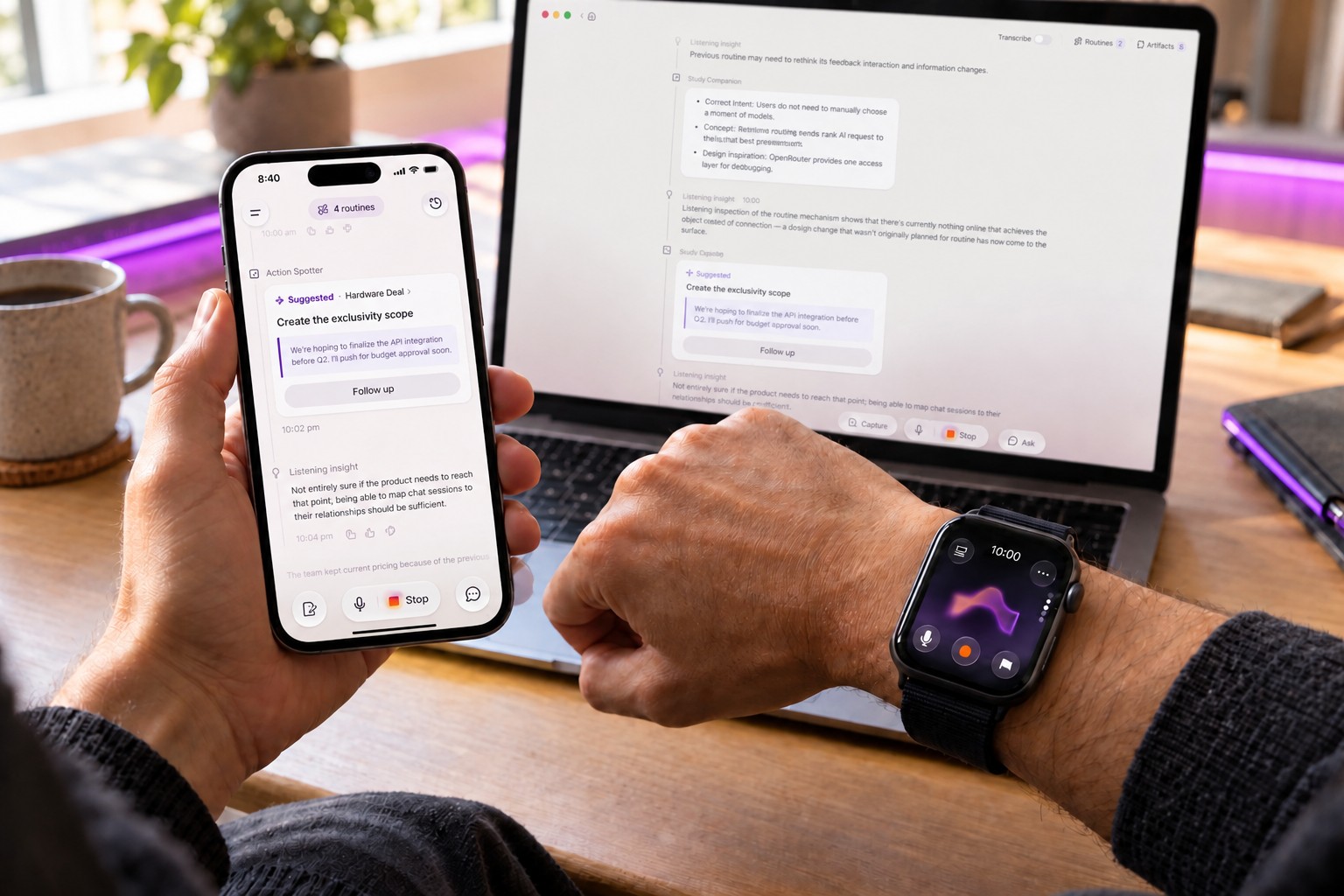
From meeting notes to an always-on assistant
Ambi’s apps can work like meeting-note services, but users can also switch on continuous listening. The company wants its agent to start tasks during a meeting and draw on a user’s calendar, meetings, knowledge base and internet data to offer timely ideas or relevant information. Users can begin a task on one device and continue it on another.
That ambition goes beyond the familiar post-call workflow: produce a summary and action items, then connect them to other software. Ambi is also developing a desktop app that could analyse how someone works and retain important moments to make recommendations more personal. Littlebird and Minimi already offer similar features.
The company plans to make its own device with a screen, speaker, camera and microphones. Like the apps, it would collect context and surface information.
Mo told TechCrunch that AI systems are often confined to a screen. With Plaud devices, he said, users have to wait for a recording to transfer to a phone, upload to the cloud and be processed. Ambi, he said, is meant to make AI available anywhere and at any time.
The $26 million came in several rounds led by Luminous Ventures, an investor in Meituan and Unitree Robotics, and Huaqin, a Chinese electronics manufacturer that works as a contract manufacturer.
The people outside the conversation
An always-on assistant creates a problem that app controls alone cannot settle: people near the user may not know they are being recorded. It remains unclear how clearly Ambi’s apps and planned device will alert bystanders.
Some meeting-note services have faced lawsuits over recording conversations and collecting data without participants’ consent. Apple’s recent Voice Intelligence launch has also prompted privacy concerns because it continuously recognises speech.
Mo says ambient-data collection can be switched off at any time and is disabled by default. Ambi says it does not store user recordings and encrypts data, but has not specified its encryption method. The company still leaves users responsible for telling others when ambient data is being collected.
Mo said Ambi should explain that responsibility to users and has tried to put warnings wherever possible. But he acknowledged that no warning can solve the problem when someone deliberately conceals a recording, and that the industry has yet to find a way to alert everyone affected.
I think that is the harder test for Ambi than whether its agent can offer a useful suggestion mid-meeting. The company is asking users to treat their surroundings as personal context, while asking everyone else in those surroundings to trust that the user will disclose what is happening.
Ambi has more than 50 employees across offices in San Francisco, Beijing, Shanghai and Shenzhen. It is hiring for sales and AI engineering roles focused on speech-recognition models. Those models may improve what the assistant hears; they do not answer who gets to know that it is listening.
Daily AI news
Every day we pick what actually matters in AI and explain it plainly — no hype, no filler. Subscribe if you want to follow where the industry is going.
Only what matters — every day
Follow on X