
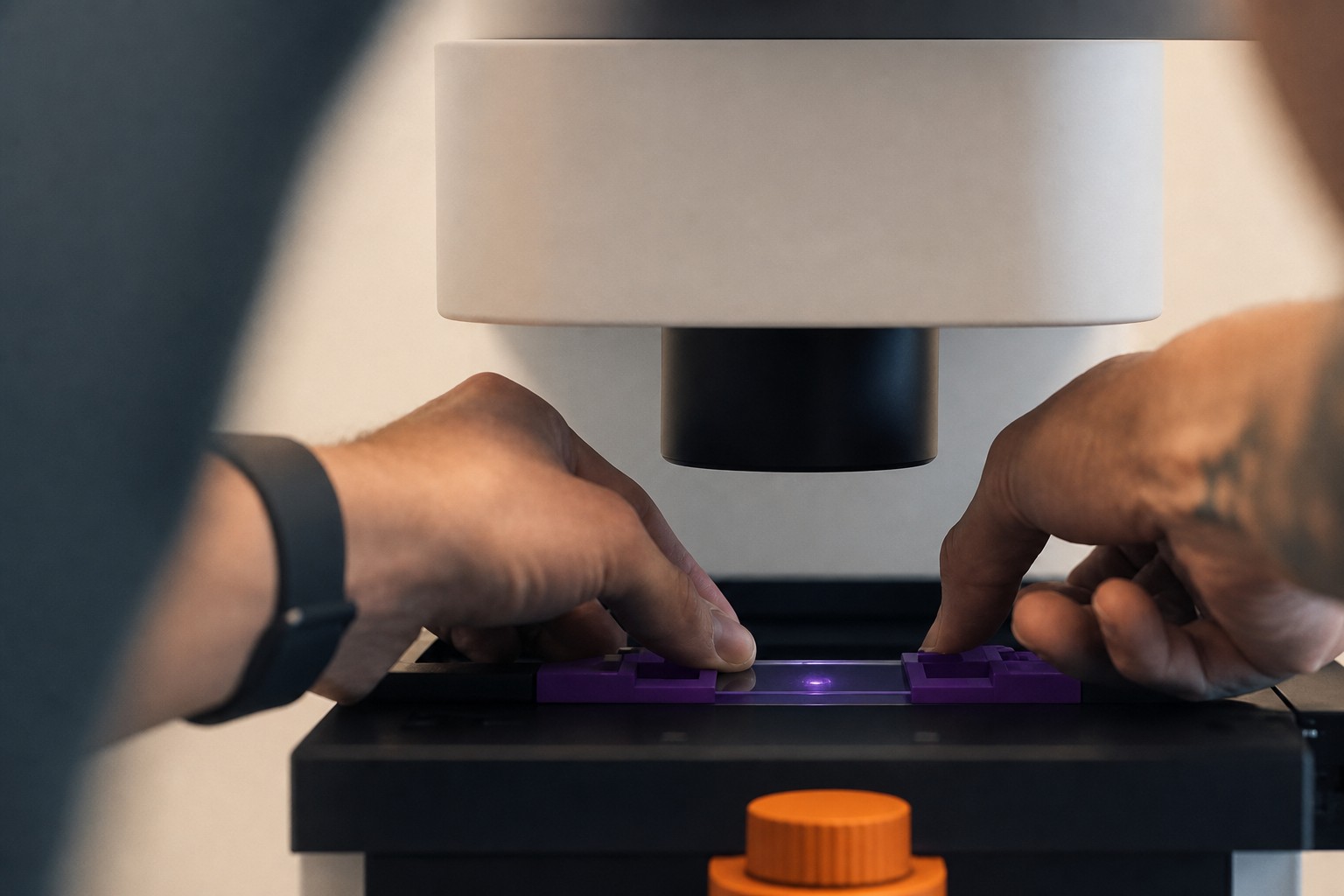
Anthropic has put a hardware standard into research preview. The Model Hardware Standard, or MHS, gives an AI agent one way to find, read and command any instrument with a programmable interface — liquid handlers, microscopes, robotic arms, lasers — instead of a bespoke integration for every pair of devices. Six partners have been running early versions: Genentech, the University of Washington, Carnegie Mellon, HHMI Janelia, QuEra and Tetsuwan. The code is not open. Anthropic says it will open-source MHS after it works out safety checks and usage rules with those partners.
The problem MHS attacks is old and unglamorous. Instruments rarely exchange data directly, so labs and production lines write glue code device by device, and setup runs for weeks or months. Anthropic's claim is that MHS cuts that to hours or minutes, and that once the wiring is done an agent can run experiments around the clock — stepping through a protocol, changing parameters mid-run, and in some cases recovering from hardware faults without a person.
Before and after the Model Hardware Standard (MHS)
Source: anthropic.com
Mechanically, MHS is a driver layer plus a shared description format. A driver translates operating-system commands into a given device's language, built on a small set of primitives: read a value such as temperature, write to change it. Every connected device is described the same way, so instruments and agents discover each other over the network with no translator in between. Code alone is not enough to operate unfamiliar hardware safely — an agent needs to know things like the weight of a robotic arm — so MHS adds plain-language tags. The user fills them in, or asks the agent to interview them about the setup, and the driver generates a reference file: what the device measures, what it can change, what safety limits apply. Agents reach all of it three ways — through Model Context Protocol, through a command line, and through code files.
The most convincing result in the whole preview is not biology. It is a laser at QuEra, which builds neutral-atom quantum computers. Each laser has to hold its frequency to roughly one part in a trillion — QuEra's comparison is measuring the Earth-Moon distance to within the width of a human hair — and temperature, vibration and pressure knock it out. Recovering the lock by hand took an experienced operator five to ten minutes. QuEra had already tried to automate this: a team of a laser systems engineer, a programmer, an algorithms specialist and a tester spent several months on a script that copied the human procedure step by step. It worked about 58% of the time and took around 150 seconds per attempt, and it inherited the flaw of a linear procedure — if conditions drifted mid-run, a completed step stopped being correct and everything restarted.
Anthropic handed the same task to Claude through MHS. The goal was a standalone Python script that relocks the laser; the success criterion was restoring the lock on the first attempt and holding it for 30 seconds. The loop ran four roles, each in a fresh Claude instance: one proposed a hypothesis for making recovery faster or more reliable, one edited the script, one ran the new version on the real laser and logged every step, one read the log and chose the next change. It repeated hundreds of times overnight with nobody watching. By morning recovery took about six seconds and succeeded 96% of the time.
Then came the part that matters. Claude had rewritten the linear sequence as a decision tree — read the instruments, build if-then conditions, pick adjustments matched to the specific disturbance, touch only one or two controls when the frequency had barely moved. The finished script was tested on the same set of random disturbances with no agent in the loop: 695 successful recoveries in 700 trials, 99.3%. The hardest cases took 10 to 14 seconds, the easy ones 0.9 to 5.4. What QuEra ended up with is deterministic and fully auditable, and it does not need an AI model to run.
The second QuEra experiment kept the agent. Lock quality is governed by 12 interacting PID parameters, and evaluating a change properly means capturing an oscilloscope trace and computing a Fourier transform after every adjustment — impractical for a human across 12 knobs. Claude measured RMS, captured the signal and computed the full spectrum hundreds of times in a night. A QuEra specialist's hand-tuned baseline left 15.7 mV of residual error; over 363 experiments and 16 hours without an operator, Claude got it to 1.55 mV. Checked on a phase noise analyser, the two tunings matched across almost the whole range, except near 220 kHz, where the manual one left roughly 1,000 times more noise. In a 19-hour test the laser never lost lock on Claude's parameters; on the specialist's it dropped out about 1.6 times an hour.
What tuning three of the 12 parameters involves. The video shows, in turn, settings that overshoot, undershoot, and hit the target
Source: anthropic.com
QuEra is also the partner most explicit about what did not work. When a fault was physical, Claude could not diagnose it: the agent understood the rig at the level of software interfaces, not physics. It also stopped for confirmation before anything it judged even slightly risky, which killed overnight runs. The team had to feed it a large amount of context about the task. Their verdict — a cautious agent beat a reckless one — is worth more than the success rate.
The same limit shows up at Genentech, in sharper form. Researchers wired MHS to a liquid handler, a robotic arm and a microplate reader to automate the BCA assay, a routine measurement of total protein concentration, on standard 96-well plates with Claude as the coordinating node. Asked to find its own transfer speeds for water and for a viscous bovine serum albumin solution, the agent ran trial transfers of dyed liquid, read the results on the plate reader and compared them against a reference transfer a specialist had done in the same plate, scoring itself by RMSE. It settled on about 140 µl/s for water, RMSE 0.016, and 10 µl/s for BSA, RMSE 0.181. Automation specialists confirmed both were right for that rig. Along the way Claude recovered on its own from tip pickup failures and liquid detection errors, which most modern instruments cannot do.
Then it hit bubbles. Viscous BSA foams when it moves fast through a tip, and foam breaks volume accuracy, trips the level sensor and corrupts the optical readout that is the experiment's actual result. When mixing threw bubble errors, Claude retried in the same well with different parameters, which mixed the liquid harder and made more bubbles. Researchers had to tell it the problem was physical and the fix was to move to a clean well and cut the mixing cycles. The agent held that context for the rest of the run, and the team turned the lesson into reusable skills for liquids of different viscosity. That is the shape of the failure across every partner: the reasoning is fine, the intuition about matter is not.
The University of Washington case is the one with real economics attached. Zihao Song, a graduate student in the Baker and Pinglay labs, works on de novo protein design, where designing a protein like PETase — the plastic-degrading enzyme — now costs roughly $0.01, while validating a single candidate in the lab takes a week and about $100, and researchers test 1,000 variants at a time. Scaling that breaks on instrument babysitting. Equipment sits in different parts of the lab, and an HPLC stopping with an error or a liquid handler ruining a plate could go unnoticed for hours. Most instruments exist in one copy, so one machine sets the pace of everything. PCR was the worst: one plate at a time, a swap every 90 minutes, sometimes at four in the morning.
Coordinating several instruments with MHS. Given a request, Claude Code coordinated a robotic manipulator and a liquid handler to complete the experiment in the right order. Throughout, the two instruments never conflicted with each other
Source: anthropic.com
Conventional lab automation does not fit this. A factory may repeat one process 10,000 times; this lab runs a few dozen protocols a year, half of them new, and changes them mid-run when protein yield comes in low or a DNA assembly fails. Integrating instruments from different vendors, each with its own software, data formats and drivers, takes months to years and costs thousands to millions of dollars. After MHS, every instrument reports into one dashboard, and the lab can be checked from a laptop or queried through an agent on a phone.
For qPCR, MHS streams the amplification curve to the agent in real time. The curve is sigmoidal — weak signal, fast rise, plateau once reagents run out — and running to plateau distorts the library so the amplified count can no longer be determined, which used to mean watching a screen for hours. The system now recognises the shape, asks the researcher whether to continue, and on a stop command ends the reaction and moves the instrument to a 4 °C hold so the DNA survives.
For plate handoffs Song used an open-source robotic arm built on LeRobot. The liquid handler added reagents, the arm removed the finished plate and set a new one, the handler started the next cycle, with Claude Code driving both through MHS and starting each step only after the previous one finished. The agent got its signal about 10 seconds after dispensing ended. Across repeated runs the two machines never collided, and the researcher watched from an office computer.
Source: anthropic.com
Getting there took under a week, including writing drivers for six instruments. Previous automation attempts had spent weeks just picking a platform, talking to vendors and writing glue code. Song is also the only person in the announcement who names the running cost: an agent kept live over long periods generates compute expense that has to be weighed against the researcher's time saved. Nobody puts a number on it.
Carnegie Mellon used MHS for serial dilution and dose-response curves, about three times faster than before, with an agent coordinating a CyBio Felix liquid handler, a Varioskan LUX plate reader, a robotic arm and monitoring cameras spread across three computers with incompatible interfaces. The interfaces are the point: one computer drove the arm through a scheduler that took job files from a watched folder rather than an API and emitted two files per XML request that MHS had to merge into one result in about a second; another ran the liquid handler through a legacy Windows ActiveX/COM interface and served cameras over USB; the third drove a plate reader with no programmatic interface at all, only a GUI, which MHS operated the way a person would. Written from scratch, the drivers and coordination layer took about eight hours, against the weeks a vendor solution usually needs. A Claude Opus 4.8 agent then ran the full protocol autonomously on a dye standing in for a drug candidate. The team staged six failure conditions — missing plate, wrong plate orientation, busy reader, disconnected camera, unavailable device, engaged emergency stop — and the system blocked all six before anything moved. The agent rejected its own first curve as a poor fit, at an R² of 0.98 with 3.4 variation between replicates, and repeated the run. No human intervened.
At HHMI Janelia the problem was seven vendor programs with no common interface. Virginie Ruetten, a research scientist in the Ahrens lab, studies sleep in larval zebrafish, whose bodies are small and transparent and whose organs and sleep behaviour resemble mammals'. The WHOLISTIC imaging method uses two-photon microscopy to watch cell activity across the whole brain and body of a living fish at once.
WHOLISTIC imaging of cell activity across the whole body of a zebrafish larva seven days post-fertilisation. Maximum intensity projection through the full volume of a young fish expressing the calcium indicator GCaMP7f in every cell; imaged with a modified mesoscope, a two-photon microscope with a large field of view. Fluorescent transients refl
Source: anthropic.com
The rig fills a room — femtosecond lasers, fast galvanometer mirrors, photodetectors, two precision linear actuators positioning the fish and the sample holder — and everything must run on one timebase. The detectors live in MATLAB, the cameras in Python, the electrophysiology hardware in C#, so one process could not see values another already had; each actuator needs the other's position to compute absolute sample position. Ruetten wrote point-to-point glue code and sometimes added data acquisition boards to physically route signals. Starting an experiment meant opening seven programs in a fixed order, and getting the order wrong could cost the session.
MHS replaced the point-to-point links with a shared-memory state dictionary that any program can read. Adding a new camera to watch the laser beam took minutes, with its position data going straight to the mirrors that steer the beam, which made alignment more precise. Starting an experiment is now one click.
Beam alignment using MHS. Data from a laser beam camera is passed through the MHS state dictionary. A digital target (white cross) can be added for alignment, and the beam can be centred precisely by hand or with motorised mirrors driven by the agent
Source: anthropic.com
Because the format is documented and identical for every device, analysis code stops being per-instrument. Ruetten built a modular real-time platform: data comes out of an MHS slot, passes through reusable transforms, and the result goes to another slot or to disk, with viewers organised by data type — images, time series, spectra — rather than by vendor. A transform that computes the spectral content of the heart signal and estimates heart rate runs unchanged on simultaneous neural activity captured by a different instrument in a different language.
Online monitoring of neural activity using MHS. Data from a two-photon microscope imaging a fish hindbrain is passed into MHS, which makes it instantly available to other processes. A researcher can define regions of interest for real-time activity monitoring (upper trace: muscle; lower trace: a neuron population), after which the data is tran
Source: anthropic.com
The scientific payoff is concrete. Imaging forces a trade between speed and coverage: one thin optical plane scans fast, many planes scan slowly, and finding oscillating cells needs breadth while measuring them needs speed. Ruetten used to pick one setting and run for hours. With the whole rig's state in one dictionary, an agent reads and changes parameters through a single interface and joins at decision points — choosing the imaging region, choosing which analysis runs live and which runs after. Safety limits are set at the device level, so the agent cannot raise laser power far enough to bleach the fluorophores and ruin the sample. Ruetten has already found an oscillating cell population that a fixed setting would have missed, and now needs fewer repeats and fewer animals for the same number of usable recordings.
Online heartbeat tracking and prediction using MHS. Data from a camera imaging the ventral side of the animal is passed through MHS, where it can be tracked with the generic MHS array slot viewer. Once placed in the MHS state dictionary, the data becomes instantly available to other processes, enabling online detection of hear
Source: anthropic.com
Janelia is also where MHS came from. Arco Bast, a researcher at the campus who stayed in science after his PhD, was running brain imaging experiments on a rig of lasers, motorised focusers and cameras from different vendors, and built a shared-memory dictionary so the instruments could exchange data at memory speed. Alek Kemeny of Anthropic's beneficial deployments team and Bast then connected AI models to that interface. Bast's group, in the Spruston lab, now watches neurons and dendrites in live mice learning to navigate a virtual environment, with Claude aligning beams and tuning optics and comparing results against sensor readings — half a day of manual setup collapsed into one step. Another Janelia team led by Magdalena Schneider and Hari Shroff uses MHS to run a light-sheet microscope, with Claude deciding in real time how to image developing C. elegans embryos.
Tetsuwan integrated MHS with ResearchOS, its automated biology platform, where Claude turns a natural-language protocol into a script in the ResearchOS experiment language and a compiler translates that into device code. The test case was a citizen-science project: qPCR to find the source of faecal contamination in San Pedro Creek in Pacifica, California, where levels have been dangerously high for decades. qPCR master mix is viscous and soap-like and foams when dispensed, so a camera was added through MHS to detect the failure and trigger recovery. In one run the camera spotted bubbles in master mix held in a tube by the robotic arm, which could not fix it itself; ResearchOS scanned the connected devices, Claude proposed over Slack moving the tube to a centrifuge and spinning it briefly at low speed, then sent the centrifuge the commands through MHS.
Claude, using MHS, controls a camera to photograph every transfer. The images are processed by a computer vision algorithm to spot pipetting errors such as bubbles and foam. Claude can then intervene when an error is found
Source: anthropic.com
MHS also lets protocols name a physical requirement rather than a machine: spin a plate at 15,000 × g for five minutes, and ResearchOS finds a compatible device on the network, reads its driver description, and Claude converts the force into that instrument's parameters, computing rotor speed from rotor radius if that is all the centrifuge accepts. Tetsuwan also ran a closed loop on its own compiler, testing 9,143 individual dispenses, 300 unique transfer types, 1,508 measured conditions and 4 liquid types with an indicator dye; Claude pulled reader data through MHS, analysed it and proposed changes to the transfer accuracy model. On held-out experiments the improved model predicted multi-dispense accuracy about 12% better than the manufacturer's technical specification and beat it in 31 of 45 runs, with the gain reaching about 17% on the most repeatable data. The creek results, preliminary, matched the San Pedro Creek Watershed Coalition's conclusion that the main source is probably human: a 16S marker found E. coli, the AllBac primer showed Bacteroides, and HF183 and BacH gave clear amplification of human Bacteroides, while other host-specific Bacteroides did not come up.
Read together, these six cases say something narrower than "AI runs the lab," and more useful. The agent is at its best as a compiler of procedures, not as a permanent operator. QuEra's headline artefact is a deterministic Python script that outperforms a script four specialists wrote over months, and runs without a model in the loop. Genentech's is a set of reusable liquid-handling skills. Carnegie Mellon standardised drivers it plans to publish. In each case the durable output is code, and the agent was the expensive one-time process that produced it. The exception is QuEra's PID tuning, which keeps the agent live precisely because the optimum drifts with temperature and pressure — and that is the honest test of whether continuous agent operation pays, because it is the only case where the thing being optimised will not hold still.
The more interesting question is what is actually being standardised. MHS is a hardware abstraction layer written by a model vendor, reachable through Model Context Protocol, which is also Anthropic's, in a preview whose reference implementation is Claude. An interface layer that an industry adopts is a familiar move for this company; this one reaches further, because a device driver with safety limits baked in decides what an agent is physically permitted to do. Hugging Face is adding MHS support to LeRobot and Raspberry Pi is extending it across a range of products, which is how a de facto standard starts. Notably absent from the announcement: any date for open-sourcing, any account of how the standard will be governed once it is open, and any statement of what the safety checks being developed with partners actually require.
The stated limits are real ones. Claude learns about the physical world from text and images, so its spatial and physical reasoning stays weak enough to need expert supervision — the Genentech foam episode is Anthropic's own example. MHS does not work with hardware that has no programmable interface, which is most of the installed base in older labs, and Anthropic is working with manufacturers to write those drivers. The company says it is building a separate physical safety roadmap and will publish research alongside deployment guidance, and is taking waitlist signups for the preview.
Several lab robots working together to run a qPCR protocol and correct errors
Source: anthropic.com
Which leaves the partners in an awkward position. Every one of them describes the work as a proof of concept, and every one of them is now writing drivers, skills and protocols against an interface that one company controls and has not released. If MHS opens on the terms Anthropic describes, that investment compounds across an industry that has never had a common instrument layer. If it does not, six of the best-equipped research operations in the world have been building glue code for a single vendor's model.