

Anthropic has published a prototype set of measurements for how fast AI development moves inside a frontier lab, and pointed them at itself first. The central number: Claude now leads 26% of the company's own AI research and engineering work, and more than 90% of that work happens at a level where AI at least collaborates with a human. Nothing Anthropic measured has reached full autonomy. In one sampled week, about 6% of the compute the company spent on AI R&D went to safety work. Anthropic is proposing all of this as a template: numbers any frontier lab could publish on an open methodology, so the pace of development can be watched from outside.
Three metrics make up the package — the share of AI R&D that AI performs, the quality of oversight over AI agents, and how compute is allocated. For each, Anthropic describes what was measured, what came back, and what would be needed to publish the figure regularly in a form other parties could verify. The framing is explicit about its politics: the company says that while the world debates slowing frontier development, society needs better information about how that development actually proceeds, and notes that under coordinated measures to slow it, these numbers would look different. Such measures are something CEO Dario Amodei has previously proposed. Marina Favaro and Philly Wright co-authored the publication; Jack Clark led the research portion.
Alongside the metrics, Anthropic said it plans to place independent evaluators from several organizations inside the company, with access to internal processes, systems and data comparable to that of its own risk-assessment teams. Their remit: audit safety practices, log incidents, and monitor key indicators, including the ones published here.
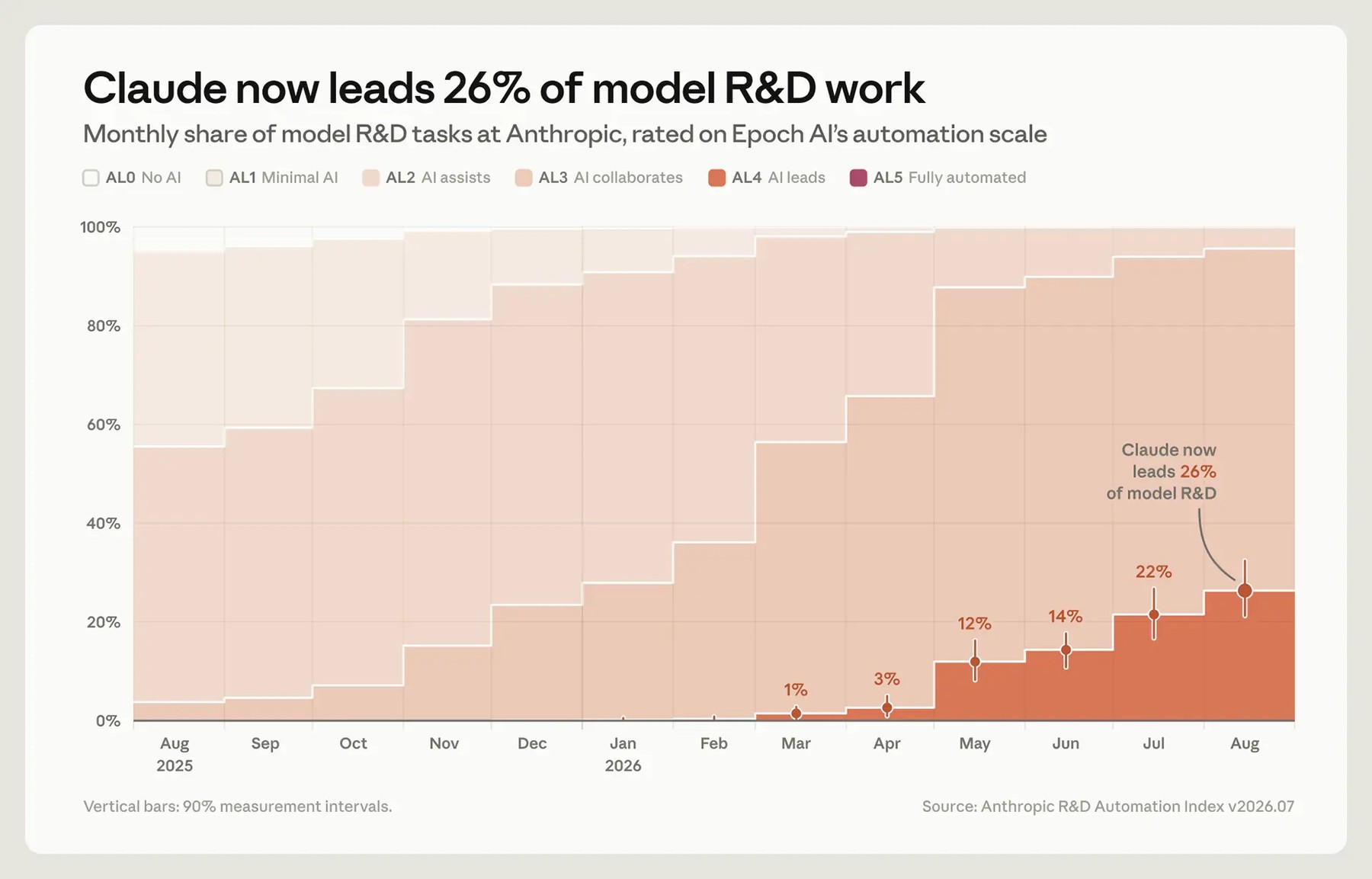
The automation figure is the one that will travel. Anthropic built what it calls the Anthropic R&D Automation Index by cataloguing every kind of AI research work done in the company, scoring each for automation, and combining the scores. The catalogue was assembled bottom-up from work records — Slack and various internal documentation sources. For each week of July 2026, the company randomly sampled 20% of employees from every department involved in the model development cycle; a Claude research agent read each sampled person's week and listed the tasks they had completed. That produced a flat list of roughly 15,000 granular model-development tasks, which Claude then organised into a hierarchical tree: 542 nodes, 378 of them terminal, covering work such as diagnosing and fixing defects in the evaluation platform, configuring sandbox egress and network policy for a reinforcement learning environment, and working through incidents in model-serving systems. Anthropic then froze the tree so every measurement runs against the same body of work.
Scoring uses Epoch AI's automation scale, AL0 through AL5. AL0 is no AI involvement. AL3 is "AI collaborates" — the model does large parts of the task under close human direction. AL4 is "AI leads" — the model can carry most of the work end to end from a high-level prompt while a human watches. AL5 is full autonomy, with no human in the loop. For each node, a Claude agent gathered evidence on who does the work, with what tools, and how much of it AI performs; a separate Claude acting as judge read that evidence and assigned a level. Claude leads 26% of the work. More than 90% sits at collaborate or above. AL5 is empty.
Source: anthropic.com
The validation detail is more interesting than the index. Anthropic asked the employees who own each area to rate the relative automation level of their own work, blind to what evidence the models had gathered and how they had scored it. The judge model matched humans exactly 59% of the time. Humans matched each other exactly 35% of the time. Model and human landed within one level of each other in 97% of cases. Anthropic presents this as evidence the judge is about as reliable as a person, which is fair. It is also evidence that the underlying scale is soft. A measure on which two informed humans agree exactly about a third of the time does not comfortably support a headline quoted to the percentage point. Anthropic half-concedes this, noting it is not always obvious where "AI collaborates" ends and "AI leads" begins.
The frozen tree carries its own limit, which the company states: growth in the index relative to the July 2026 baseline shows that work humans were doing then is being automated, not whether new kinds of work have appeared for humans to move into. To test that, Anthropic built an alternative fixed tree from January 2026 data and compared the new tasks appearing each month from February to July against the January set. It found no growth in "new" tasks between the two, which it reads as a sign that the structure of model-development work is stable at this level of analysis.
The second metric is the one that arrives without numbers. Anthropic says it has built a system to observe AI agents acting inside its systems and intervene in their work, and proposes three indicators: coverage, the share of agent actions a monitor checks before or after execution; review latency, the time between an action and its check, first by an automated monitor and then by a human; and escalation rate, the share of actions an online monitor blocks or reroutes, or an offline monitor flags for further review. The figure it does supply is the scale. In August 2026, roughly 30,000 agents were running simultaneously on Anthropic's most popular internal platform, performing research and engineering tasks. The values for coverage, latency and escalation are not in this publication; Anthropic says it published them in a recent risk report.
The reasoning behind the metric is worth more than the metric's absence here. Anthropic's current monitoring finds that individual agents rarely misbehave — but if millions or billions of agents are working across the economy at once, rare events become routine. Two design choices support the oversight. Each agent gets its own identity, persistent across model upgrades, so every action and every piece of data traces to a specific agent over time, and so an agent treats another agent's message as a claim to be checked rather than its own thought. And agents communicate through a shared open message system rather than privately, with every message tied to a sender identity and matched against session transcripts. METR has previously red-teamed Anthropic's offline monitoring platform.
The compute measurement covers 13 to 20 July. Anthropic sorted every workload into a small number of categories, then calculated what share of AI R&D compute went to safety work: about 6% across all AI R&D compute, and about 12% of the compute for AI R&D performed by AI itself. The method leaned on existing capacity-planning tools that periodically sample accelerator usage and label workloads from metadata, with third-party cloud usage folded in from providers; Claude then classified each workload as safety work or other R&D using a prompted classifier. Anthropic did not classify all of the nearly 10,000 runs in that week — it sampled about 14%, oversampling the runs that consumed the most compute, so the result tracks the distribution of compute rather than the count of jobs.
Anthropic calls the numbers deliberately conservative, and they are. A token that served capabilities and safety equally was excluded from the safety count. Guardrail classifiers were left out entirely, and the company says those require a comparable volume of compute and make its models substantially safer in the world. The classifier's disagreement with human labellers ran to one or two percentage points once each category had a detailed written definition with explicit boundary cases — though Anthropic notes some cases stayed too hard even after hours of human review, and that another company or a regulator could draw the line differently.
Here is what I think the package actually is. Anthropic is writing the ruler it expects to be measured by. That is not disqualifying — someone has to go first, and no other lab has published anything comparable — but it shapes every number in it. The company defines what counts as safety work, runs its own models as judges over its own systems, sets the sampling and the weights, and reports the result. Anthropic names the problem itself: a judge model can make the same mistakes as the model it reviews, and a developer drawing the safety boundary has every incentive to draw it flatteringly, which is why it says the burden should fall on the company to prove a given piece of work is safety work. The proposed fixes — third-party replication, other developers' models as judges, an agreed common definition negotiated in advance — are all in the future tense. External experts red-teamed these measurement proposals at a workshop Anthropic convened, which is the strongest verification in the package, and it happened before publication rather than as a standing check.
The 6% figure will be quoted without its caveats, and it is the weakest number in the set. One week. Conservative by construction. Guardrail classifiers excluded. And, as Anthropic says plainly, compute share measures spend, not effort: a more efficient safety classifier lowers the number without lowering the safety work, and a faster production inference stack raises it. The company's own classifier overhead moved in both directions for exactly those reasons. The honest reading of 6% is that it is a unit of comparison waiting for something to compare against — a second week, or a second lab.
The more interesting number is the 12%. Compute spent on AI R&D that AI itself performs is twice as safety-weighted as the pool overall. The publication offers no explanation for the gap, and the gap is large enough to want one.
What the announcement is quiet about is what happens when these numbers move. Anthropic publishes 26% and says it intends to keep updating it. It does not say what figure would be too high, what would trigger a pause, or what anyone would be obliged to do at 40% or 60%. The nearest thing to a commitment appears in the conditional: such metrics "could" ground stricter requirements, for instance a fixed testing window before a new model is used for further AI research, or a cap on the share of compute routed to agents doing AI research. Anthropic's proposed frontier AI framework, AAIF, includes transparency requirements governments could make mandatory. But transparency about the pace is not a limit on the pace. The company has built a speedometer and declined to name a speed limit.
Compute, Anthropic writes, is among the most auditable inputs to AI R&D, and for that reason may become one of the key levers for slowing development. The load-bearing result of this publication is that the lever is workable: a week of a frontier lab's accelerator usage can be sorted into categories, sampled by compute weight, and reported to outsiders — imperfectly, but well enough to argue about. That demonstration points somewhere Anthropic's competitors will like considerably less than Anthropic does. The company that has argued for a coordinated slowdown has now shown that the meter such a regime would require can be built, and has installed the first one on itself, where it costs nothing and binds no one.