
A board shaped by the mission
Anthropic is a public benefit corporation, a legal structure that lets it weigh its public mission alongside profit. Its purpose is to advance AI safety, and the status gives the board room to make safety decisions without treating shareholder interests as its sole obligation or fearing lawsuits from investors who disagree.
President Daniela Amodei chairs the board. Its other members are CEO Dario Amodei, her brother; Netflix co-founder Reed Hastings; former Microsoft and GM CFO Christopher Liddell; Novartis CEO Vas Narasimhan; and Spark Capital partner Yasmin Razavi. One seat is vacant.
A separate body, the Long-Term Benefit Trust (LTBT), holds a special class of shares. It can elect and remove a majority of the board, known as Class T directors, and is charged with keeping Anthropic aligned with its mission to benefit humanity.
The trust is chaired by global health expert Neil Shah, a former managing director at charity evaluator GiveWell. Its members also include former Federal Reserve chair Ben Bernanke, national security expert Richard Fontaine and Harvard physicist Christopher Stubbs. One seat is vacant; current trust members will choose who fills it.
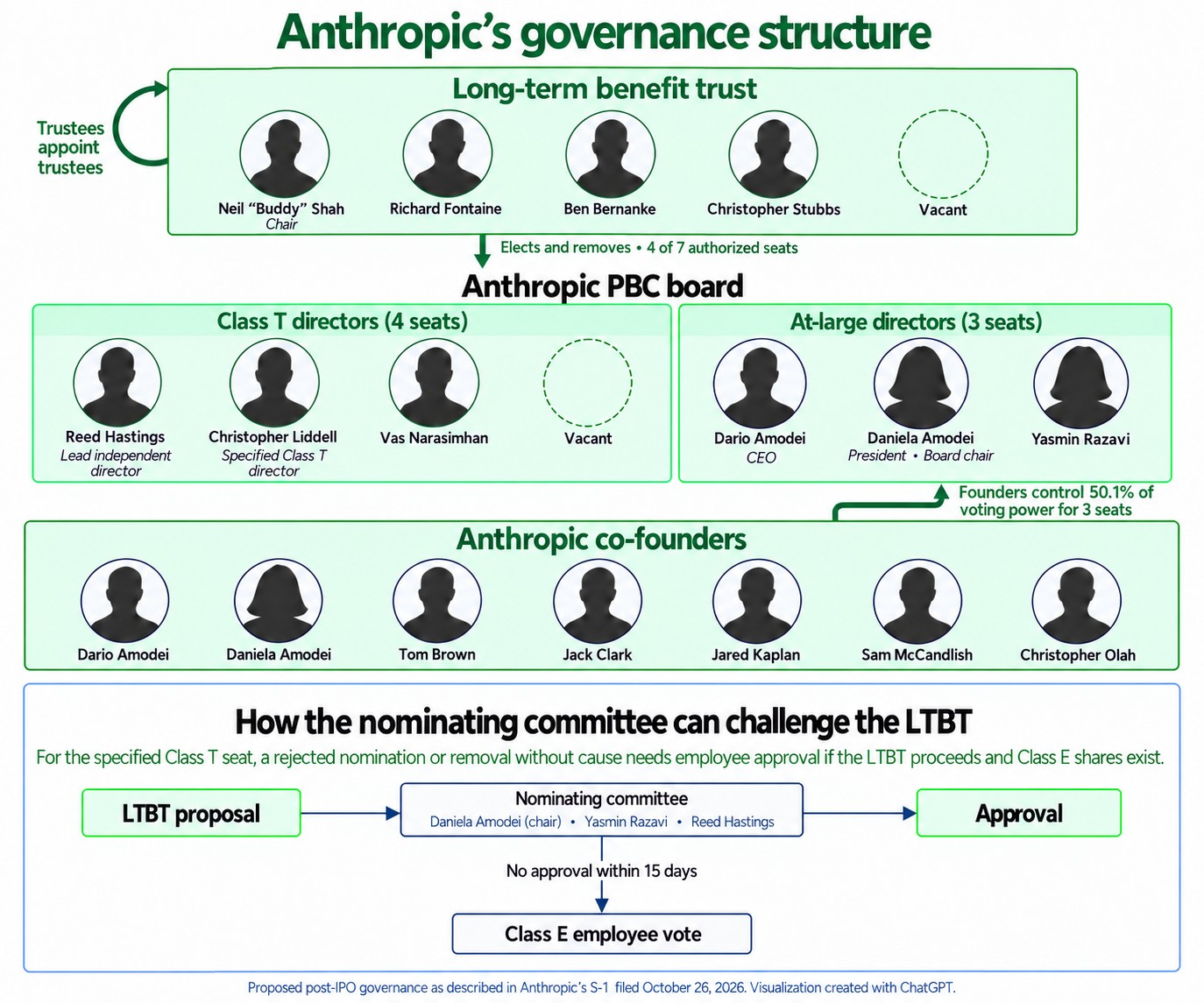
The seven founders hold another special share class. Acting together, they control 50.1% of shareholder votes and can elect three directors. If a majority of the founders no longer acts as a bloc, their shares instead vote in proportion to the votes of ordinary shareholders.
The board also has a check on the LTBT. If the trust nominates one of its four directors for a “Specified” role, or removes such a director without alleging misconduct, the board’s nominating committee can reject the decision. The matter then goes to a vote by company employees.
The limits of the design
Anthropic’s structure appears to formalize a kind of employee influence that proved consequential during OpenAI’s brief governance crisis. OpenAI’s board fired CEO Sam Altman, saying it feared he had not been candid with it; employees backed Altman, the board reversed course and reinstated him, and the company later created a new governance system. That episode is a reminder that formal voting rights do not always tell the whole story.
Anthropic’s balance of power could also shift in less dramatic ways:
The LTBT would continue after founder control ends, unless 85% of ordinary shareholders vote to dissolve it or the trust itself chooses to leave with board approval. Control would pass to ordinary shareholders only if both special share classes eventually disappear.
I think the design’s central uncertainty is not who holds each formal power, but how those powers would interact when the board, trust, founders and employees disagree. The announcement lays out several veto points, but says little about how a conflict would play out in practice. That leaves public investors with a clear limit on their authority—and an unresolved question about who can ultimately settle a dispute over what AI safety requires.
Daily AI news
Every day we pick what actually matters in AI and explain it plainly — no hype, no filler. Subscribe if you want to follow where the industry is going.
Only what matters — every day
Follow on X