
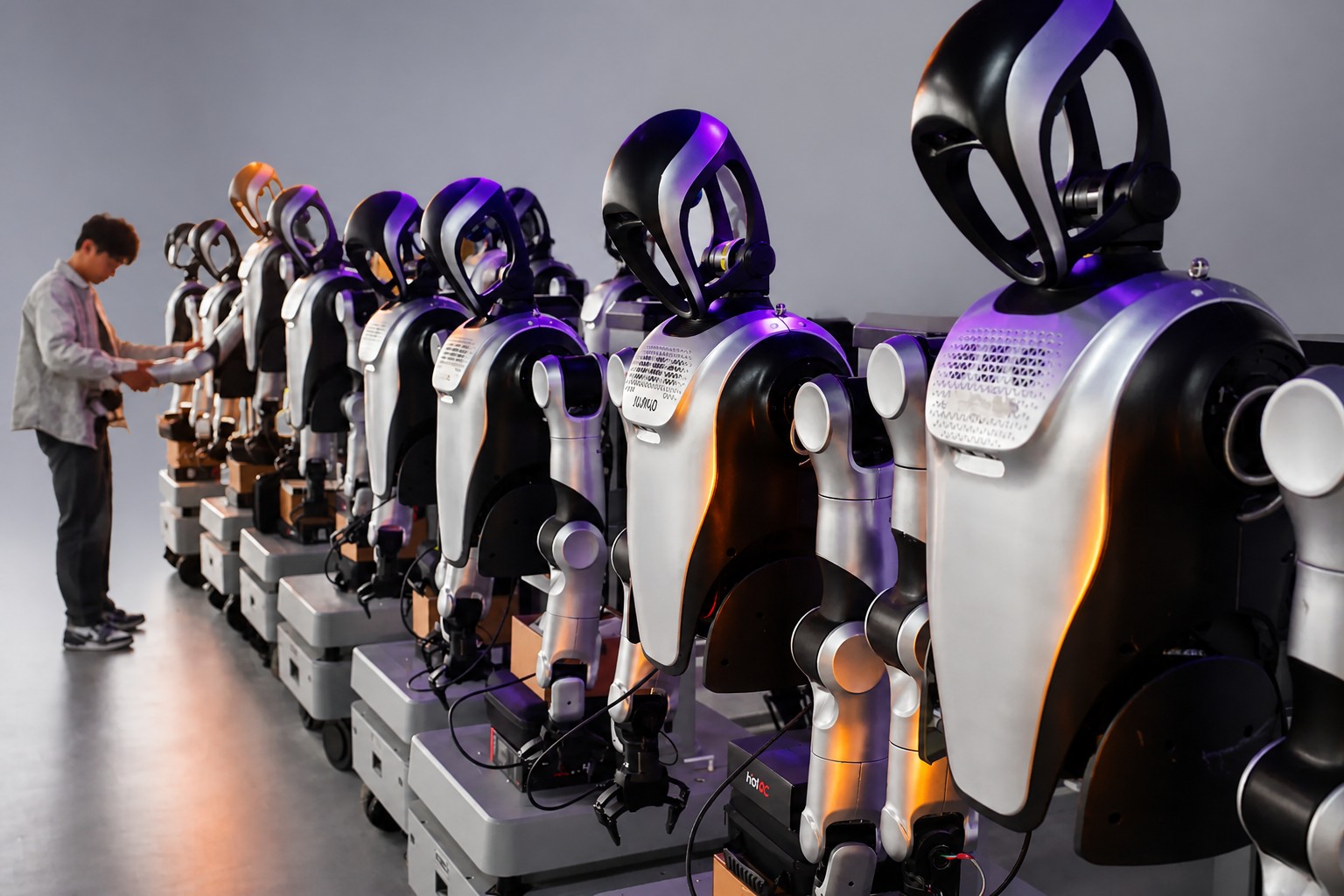
Antioch, a New York startup that builds synthetic training data for robots, has raised $32 million in a Series A led by Greylock, on the argument that the robotics industry does not need to spend what Figure AI just committed to spending. Figure unveiled Index last week — a distributed collection system that has already gathered more than 16 million videos from 108 countries, paid $15 million to the people who shot them, and carries a pledge of over $1 billion on data and compute across the next 12 months. Antioch's counter-position is that simulated data is sufficient to train the next generation of humanoid robots.
A*, Category Ventures, Box Group and Icehouse Ventures joined the round. Alongside it, Antioch named the customer most robotics startups would trade a lot for: Amazon Ring. It also works with the cloud provider Nebius and with Nvidia.
The problem Antioch is selling against is a timing gap, not a data gap. In software, the development loop compressed from weeks to days once a system could write code, compile it, run it, find the bug and try again — fast, imperfect, usually good enough. In robotics nothing compressed. A new camera, a different radar, a retrained policy, a new skill: each one still has to be revalidated on physical hardware, indoors, with engineers standing there. Harry Melsop, Antioch's co-founder, frames automating the physical world as one of the defining economic opportunities of the moment, and argues it can only move faster if AI is given the tools to check its own work.
Antioch's platform builds high-fidelity simulations matched to a specific customer's hardware and runs them in the cloud, where a single experiment can contain thousands of parallel trials. Jason Mitura, Amazon's vice president of software development and chief product officer for Ring, said the results held their accuracy even under deliberately hardened conditions, with the simulations closely matching physical tests including in scenarios that were intentionally kept out of tuning. Those held-out scenarios are the whole test: they distinguish a simulator that learned physics from one that merely fitted the test set it was calibrated on.
Melsop does not call Figure's billion a waste. For a company with those resources, he says, collecting real-world data is a sound approach, and real data will always be the quality benchmark. His point is that almost nobody else can operate at that scale.
He also identifies what video alone cannot capture. A head-mounted camera does not record how hard a person squeezed a towel, and it does not encode the difference between the weight of a kettle and the weight of a ceramic mug. Teleoperation data carries that information, but an hour of it costs tens to hundreds of times more to collect. Simulated data, by contrast, arrives fully labeled and immediately usable, and can generate the cases that would be difficult, expensive or irresponsible to stage in the real world.
The flywheel argument is borrowed openly from driving. Melsop points to Tesla, where customers pay for the car and simultaneously build the autonomy dataset; Index works the same way, with people getting their houses cleaned while Figure gets the footage. Under a simulation-first approach, real data changes job. It stops being the base training material and becomes the correction signal: a robot in the field quickly exposes where the simulator is wrong, because a motor behaves differently once it is hot or worn, and other properties of an environment are hard to anticipate in advance. Melsop calls this long-tail accuracy — a small volume of expensive, high-quality real data fed back into the simulator, improving everything the simulator then produces. It is the loop Waymo, Tesla and Wayve each built for themselves, packaged for companies that will never own five million cars or five million robots.
Read carefully, though, Antioch is not claiming what the funding announcement implies. Melsop concedes that real data stays the benchmark and that some of it remains necessary; his actual claim is that simulation reduces the volume required and makes each collected sample do more work, so a company may not have to spend the full billion. That is a real product and a considerably narrower proposition than "robots don't need real-world data." The $32 million versus $1 billion framing is a pitch, and the gap between those two numbers is mostly a gap in what the two companies are trying to build, not a verdict on method. Figure is assembling a dataset it will own; Antioch is selling a tool that makes datasets cheaper. Both can be right.
What is conspicuously missing is any measurement. For a company whose entire product is fidelity, the only public evidence of fidelity is a customer executive saying accuracy held up. There is no sim-to-real gap figure, no error rate on the held-out scenarios, no count of customers beyond Ring, no revenue. Figure, for its part, published a number that invites its own arithmetic: $15 million across 16 million clips works out to just under a dollar per video, which says something about what the marginal real-world sample is currently worth.
Antioch's stated verticals show where simulation is actually being bought today: aerial autonomy and drone delivery, ground autonomy for warehouse AMRs and AGVs, intelligent security systems including the Ring work, false-alarm analysis, industrial automation and construction robotics. The company is also working on radar, lidar, infrared and other non-visual sensors, which Melsop describes as a multi-modal problem. The round's angel investors include Palantir chief technology officer Shyam Sankar, Foxglove chief executive Adrian Macneil and Nvidia executive Ian Andrews.
So the claim is humanoids and the revenue is cameras, drones and warehouse floors. Figure's billion buys a dataset; Antioch's $32 million buys the argument that the dataset can be smaller. Ring's security cameras will settle which is cheaper years before any humanoid does.