
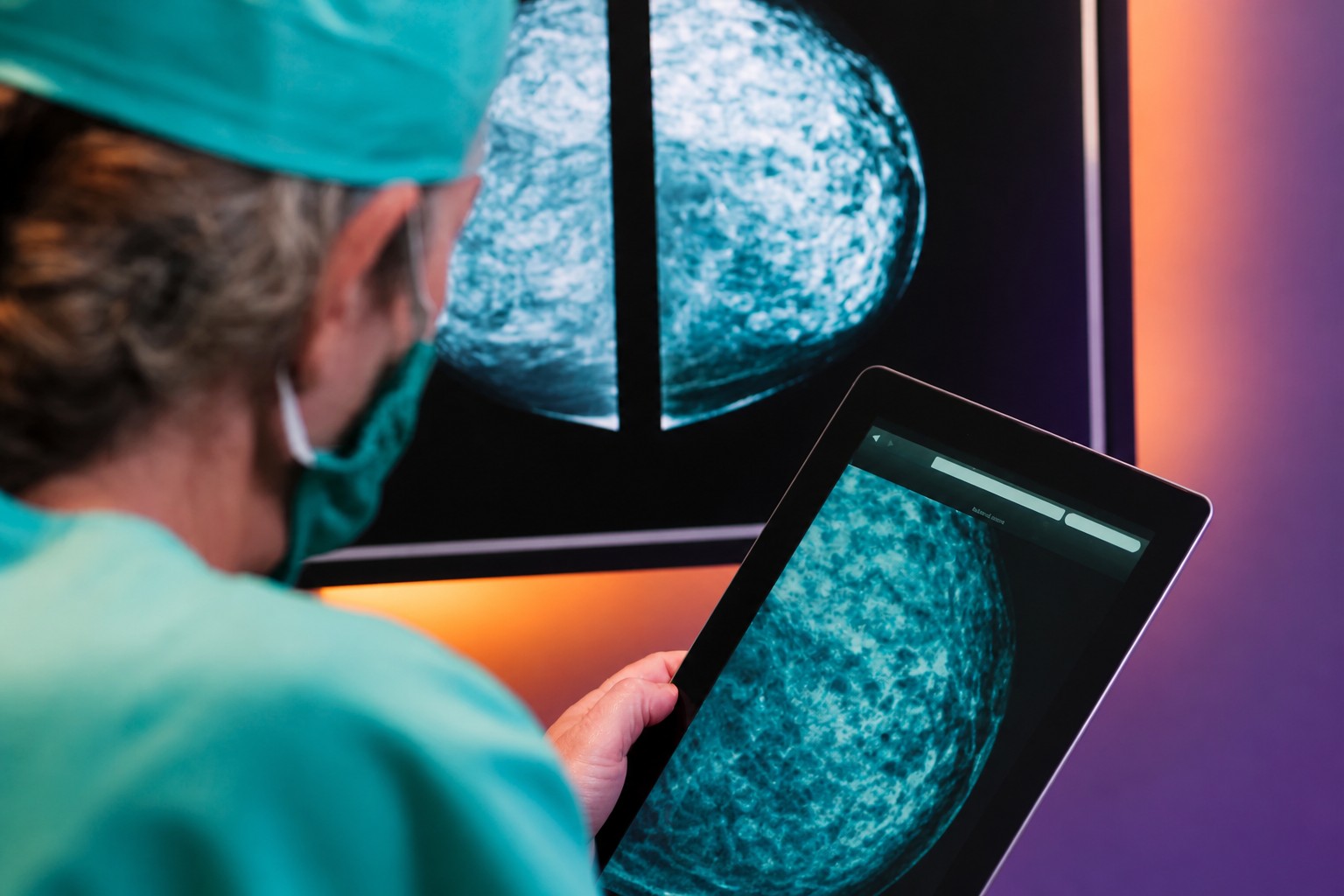
Rene Haas, chief executive of Arm Holdings, told the BBC that AI will help find a way to treat cancer within the lifetime of the current generation — something he says people today could not achieve on their own. The task he named is a narrow one: modelling how cancer affects a DNA marker. Haas left the board of the pharmaceutical company AstraZeneca in April, and makes the prediction from the chip side, as head of a company valued at $269 billion (£199 billion).
His account of how it happens is the chip industry's standard one. Simulating cancer's effect on a DNA marker is, he says, currently too hard both for people and for the computers AI systems run on; as more models are loaded onto those computers and the computers themselves improve, the problem becomes solvable. There is no date beyond a generation, no named programme, no dataset, no collaborator.
AI tools are already in use in oncology research and trials. The one measured result here is from the UK's National Health Service, which reported earlier this year that funding for AI-equipped X-ray tools got lung disease results to more than 4 million patients faster. That is a genuine number and worth having, and it is a throughput number: the same diagnosis, sooner. Placed next to a cure, it is measuring something else entirely.
Haas made a second forecast in the same interview: humanoid robots in wide use within five years, with a shortage of chips holding the field back. AI, he said, lets such robots see and learn, and lets them be reconfigured for new work — a service robot programmed to make a bed could go on to fold towels in the room, empty bins and run other errands.
Arm is what gives both claims their economics. Listed in New York and still headquartered in Cambridge, it has its designs used by about 500 companies worldwide, among them Apple, Samsung, Qualcomm and Nvidia. It employs more than 7,000 people, roughly 3,000 of them in the UK, and is reckoned the largest technology company headquartered in Britain. Haas joined in 2013 and became chief executive in 2022; he was recently also made chief executive of SoftBank's international business, and SoftBank, one of the world's largest technology investors, holds a stake in OpenAI. Earlier this year Arm put forward a pay scheme that could make Haas a billionaire if he meets targets for turning the chip designer into a $1 trillion company.
The two forecasts have the same shape, and the shape is worth stating plainly. In each, the obstacle is compute and the remedy is more of it. Cancer is unsolved because the machines are not good enough yet; humanoid robots are five years out because there are not enough chips. Arm designs the architecture those chips are built on, and Haas' own compensation is tied to Arm reaching a trillion dollars, which happens only if demand for compute keeps compounding. None of that makes him wrong. It does mean his diagnosis of what stands between us and a cancer treatment doubles as a description of his product's addressable market, and it should be read with that in view.
Notably absent is any account of what the DNA-marker problem actually is. Which marker, which cancer, whose data, what would count as having solved it — none of it is in the claim, which is what allows the claim to be made without a date attached. Haas stepped off AstraZeneca's board in April; the forecast arrives after he left the industry that would have to deliver on it.
A prediction of this kind costs nothing to make and does real work while it stands. A generation is long enough that nobody collects, and in the meantime it recasts every chip Arm's customers order as a down payment on curing cancer. The five-year robot call is the one that can actually be checked — and it arrives with its excuse already attached: not enough chips.