
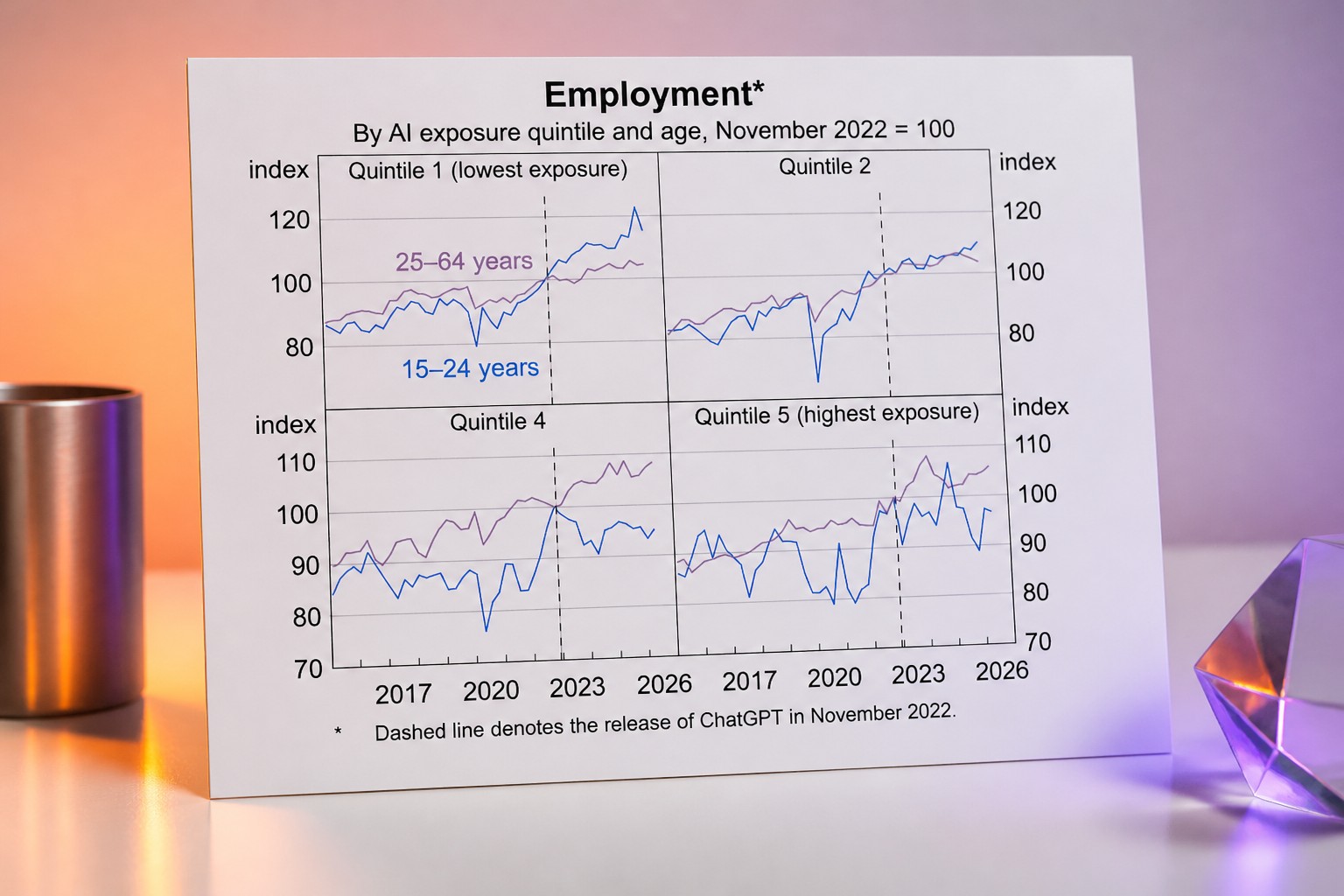
Analysis by the Reserve Bank of Australia shows that AI has so far had little effect on employment across the country, but young workers in fields most exposed to automation are finding things harder. Since ChatGPT launched in late 2022, job vacancies have declined across all groups, with the steepest fall in occupations highly exposed to AI. Among workers aged 15–24 and recent university graduates in these fields, employment is lower and unemployment higher than among more experienced colleagues. The study does not prove that AI itself is the cause: it measures theoretical exposure to the technology, not whether companies are actually using it.
AI affects young workers in Australia most
Young workers are finding it harder to get jobs
Mike Major developed a monitoring system for the Reserve Bank of Australia to track the groups of workers and occupations where the effects of AI adoption may emerge first. The focus is on early-career professionals and workers in fields highly exposed to AI: programming, office work and customer service.
The data show that vacancies declined across all groups after ChatGPT appeared. The steepest drop was in occupations most exposed to AI. Within this group, people aged 15–24 and recent university graduates have lower employment and higher unemployment than older workers.
Major cautions that it is too early to draw firm conclusions from these data. The study does not establish a direct causal link and measures only the theoretical exposure of occupations to AI, not whether companies are using the technology in practice. Changes in the business cycle after the pandemic or the spread of remote work may also have affected the figures. SEEK data indicate that AI is both augmenting existing work and creating demand for AI skills.
Other studies show a similar pattern
In August 2025, Stanford University researchers examined millions of US payroll records and found a similar trend. Since late 2022, the relative employment of workers aged 22–25 in AI-exposed occupations has fallen by 13%, and by nearly 20% among young software developers. More experienced professionals in the same fields maintained or improved their employment levels.
A study by Anthropic published in March 2026 also found signs of declining hiring of workers aged 22–25 in occupations highly exposed to AI. Their likelihood of finding a job fell by about 14%. However, the researchers found no systematic increase in overall unemployment. In their assessment, the potential for automation and the actual use of AI still differ considerably.
Anthropic offered an example from its own operations. According to an internal analysis, since the beginning of 2025 the share of early-career employees among technical staff has fallen from 27% to 9%. By August 2026, AI agents at the company were already logging six times as many working hours as human employees. Anthropic stresses that it is not a typical example: it is a software company that uses AI particularly actively.
Researchers warn of a risk they call the “tragedy of the cognitive commons”: if entry-level positions disappear, there may be a shortage of experienced professionals in the future—assuming those professionals are still needed.
The overall effect is not yet visible
A large-scale study of 25,000 workers in Denmark found no measurable changes in wages or working hours, despite 64% of workers using AI. On average, employees saved only 2.8% of their working time through the technology.
An analysis published in January 2026 covered 10.6 million LinkedIn profiles and US unemployment data. A team led by Morgan Frank of the University of Pittsburgh found that problems in AI-exposed occupations began in early 2022, several months before ChatGPT launched. The decline in employment therefore cannot be attributed to AI alone. Macroeconomic factors may have played a larger role, such as changes in Federal Reserve interest-rate policy or a correction after the sharp increase in hiring during the pandemic.
At the same time, AI is creating demand for new skills and jobs. According to the World Economic Forum’s “Future of Jobs 2025” report, 77% of surveyed companies prioritize upskilling employees over cutting staff. The forum’s researchers forecast that the number of jobs will grow by a net 78 million by 2030. According to LinkedIn, the number of AI-related vacancies increased sixfold in one year.
Dataist's take: Available data point to the vulnerability of young professionals, but do not yet make it possible to separate AI’s effects from those of economic and pandemic-related changes. Assessing the long-term impact also depends on whether entry-level positions remain: without them, the pipeline of future experienced professionals could shrink.
Daily AI news
Every day we pick what actually matters in AI and explain it plainly — no hype, no filler. Subscribe if you want to follow where the industry is going.
Only what matters — every day
Follow on X