
What the cameras were built to see
Graciela told her mother and sister by voice message that she had crossed the border and entered the United States. She was trying to find work and send money to her three children and parents in southern Mexico. Her oldest son, 11, had asked her to bring him a bicycle.
She paid smugglers 20,000 pesos, about $1,150, for instructions on when and where to start. The current average price is $12,000. She was expected to walk alone, without a guide, while her phone transmitted location data to a smuggling safe house in Tijuana.
The route took her through the Otay Mountain Wilderness, where migrants use steep terrain and animal trails to avoid patrols. The eastern edge of San Diego was only a mile away, but migrants often travel 10 to 20 miles north through the mountains to reach smaller towns and remote highways with fewer checkpoints.
On the afternoon of September 14, Graciela sent her mother one last message. She whispered that she could no longer walk. At some point, she encountered a man on the trail. She asked her sister to pray for her; the man said there was no time.
Her phone continued receiving messages, but she stopped replying.
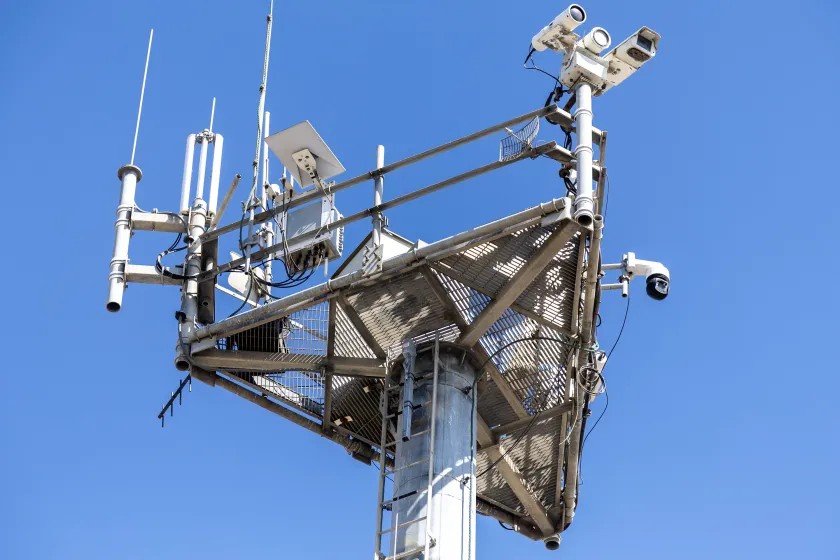
The tower near where she died had been operating since 2019. Manufactured by General Dynamics, it carried two sets of electro-optical and infrared cameras with long lenses that could track targets from 5 to 7 miles away. Graciela was roughly one mile from it.
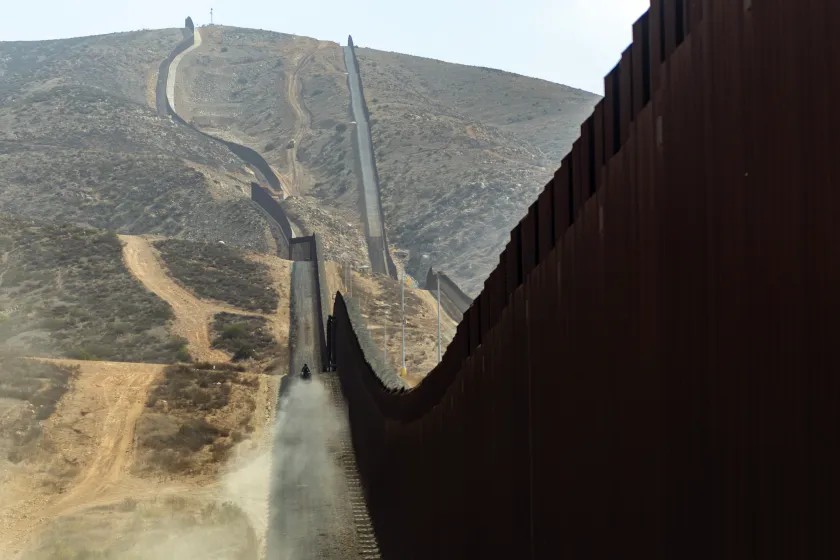
A border agent rides an ATV along the U.S.-Mexico border outside San Diego, September 2026. While the mountainous terrain makes some areas difficult to access, the area is blanketed with interconnected surveillance technology.
Source: technologyreview.com
The tower was one component of a much larger system:
More than 120 surveillance towers stand along California’s border, according to documents and field observations collected by the Electronic Frontier Foundation. In June 2026, the Government Accountability Office said Customs and Border Protection had 803 towers installed across the southwest border and planned 175 more. The program is estimated to cost $1.4 billion, with $1 billion in funding expected under the One Big Beautiful Bill Act, passed in 2025. By 2034, the number of towers is expected to reach 2,300.
The public case for these systems is detection and interception. Anduril, which makes roughly half of the towers now installed along the US-Mexico border, said in a 2024 press release that its systems had “directly helped save lives and prevent illegal drugs from entering the United States.” In June 2026, the company said its installations had “autonomously detected hundreds of thousands of border crossings.”
John Morris, chief of the Border Patrol sector in Arizona, told reporters at a conference in May 2026 that the agency knows about almost everything that crosses the border.
The deaths documented by the investigation leave two possibilities: the system failed to detect people who needed help, or it detected them and officials did not respond.
Anduril did not answer the Times of San Diego’s questions about how its systems operate in mountainous terrain. General Dynamics referred questions about the tower near Graciela’s death to Border Patrol. Border Patrol did not say whether its cameras saw Graciela before she died or how the surveillance network is used during emergencies.
A surveillance network with blind spots
The investigation identified hundreds of deaths along the California border and at least 138 between 2022 and 2025 within the nominal coverage area of a nearby tower. Terrain changes the meaning of that number: being close to a tower does not mean a camera could see the body.
MIT Technology Review’s topographic analysis found that at least 81 of those people were probably in direct view of a tower, with no hill or other terrain blocking the camera.
The cases included:
Some migrants die quickly after falling from a wall or drowning in a canal or river. Others die slowly from heat or cold, in situations where emergency assistance could have made a difference. The dead have included people from nearby parts of Mexico and from African countries. The oldest was 70; the youngest was 5.
Rafael Hernández Larraenza, head of the Desert Angels search-and-rescue group, says some towers are little more than decoration. At periodic meetings with searchers, he says, Border Patrol employees have told volunteers that they lack the capacity and time to conduct searches.
Bryce Peterson, who collects data on migrant remains for No More Deaths, said people who need help “are not a priority.”
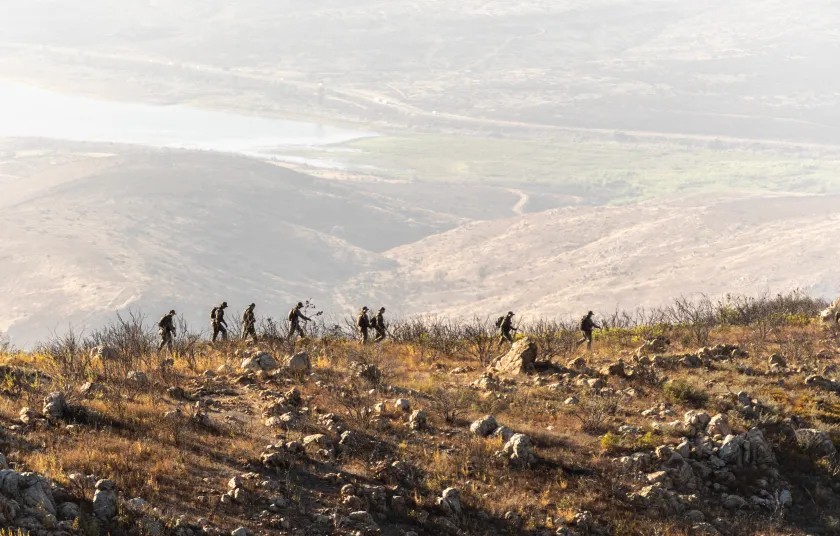
Agents in Border Patrol gear hike a ridge in the Otay Mountain Wilderness, September 2026. Agents said the group was on a training hike.
Source: technologyreview.com
At Graciela’s last known location, two towers could observe the area. The closer one stood between two rows of border fencing and rose more than 100 feet above the slope. A newer Anduril tower stood on the other side of a hill, 1.4 miles away, and was only 33 feet tall.
The Anduril installation automatically decides whether a moving object is of interest. Its two dark, circular cameras rotate slowly, lock onto a target, and then move on.
Volunteers from Border Angels describe the area as filled with “beacons” capable of seeing large sections of the mountains. Cameras are also hidden inside rocks and bushes. Roadside cameras read license plates; sometimes a reader is attached to the back of a traffic cone and records vehicles as they leave.
The towers have operated in the area since 2011. AI-controlled towers appeared in 2018, many of the systems now covering California arrived in 2021, and longer-range cameras were added in 2026.
The announcement is quiet about failure
The surveillance buildout has made the border more visible without making responsibility clearer. That is the central weakness of the system: its advertised capability is easy to count, while its performance in the situations that matter most is difficult to establish.
In October 2024, NBC News reported an internal memo saying that 30% of older towers, whose footage was supposed to be watched by employees in control rooms, were not working. Many lacked parts or used obsolete equipment. The 150 broken towers remained in place, becoming multimillion-dollar “scarecrows.”
In September 2025, the Government Accountability Office said Customs and Border Protection had begun repairing towers with spare parts and updating their equipment. The report did not say how many installations were still out of service. Border Patrol did not answer whether the tower near Graciela was working when she died.
A March 2026 report described problems with seven G-BOSS(E) towers installed in the Otay Mountain Wilderness. The military towers were vulnerable to tipping, rodent damage, exhaust-system failures, and drained batteries. On a rough mountain road, one tower was shaken so badly that its cameras became stuck at high magnification and stopped working properly.
RAND analysts wrote in a 2020 report that the metrics needed to measure the success of border towers were not directly observable. The towers may deter migrants from controlled areas more effectively than they improve officials’ awareness of what is happening there.
That distinction matters. If the principal effect is to push people into more remote terrain, the technology may be making rescue harder even as it expands the government’s ability to monitor the border.
My guess is that this is why the question of whether the cameras “saw” Graciela is too narrow. A system can fail because a camera missed her, because software did not classify her as important, because an operator ignored an alert, because no one was watching, or because the institution had no procedure for treating a detected migrant as someone needing rescue. The announcement of more towers does not tell us which failure occurred.
Manufacturers say AI towers can identify migrants autonomously, but detention still requires human action. A Customs and Border Protection representative told RAND analysts that smugglers had begun sending migrants individually instead of in groups, creating more separate targets and more alerts than staff could review.
Peterson says Border Patrol often ignores a healthy person walking alone because officers prefer to intercept groups. Larraenza says he has met dehydrated people who called for agents but said the agents did not stop. He also describes cases in which officers did everything possible to find someone.
The system’s ability to detect movement and the agency’s willingness to intervene are therefore separate capabilities. Graciela’s final messages mentioned helicopters and white patrol vehicles on the road below. Patrol cars were visible from the area where journalists later visited her death site. Without coordinates supplied by searchers, César Ortigosa of the Armadillos search group believes Border Patrol would never have gone looking for her body.
How Graciela was found
Irma, Graciela’s sister, spent two weeks trying to reach the smugglers. When they did nothing after learning that Graciela was missing, Irma threatened to give police one smuggler’s phone number. He then sent a screenshot of Graciela’s last known location.
On October 3, nearly three weeks after Graciela’s last message to her mother, Armadillos gave the coordinates to Border Patrol.
The next day, forensic examiner Jennifer Wright arrived at a dirt road about 100 yards north of the US-Mexico border. She found the skeletonized remains of a woman lying on her back in the ground, surrounded by brush and dry vegetation on steep slopes.
The body had decomposed rapidly under the sun and because of animal activity. The examiner could not determine whether Graciela had been killed or died of dehydration. There was no water or food nearby.
Her clothing and belongings included:
The body was naked. It was impossible to tell whether someone had removed the clothing or Graciela had done so while delirious from dehydration, a symptom that can appear shortly before organ failure.
DNA later confirmed her identity. Irma paid more than $4,000 to send the remains to Mexico, and the family held a funeral nine months after Graciela’s death. Her oldest son sometimes sits and says he misses his mother.
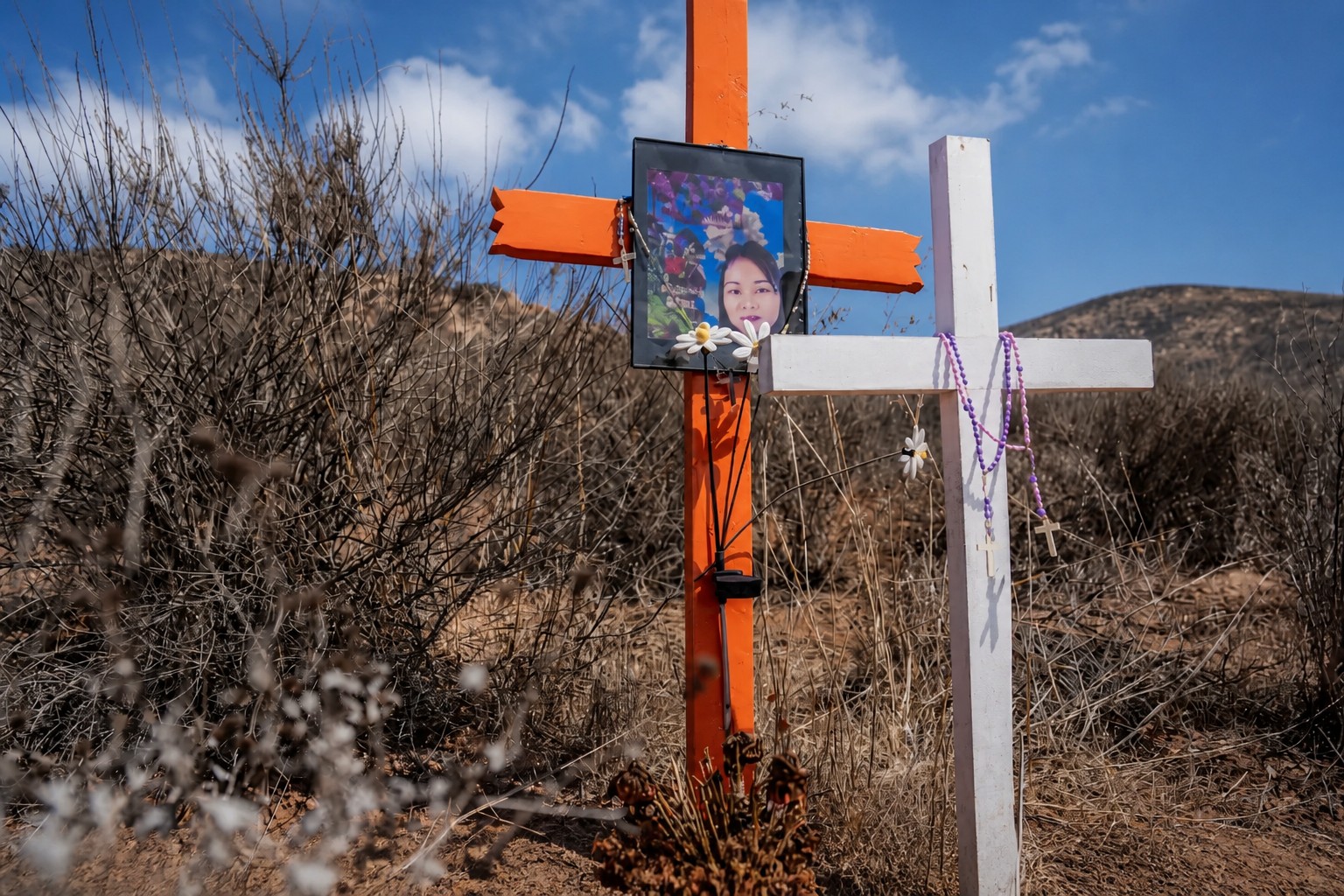
Border Patrol allowed Ortigosa and other searchers to place a cross near the site. At a later visit, Ortigosa played one of Irma’s voice messages over the ground where, almost a year after the body was removed, its trace was still visible.
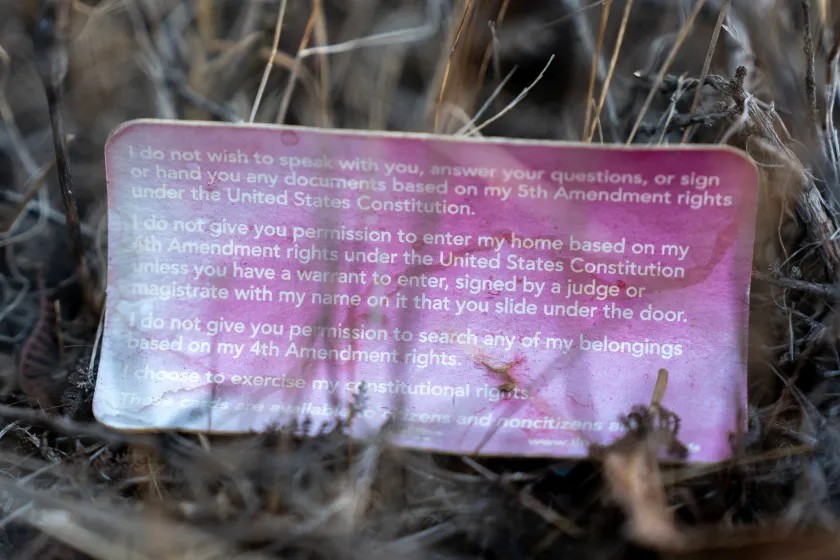
A discarded card shows advice that advocates give to migrants about what to say if they are apprehended.
Source: technologyreview.com
The tower beside Graciela’s death site may have recorded her. It may have been working. It may have detected her movement and classified it as something other than an emergency. Or it may have been pointed elsewhere, blocked by terrain, or ignored by the people responsible for responding.
No available record resolves that uncertainty.
What the investigation does show is a widening gap between surveillance coverage and rescue capacity. Towers have pushed migrants toward longer and more dangerous routes, according to Larraenza. Now that hundreds of installations cover more of the border, some migrants try to cross directly through monitored areas instead of taking even longer detours.
Peterson says they may run through known sensor zones to reach the next relatively safe place before patrols arrive. They may skip water, move faster, or run for 15 minutes without stopping to care for themselves.
In the first half of 2026, Border Angels volunteers saw fewer people taking the water, Gatorade, and canned food they left in Otay Mountain. Other routes saw supplies disappear more often, suggesting that migration routes were changing rather than closing.
The technology is expanding into the space where people are most vulnerable, but the public evidence still cannot show whether it is saving them. That is not a minor reporting gap. It is the difference between a border system designed to find people and one designed merely to make them feel found.
How the investigation was conducted
The Times of San Diego assembled records from several sources, including San Diego and Imperial county medical examiner and coroner data collected by No More Deaths. Some records were obtained only after legal action, and the lists may undercount deaths because many missing migrants have never been found.
Journalists compared the coordinates of each death with nearby towers and checked each tower-location pair against maps. They also reviewed dated satellite imagery to confirm that a tower was already installed when the remains were found.
The analysis covered deaths beginning in 2022, shortly after the sharp increase in towers installed in California. The Electronic Frontier Foundation catalogued towers through site visits and satellite imagery. MIT Technology Review then used terrain analysis to assess whether a person at each death site was likely visible from the nearest tower.
The reporting was prepared by Lilian Perlmutter, a Times of San Diego and NEWSWELL journalist covering migration in California. She previously worked in Mexico City and has written for more than 25 publications, including the L.A. Times, Rolling Stone, The Guardian, and The New Republic.
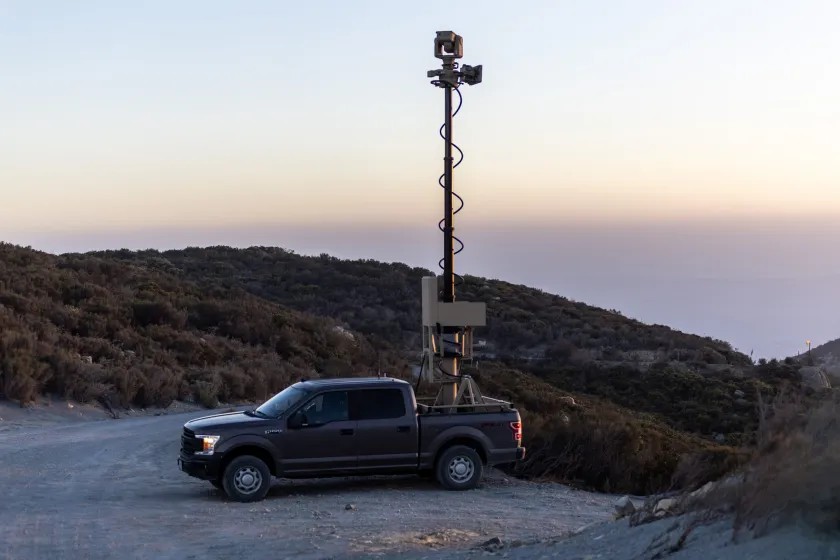
A portable surveillance tower rises from a pickup truck in the Otay Mountain Wilderness outside San Diego, September 2026.
Source: technologyreview.com
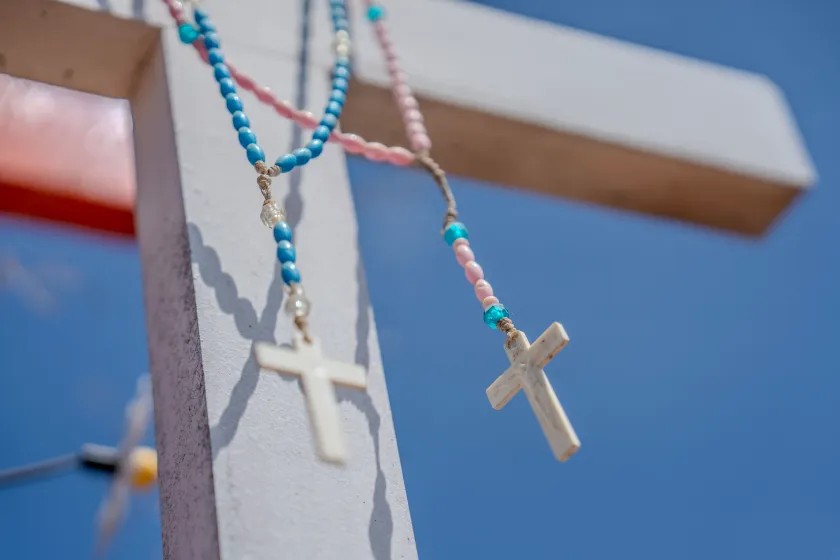
Rosaries hang on a memorial for Graciela Gómez Hernández. The mountains east of San Diego continue to be a risky crossing spot. One migrant advocate said in mid-September that at least two more people had gone missing in the area in the past few weeks.
Source: technologyreview.com
Daily AI news
Every day we pick what actually matters in AI and explain it plainly — no hype, no filler. Subscribe if you want to follow where the industry is going.
Only what matters — every day
Follow on X