What BotPsy is designed to do
The model can use tools for simple tasks involving web searches, travel and everyday errands, shopping and finance, customer service, device and car controls, files, calendars, email, and messaging.
The developers cite several problems with cloud services as reasons to build local models. Their costs can change unexpectedly, access depends on third-party providers, and closed models limit customization for specific workflows. Cloud processing also raises questions about privacy, data control, and transparency. The developers say that a small specialized model that is cheaper to run on a device is sufficient for many everyday tasks.
BotPsy is better suited to low- and medium-complexity tasks. The developers warn that it can make mistakes and is not intended for applications where a wrong answer could have serious consequences.
Benchmark results
On key tool-use tests, BotPsy scored about twice as high as the base Qwen3.5-0.8B-Think: its BFCL v4 score rose from 23.4 to 44.0, ACEBench from 30.1 to 58.7, and τ-bench from 23.2 to 51.5. The last figure is the average across tasks in retail, telecommunications, and banking.
Among models with up to 1.2 billion parameters, BotPsy outperformed Qwen3.5-0.8B-Think, LFM2.5-1.2B-Think, and MiniCPM5-1B-Think on all six benchmarks: BFCL v4, ACEBench, τ-bench, ToolSandbox, Claw-Eval, and BrowseComp-Plus.
BotPsy scored best among all evaluated models on five of the six tests. It outperformed Qwen3.5-2B-Think, which has 2.5 times as many parameters, on BFCL v4 — 44.0 versus 37.7; ACEBench — 58.7 versus 55.4; τ-bench — 51.5 versus 46.5; ToolSandbox — 64.6 versus 41.2; and BrowseComp-Plus — 4.5 versus 2.8. Qwen3.5-2B-Think remained ahead on Claw-Eval, with 48.9 versus 46.5.
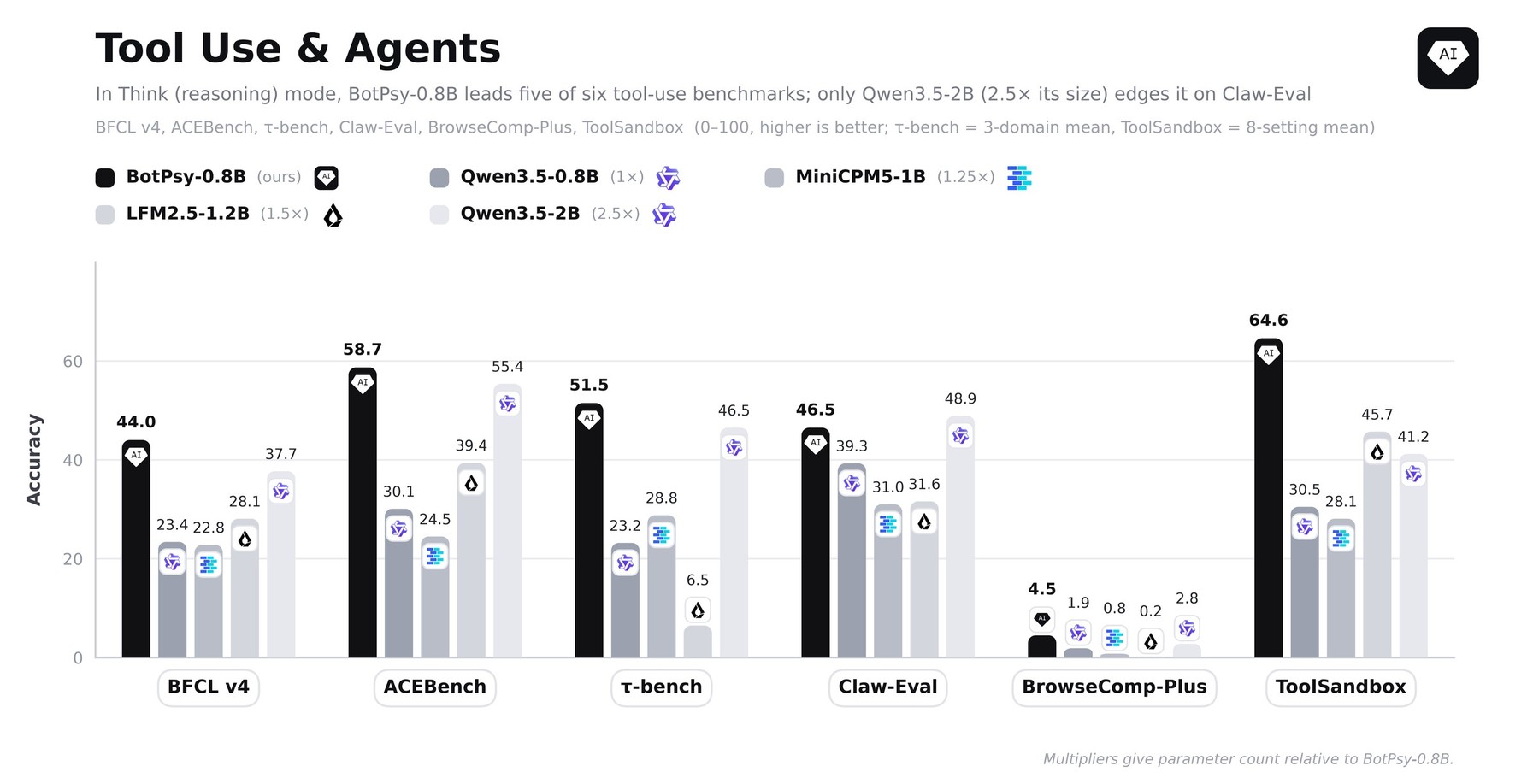
Figure 1: BotPsy-0.8B significantly outperforms its base model and leads five of the six tool-use and agentic benchmarks, including against Qwen3.5-2B-Think (2.5× its size); only on Claw-Eval does Qwen3.5-2B-Think edge ahead.
Source: huggingface.co
BotPsy also showed an advantage on tests involving multi-step interactions. In the telecommunications scenario of τ²-bench, where an agent must hold a long conversation and help a user solve a problem, it scored 82.5, compared with 69.3 for Qwen3.5-2B-Think. On multi-step BFCL v4 tasks, BotPsy’s score rose from 7.5 for the base model to 46.1. In the retail and services task groups, it scored 58.3, compared with 47.4 for the next-best model; in device and system control, it scored 46.1 versus 31.9.
The model is also better at recognizing when it should not call a tool. On BFCL v4 hallucination tests, which check whether a model refrains from making an unsuitable call, BotPsy scored 86.1, the highest of all evaluated models. In ACEBench’s special scenarios, where a request is incomplete, has incorrect parameters, or cannot be completed with the available tools, BotPsy scored 51.3, compared with 13.7 for the base model.
Instruction following and safety
Tool-use training did not reduce the model’s general knowledge. Its GPQA Diamond score rose from 33.2 to 38.1, and its MMLU-Pro score from 41.6 to 48.9. BotPsy outperformed models with up to 1.2 billion parameters on both tests, but Qwen3.5-2B-Think scored substantially higher, at 59.9 and 65.5. The developers suggest BotPsy should use tools to find facts it does not know rather than serve as a model for storing knowledge.
Instruction following improved on IFEval, from 59.7 to 90.8, and on IFBench, from 22.0 to 55.9. The latter was the best score among all evaluated models. On tests of general knowledge and instruction following, BotPsy also outperformed every evaluated model with up to 1.2 billion parameters.
On Multi-IF, a multilingual benchmark that tests instruction following over three exchanges in eight languages, BotPsy scored 67.2. That was comparable to Qwen3.5-2B-Think at 66.9 and LFM2.5-1.2B-Think at 68.2. In the first exchange, BotPsy scored 84.3, the best result among five models, but its score fell to 51.0 by the third. The two other models scored 56.5 and 56.2 on the third exchange. BotPsy performed worst in Hindi, at 24.5, and Russian, at 57.6; its scores in English, Chinese, French, Spanish, Italian, and Portuguese ranged from 72 to 80.
In automated safety checks across six harm categories, BotPsy gave unsafe answers in 21% of cases, compared with 36% for the base model. This was the lowest rate among models with up to 1.2 billion parameters: LFM2.5-1.2B-Think scored 35%, and MiniCPM5-1B-Think 47%. In prompt attacks that try to get an agent to follow instructions in untrusted tool output, the rate of unsafe answers fell from 46% for the base model to 31%.
BotPsy was also less likely to get stuck in repetitive reasoning. Across all IFBench attempts, the share with repetitive reasoning fell from 22.9% to 1.4%, while the share of runs that reached the 32,000-token limit fell from 28.3% to 0.2%.
Limitations and weak points
BotPsy performs worse in open-ended search than in several other scenarios. It scored 4.5 on BrowseComp-Plus — the best result among five models, but low in absolute terms. On BFCL v4 web-search tasks, BotPsy scored 14.0, and on memory tasks, 16.3; Qwen3.5-2B-Think was ahead in both cases, with scores of 19.8 and 26.1. On Claw-Eval, BotPsy beat its base model, scoring 46.5 versus 39.3, but fell short of Qwen3.5-2B-Think’s 48.9.
Qwen3.5-2B-Think also scored higher on ACEBench’s special scenarios, with 58.0 versus 51.3. On the banking section of τ³-bench, no model scored above 5: BotPsy and its base model both scored 4.1, while Qwen3.5-2B-Think scored 4.8.
In simple scenarios requiring a single tool call, BotPsy scored between 70 and 79 in every application group with enough tasks. The communications and social services group had only six scenarios. BotPsy’s overall score was 75, compared with 54 for the base model and 70 for Qwen3.5-2B-Think.
In complex scenarios requiring multiple steps or tools, BotPsy scored 39.5, compared with 17.9 for the base model and 30.8 for Qwen3.5-2B-Think. Its largest gains over the base model were in communications and social services, at 61 versus 13; retail and services, at 58 versus 27; and device and system control, at 46 versus 15. Qwen3.5-2B-Think outperformed BotPsy only in personal productivity and work tasks: 64 versus 58 across 38 scenarios, mostly from Claw-Eval. In communications and social services, MiniCPM5-1B-Think narrowly beat BotPsy, scoring 61.5 versus 60.5. Overall, multi-step tasks remained harder for the model than single calls.
The weakest area was complex information search and research tasks, where BotPsy scored 15, compared with 79 on single calls. Most of these tasks were in-depth search questions from BrowseComp-Plus. They were difficult for other models of this size, too: the base model scored 9, and Qwen3.5-2B-Think scored 14.
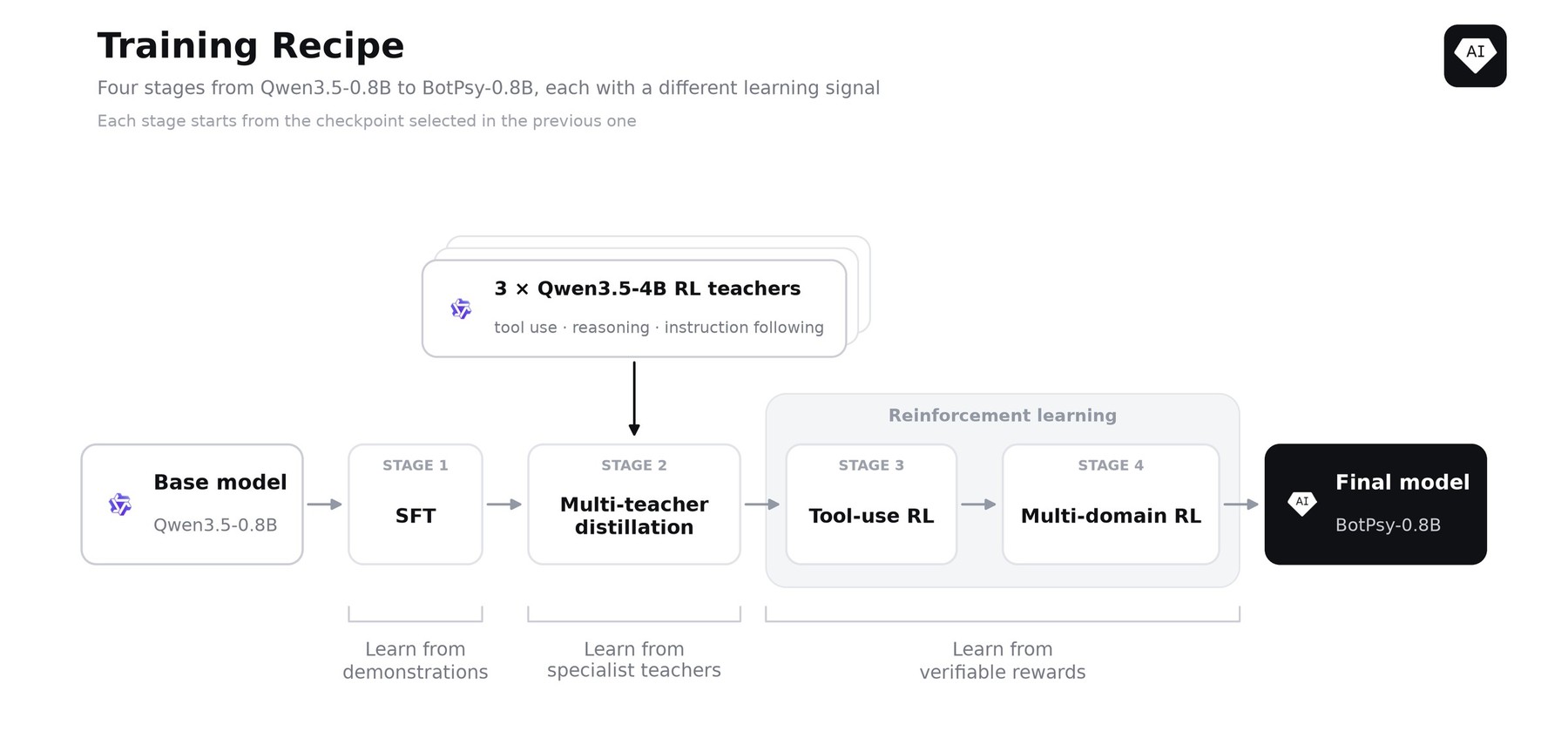
Figure 3: BotPsy training recipe. The student goes through four stages. Three specialist Qwen3.5-4B teachers, each RL-trained for one skill, guide it during the distillation stage.
Source: huggingface.co
Reasoning speed and number of steps
Efficiency comparisons used the same questions and tasks — those solved by all five models. Reasoning-token counts were calculated separately for each model using its own tokenizer.
For correct answers, BotPsy used 1.4 to 3.1 times fewer reasoning tokens than the base model: 3,690 versus 11,563 on GPQA Diamond, 1,912 versus 5,105 on MMLU-Pro, 3,148 versus 4,433 on IFEval, and 4,204 versus 11,576 on IFBench. BotPsy also had higher accuracy on all four tests. It was not the most concise model in every comparison: LFM2.5-1.2B-Think used less reasoning on MMLU-Pro, IFEval, and IFBench, while MiniCPM5-1B-Think used less on IFEval and IFBench. Both models had lower accuracy on the respective tests.
On multi-step τ²-bench tasks, BotPsy took fewer turns than the base model:
BotPsy nevertheless solved twice as many retail tasks and 2.6 times as many telecommunications tasks as the base model. MiniCPM5-1B-Think used fewer turns in retail, at 8.7, but completed only 9.9% of the tasks in that group.
How the model was trained
BotPsy is based on Qwen3.5-0.8B. It was trained in four successive stages: supervised fine-tuning (SFT), multi-teacher on-policy distillation (MOPD), and two reinforcement-learning stages. Each stage began with the best model version produced by the previous one. Training used examples of actions, probability distributions from larger teacher models, and rewards calculated using rules and checks.
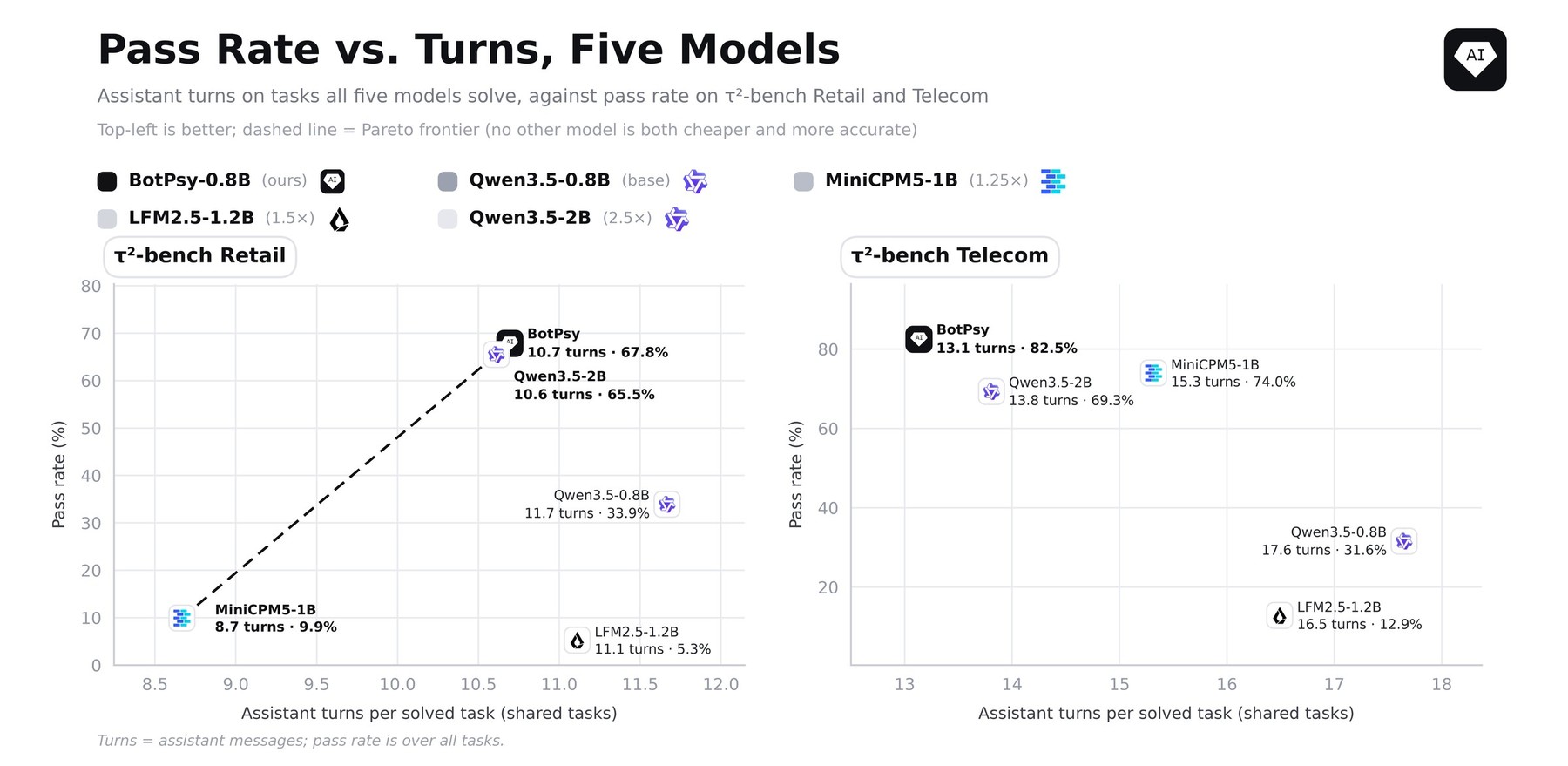
Figure 9: Pass rate against assistant turns per solved task on τ²-bench retail and telecom. Turns are measured on tasks all five models solve; pass rate is over all tasks. Top-left is better; the dashed line is the Pareto frontier.
Source: huggingface.co
During SFT, the model was trained on conversations about tool use. The data included multi-step interactions in simulated environments, repeated single, parallel, and multi-step calls, as well as situations where no tool should be called.
The model then generated its own responses, with a specialized teacher evaluating each token. The training signal was token-level reverse Kullback–Leibler divergence. For this stage, the developers first trained three Qwen3.5-4B models with reinforcement learning: one for tool use, one for general reasoning, and one for instruction following. Each prompt was routed to one of these teachers. The goal was to restore some of the knowledge and instruction-following ability lost after SFT; tool-use scores also improved.
The first of the two reinforcement-learning stages used DAPO. The model learned from rewards calculated by rules and checking programs, without additional evaluations. The focus was on tool calls, as well as instruction following and multiple-choice questions in the natural and exact sciences. Reasoning and tool-call formats were checked against the Tool-N1 example, but instead of rewarding only a correct or incorrect answer, the training used partial rewards based on the ToolRL approach: it separately compared tool names, argument names, and argument values with the reference.
The second stage added tasks with verifiable answers from different areas: mathematics, programming, multiple-choice knowledge questions, instruction following, structured responses, and multi-step tool use in a simulated work environment. Although this dataset did not include multi-step conversations, results on multi-step function calling improved.
The data mix changed at each stage. SFT focused mainly on tool use. The MOPD dataset combined tool use, knowledge checks, and instruction following to improve tool calls and restore general-task performance that had declined after SFT. The first reinforcement-learning stage again focused primarily on tools, while the second shifted the balance toward instructions, knowledge, mathematics, and programming, while retaining a smaller share of tool-use tasks.
Release and future plans
BotPsy is planned for release with open weights under the Apache 2.0 license for research and training. Three precision variants will be available: bf16, Q8, and Q4. The model will be offered in safetensors format on Hugging Face and as GGUF files for QVAC SDK and llama.cpp.
Tether AI Research plans to expand the capabilities of local AI agents and connect them to more devices and local services. The company wants to develop Hypersearch for more reliable decentralized peer-to-peer queries and private, encrypted web search that bypasses corporate tracking systems. QVAC Fabric’s local fine-tuning mechanisms are intended to better account for users’ preferences, workflows, and toolsets. In future versions, a smartphone will be able to offload resource-intensive tasks to home computers or trusted secure peer-to-peer nodes as it switches between offline and connected modes.
The company also plans to strengthen data-protection protocols and add data exchange between agents on trusted local networks. These plans describe the direction of future development; the source does not specify when they will be implemented.
The model is positioned as a local assistant for everyday tasks, not as a universal replacement for larger models: its results are especially notable in tool use and multi-step interaction, but complex search and some other tasks remain weak points. Dataist’s take: open weights and the ability to run the model locally give developers a foundation for customizing these assistants, but the warning that the model can make mistakes and the restriction against using it in sensitive scenarios remain significant limitations.
Daily AI news
Every day we pick what actually matters in AI and explain it plainly — no hype, no filler. Subscribe if you want to follow where the industry is going.
Only what matters — every day
Follow on X