
How the implant helped control a hand
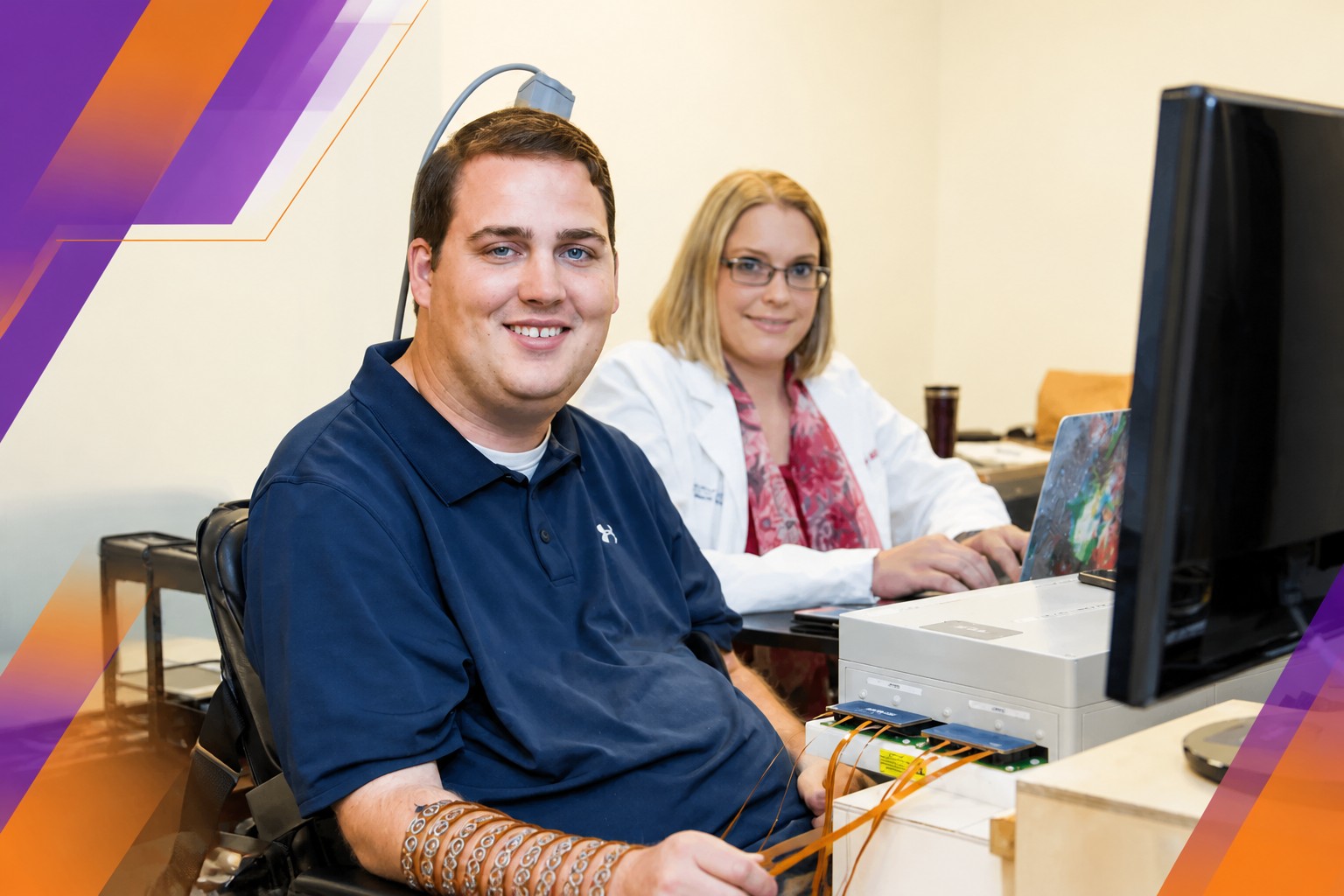
In 2010, when Burkhart was 19, a diving accident left him paralyzed below the chest. About four years later, he agreed to test an implant designed to control his hand.
A 96-electrode array was implanted in the part of his brain responsible for movement. A cable connected it to a computer, where algorithms processed brain signals and sent commands to another set of electrodes in a sleeve worn on Burkhart’s arm. At first, the movements were small. Over time, he learned to pour beads out of bottles, move small and fragile objects, and play Guitar Hero. He could test the system only in a laboratory.
During the seven and a half years he had the implant, Burkhart took part in two clinical trials, each lasting several years. He says it was a wonderful experience, but there are parts of it he would now like to change.
Participation in research and recognition of contributions
In 2022, Burkhart co-founded the BCI Pioneers Coalition. The organization brings together people who have taken part in brain-computer interface trials and helps them share experiences with one another and with researchers. Over the past year, coalition members have been developing recommendations for scientists, doctors, and companies running these trials.
Ethical guidelines for clinical research already exist, but Jennifer Chandler, a professor of law and neuroethics at the University of Ottawa who helped develop the recommendations, says brain implant trials call for a distinct approach. Participants may live with a device in their brain for years, contributing their time, their bodies, and their intellectual effort to the research.
The recommendations were published on Tuesday and are divided into 13 categories. One addresses recognizing participants’ contributions and compensating them. Burkhart recalls going to the lab two or three times a week, for about four hours each visit. By his estimate, counting only that time adds up to a part-time workweek.
As the trials progressed, he learned more about the system and could give researchers more substantive feedback on what worked and what did not. Burkhart considers himself an important member of the team. For people with a similar level of involvement, he says, becoming a co-author of scientific papers or receiving public recognition as a researcher may matter. The recommendations’ authors emphasize, however, that not every participant will want that recognition.
Privacy and brain data
The recommendations address the protection of participants’ identities and data. Since advanced biotechnology draws media interest, researchers should explain in advance that trials may attract journalists. In some cases, it may be difficult to keep a participant’s identity completely private.
Brain activity data pose a separate issue: research teams need to collect it, analyze it, and store it at least temporarily. Burkhart was not very concerned about the use of data on signals related to movement. People with implants that translate thoughts into words may feel differently.
The recommendations say brain data should be treated as participants’ personal information. The authors propose giving people ongoing access to their own data, which was not always possible. They also say that nondisclosure agreements and other restrictions should not prevent participants from sharing data with their doctors. Such restrictions may be imposed to keep results from competitors. Burkhart says strict nondisclosure agreements are not used in every trial, but it is important to prevent them from being applied at participants’ expense.
What happens after a trial
About five years after Burkhart received the implant, his team ran into funding problems. Researchers told him the device would have to be removed and could be reimplanted once funding became available. In the end, he kept the implant until 2021. It was removed after an infection began developing where the cable passed through the skin of his scalp. Losing the device was difficult for Burkhart: he had regained the ability to move his hand, then lost it again.
A similar situation happened to Rita Leggett in Australia, who received an implant to treat epilepsy. She said she had become one with the device. Two years later, the manufacturer went bankrupt, and the implant was removed against her wishes. Ethicists described this as a possible human rights violation.
The recommendations’ authors say researchers should maintain the operation of brain devices for a “reasonable period” after a trial ends. Participants should have enough time to prepare for implant removal surgery, and researchers should set aside additional funding in advance to support people who will undergo the procedure.
Some recommendations are broad and may overlap with existing ethical standards; the document does not spell out specific solutions in every case. It was prepared with input from a small group, since very few people have brain implants so far. The team hopes to expand the recommendations over time, and Burkhart plans to discuss them with scientists at an upcoming neuroscience conference. Chandler calls the document a first version that still needs to be developed.
Dataist's take: The recommendations put on the record the questions that arise when a research participant lives with an implant for years: who controls their data, how their contribution is recognized, and what happens to the device after a trial. The document does not yet offer precise solutions for every situation and is based on the experience of a small group, so its further development will depend on broadening the range of participants.
Daily AI news
Every day we pick what actually matters in AI and explain it plainly — no hype, no filler. Subscribe if you want to follow where the industry is going.
Only what matters — every day
Follow on X