

Mathematician Tristan Buckmaster has published an open statement accusing OpenAI of pressuring him after word leaked that he and Levent Alpöge had used AI models to make progress on the Navier-Stokes equations. The central allegation is narrow and checkable: that OpenAI's Sébastien Bubeck twice pushed to strike Alpöge from the author list because Alpöge works at Anthropic, and that when Buckmaster refused, Bubeck asked why he was ruining his career. OpenAI has since published its own Navier-Stokes result, produced by roughly 10,000 coordinated AI agents over 88 hours. It denies the account.
Start with what OpenAI put out. The company says the proof was generated by around 10,000 coordinated AI agents running for 88 hours, on an internal model it describes as substantially more capable than GPT-6 Astra. The proof was also formalized in Lean. Mark Chen, who led the research effort, said the compute alone cost "millions of dollars."
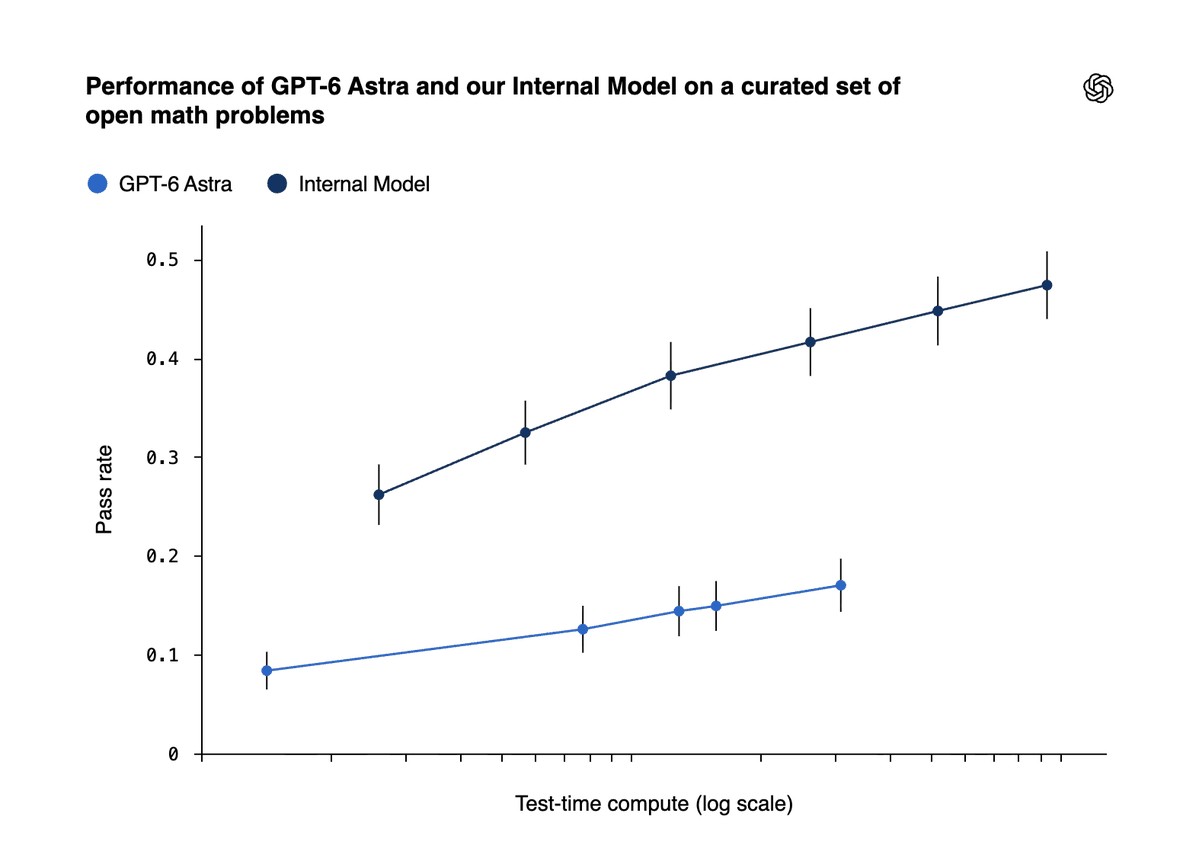
OpenAI's internal model solves nearly three times as many open mathematical problems as GPT-6 Astra, and the gap widens as compute is scaled up
Source: the-decoder.com
OpenAI researcher Noam Brown pointed to a familiar pattern around the cost. When the company introduced o3, scoring 87.5% on the ARC-AGI benchmark cost roughly $500,000. Astra now handles harder tasks for about $20. At the 2025 International Mathematical Olympiad, OpenAI and Google DeepMind both spent enormous compute; in 2026 any ChatGPT subscriber could reach a comparable result for $20. Brown expects that within a year everyone will have access to AI that can solve problems at this level.
Buckmaster and Alpöge had been working for months with a mix of models, including Anthropic's Claude and OpenAI's Codex running on GPT-5.6 Sol. By mid-August, they say, they had several new results, and they believe they found a solution for a specific variant of the Navier-Stokes equations — unpublished, and not yet formally verified. Navier-Stokes is one of the Clay Mathematics Institute's Millennium Prize problems, seven fundamental questions each carrying a $1 million prize. A confirmed proof would be a major event in mathematics and a landmark for AI-assisted research.
Rumours of a major breakthrough began circulating in early September. Alpöge learned that information about their work had reached OpenAI. On 3 September, Buckmaster contacted a mathematician at OpenAI to clarify things, stressing that the research was a private collaboration with no institutional agreements attached. That same day OpenAI asked for details and offered compute. Buckmaster proposed a call the following week; the company pressed for something sooner. On Friday he was asked whether he could talk that day. On Sunday at 12:45 he was asked whether he was free "any time today."
Bubeck joined on Sunday. Over two phone calls, Buckmaster says, OpenAI told him its internal model had produced a roughly 100-page proof of the Navier-Stokes equations with an external force. The company initially described the result as requiring "very little human involvement"; as the conversation went on, Buckmaster says a different picture emerged — a whole team had worked on it, simpler problems had been used as intermediate steps, and enormous compute had been thrown at it.
The detail that alarmed him was the external force. That framing, he says, points to the same unusual approach he and Alpöge had taken, a path almost nobody else was exploring. Throughout the project, the two had been uploading every draft into OpenAI Codex sessions. Buckmaster asked whether the model had been trained on those sessions or had access to them. He says he was told the model does not look at user data. On the direct question of whether the data had been used for training, he says he got no answer.
Then came the two proposals. In the first, Buckmaster and Alpöge would publish their Euler result and OpenAI would release its own work the next day, describing the mathematicians as the people who had come closest to the problem. In the second, Buckmaster alone would present the Navier-Stokes result and note that an internal OpenAI model had been involved. In both scenarios, he says, Bubeck twice insisted that Alpöge be removed from the author list, citing irritation that Alpöge works at Anthropic. Buckmaster rejected both and said he would go public if OpenAI published on those terms. Bubeck, he says, asked why he was ruining his career; when Buckmaster pointed out that he works in academia, Bubeck allegedly said he could stop being nice if nobody wanted to ask him to be. Bubeck later wrote separately to Alpöge saying he was not sure Tristan was entirely rational. Alpöge declined to engage.
OpenAI rejected the accusations at a press conference reported by WIRED. Bubeck said neither OpenAI's researchers nor its AI agents had seen the mathematicians' work before it was published the previous night. He said OpenAI recognises the priority of Alpöge and Buckmaster's work and congratulates them on a major achievement. OpenAI mathematician Wen Chandrasekar said the company's solution is fundamentally different from Buckmaster and Alpöge's approach. Bubeck said OpenAI began training a new model with expanded mathematical abilities on 28 August, and that after rumours of progress at Anthropic the company directed additional resources at Navier-Stokes. By Sunday morning, he said, OpenAI had a finished solution formalized in Lean.
Buckmaster is careful about what he is claiming. He says he is not directly accusing anyone, he has not seen OpenAI's proof, and he does not know whether the company used the mathematicians' data. He published the account, he says, because the sequence of announcements would otherwise have created a false impression of what happened.
That caution is what makes the story worth reading closely, because it separates two very different claims. The data question is unresolved and may stay that way — Buckmaster himself does not assert it. The author-list demand does not depend on it at all. Asking a mathematician to strip a co-author because that co-author works at a competitor is a statement about how a lab behaves when it is racing, and it would be just as ugly if OpenAI's proof turned out to be entirely independent. The denial OpenAI offered addresses the first claim in detail and the second not at all.
Bubeck's own timeline is also more revealing than it looks. Training started on 28 August; additional resources went to Navier-Stokes after rumours of progress at Anthropic. That is OpenAI confirming it aimed a specific, expensive effort at a specific open problem because it heard a rival was close. Set that against Brown's remarks at the Astra presentation in early August, where he said OpenAI had tried the Millennium problems without finding a solution and had not directed significant compute at the work. Six weeks later: millions of dollars of compute and a 100-page proof. Nothing there is a contradiction. It is the record of a company deciding, quite suddenly, that this particular problem was worth winning.
The question nobody put to OpenAI is what "the model does not look at user data" is answering. Buckmaster asked whether his Codex sessions were used for training, and says he got no answer to that question. What he got instead was an assurance about whether the model looks at user data — a different question with a different answer, and the gap between the two is where this entire dispute lives. The Lean formalization does not help here either: it verifies that the proof's steps are correct, which says nothing about where the approach came from.
Buckmaster says he had wanted to talk about something else entirely — that a mathematician working with a language model can now do in a month what used to take far longer, and that this feels like the moment Deep Blue faced Garry Kasparov. The comparison is apt in a way he probably did not intend. Deep Blue was a story about a machine beating a human. This one is about who gets his name on the paper when the machine and the human are on the same side.