Caterpillar is moving the autonomy playbook it built in mining onto construction sites and quarries, and it has put a number on the internal cost of doing so: $100 million over the next five years to train its 118,000 employees in AI, autonomous technology and robotics. Chief technology officer Jaime Mineart laid out the approach to TechCrunch at the Ai4 conference in Las Vegas earlier this month. The company is running it on 1.6 million connected assets and 16 petabytes of structured data — and funding it from a quarter in which demand for AI infrastructure pushed revenue to a record $20.5 billion.
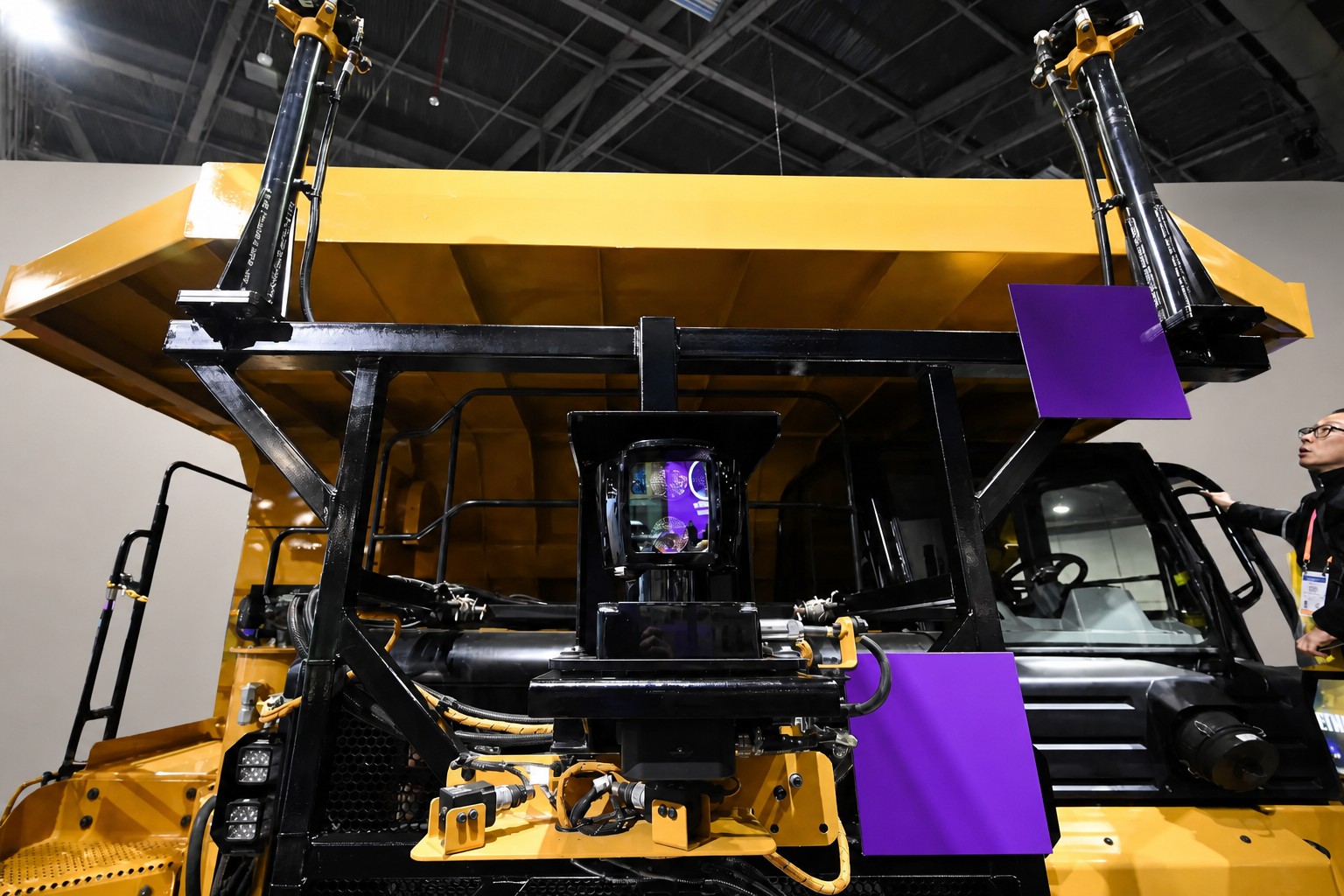
The autonomy work started in mining for reasons that had nothing to do with AI fashion. Mines are short of workers and dangerous to work in, which makes removing the human from the cab an easy case to argue. Caterpillar now sells autonomous haul trucks, drills, underground loaders and dozers, plus remote-controlled construction equipment, a software command center, fleet management and remote site survey. Mineart's point is that the next environments are harder: construction sites and quarries are more dynamic than a pit running the same haul route all day.
The newer AI work is aimed at technicians rather than machines. The Cat AI assistant lets a technician standing next to a piece of equipment ask by voice for a repair procedure, work through a suspected fault, and identify in advance which parts the job will need. Mineart says customers, operators and technicians are already using it. It runs on Caterpillar's own data, collected from connected machines — which is where the 1.6 million assets and 16 petabytes come in.
Elsewhere the company uses AI in software that scans sites and builds digital twins of its manufacturing operations, so workflows can be analyzed. Inside the business, AI agents modernize legacy code, write and test new software, and catch defects earlier.
Mineart's most useful observation is that building the technology is the smaller half of the problem. Putting an autonomous machine into service does not by itself reorganise a site around AI. Companies have to change how employees interact with the technology and rework existing processes. The hard part of autonomous systems and physical AI, she says, is fitting them into the customer's workflow and into the actual work on the ground.
To train the AI, Caterpillar draws on experienced operators and the knowledge its workforce has accumulated over decades. As machines get more autonomous, some operators are expected to move from running a single machine to supervising several at once from a remote command center.
That is the transition the $100 million is for. Set against the workforce it covers, it is about $847 per employee over five years — roughly $169 a year, or a rounding error next to a single quarter's revenue. I read that as a program rather than a transformation: enough to build curriculum and certify people, not enough to suggest Caterpillar expects the job of operating its equipment to change beyond recognition in five years. Mineart's own framing supports that reading. Nobody here is promising to replace operators; the pitch is that the same operators will run more iron.
What the announcement does not do is put arithmetic behind the one-to-many claim. An operator who supervises several machines from a command center is, by definition, a smaller number of operators per machine. Whether that shows up as fewer jobs or as the same people covering a larger fleet depends entirely on how much equipment customers deploy, and nothing in the company's account speaks to it. Also absent: how many of those 1.6 million connected assets are actually autonomous, how widely the Cat AI assistant is deployed, and who owns the data stream that makes the whole thing work. Caterpillar's advantage here rests on machine data from customer fleets, and that is a question worth someone asking.
The commercial context is the part that gets least attention and probably deserves the most. Caterpillar is on both sides of the AI trade. It is buying AI into its own operations, and it is selling into the buildout: second-quarter revenue hit a record $20.5 billion, helped by demand for power generation equipment going into data centers. Sales at the energy equipment unit rose 72% to $3.10 billion. CEO Joe Creed said demand for cloud computing and generative AI infrastructure has not slowed.
That $3.10 billion is about 15% of the quarter, but it is where the growth story lives — and it is the segment with the least connection to anything Mineart is building. Caterpillar's AI revenue today comes from selling generators to people training models. Its AI spending is a bet that autonomy eventually earns its own line. The mining playbook worked because mines are enclosed, repetitive and fenced. Construction sites are none of those, and the executive making the case is the one who says the technology was never the hard part.