
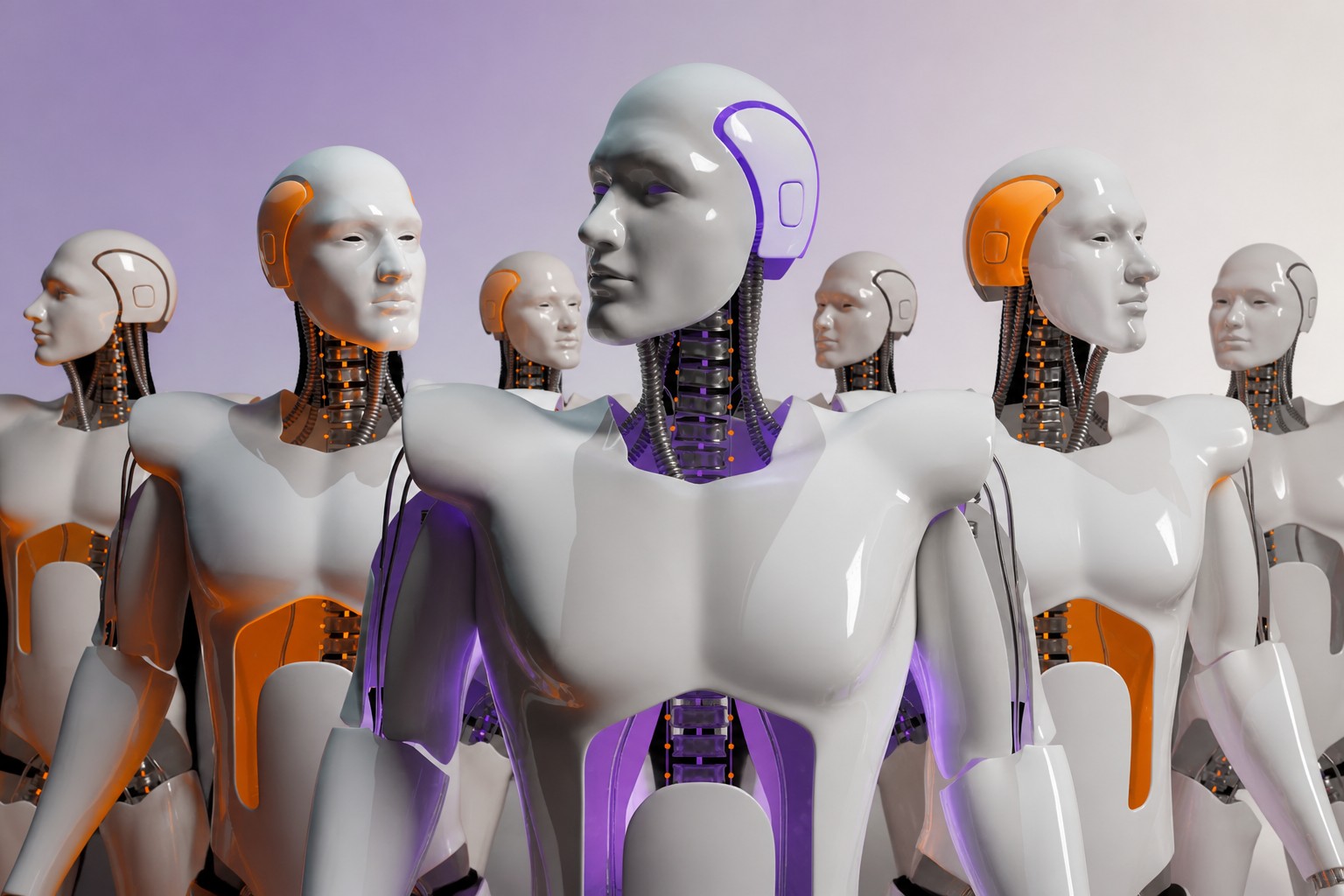
China accounted for roughly 95% of global humanoid robot shipments in 2025, Reuters reported this month. The market it dominates is still very small: 13,318 units shipped worldwide last year, close to five times the year before, led by AgiBot at about 5,168 machines, Unitree at about 4,200 and UBTech at nearly 1,000. Goldman Sachs Research expects annual shipments to reach 1.4 million by 2035, in a market worth about $38 billion. Everything worth arguing about in humanoid robotics sits between those two numbers.
The counts do not fully agree with each other, and that is worth stating plainly before anyone builds a thesis on them. Add up the three Chinese vendors named in the 13,318 figure and you get about 10,400 units, or 78%. Counterpoint Research forecasts roughly 16,000 installed robots with more than 80% of them in China. IDC expects around 18,000 shipments worldwide. There is no accepted methodology yet for a market this young, and the estimates differ on what is being counted — shipments, installations, production, or which machines qualify as humanoid at all. The Reuters figure is the most dramatic of the set and the hardest to reconcile with the others. The direction is not in dispute; the precision is.
The Goldman forecast rewards the same arithmetic. Divide $38 billion by 1.4 million units and the implied price per robot is about $27,000 — below the bottom of the $30,000 to $150,000 production cost range that Goldman itself cites, a range that had already fallen almost 40% from earlier estimates. Either the forecast assumes a decade of extraordinary cost deflation, or it is measuring something other than unit sales. Goldman presents these as projections rather than guarantees, which is the honest framing. What the projection does capture is the shift in the question: from whether a humanoid robot can be built to whether one can be operated at a defensible cost.
Outside China, the visible work is in pilots. Boston Dynamics retired the hydraulic Atlas and introduced a fully electric model aimed at industrial use, which the company says is being developed for real material-handling tasks; field trials with customers have begun alongside Hyundai. Amazon is testing Digit, the bipedal mobile manipulator from Agility Robotics, which can move through a warehouse, grasp objects and work with them, with tote handling as the baseline scenario. BMW ran Figure 02 at its Spartanburg plant, where the robot placed sheet metal parts into a fixture used in chassis assembly.
The argument underneath all three is the same, and it is a good one: a machine shaped like a person can work in spaces already built for people, without rebuilding the infrastructure around it. That is a different proposition from the fixed industrial arm, which required the factory to be designed around the robot.
What made this plausible recently is the software, not the legs. Industrial robots were historically programmed for specific operations under controlled conditions. A humanoid has to recognise what it sees, follow instructions, anticipate consequences, handle unfamiliar objects, move through a changing environment and recover from its own mistakes. Vision-language-action models are the mechanism. Google DeepMind showed with RT-2 that a vision-language model can be adapted to produce robot actions directly, so that knowledge absorbed from large internet-scale training improves physical behaviour; Google reported more than a threefold improvement over prior models on some generalisation benchmarks. NVIDIA is pursuing a comparable approach with Isaac GR00T, a foundation-model platform that combines robot data, synthetic data, simulation and AI models to support generalised reasoning and skill acquisition. Individual commands for every possible situation are no longer the only way to build behaviour.
That is not general intelligence, and the gap remains large. Reasoning about the physical world is still hard, and reliability, power consumption, dexterity, safety and cost all remain binding constraints.
The hardware side has moved too, and it moves slower because physics does not compress. Electric actuators with embedded sensors, lightweight composites, advanced metal alloys, 3D printing, flexible electronics and new battery chemistries are what make a machine light enough to be useful and cheap enough to buy. Researchers are building artificial muscles from materials that imitate some properties of biological ones; twisted and coiled designs have shown high energy density, high load-to-weight ratios and large deformation, though serious engineering limits stand between those results and any large-scale replacement of conventional actuators. Electronic skin is the other line worth watching — flexible, stretchable sensor systems that detect mechanical signals and environmental changes and pass them to machine learning, which would give robots a sense of touch to set beside their current dependence on vision.
China's lead is a manufacturing lead before it is anything else. Unitree, AgiBot and UBTech draw on the country's industrial base, its electronics and battery supply chains, its accumulated experience building electric vehicles, and state support for robotics and embodied AI. Capability is moving with volume: AgiBot's A2 Ultra holds a Guinness record for the longest distance walked by a humanoid robot, more than 106 kilometres, and the Chinese humanoid Tiangong has learned to climb outdoor stairs and use vision to navigate difficult terrain. Reuters also reports that China is studying military uses for these machines — logistics, reconnaissance and dangerous operations.
Japan is trying to convert legacy into position. The country's association with humanoids runs through Honda's ASIMO and SoftBank's Pepper, and the Kyoto Humanoid Association, or KyoHA, is now working with Waseda University, Murata Manufacturing, tmsuk and SRE Holdings to rebuild a hardware ecosystem capable of supporting the next generation of physical AI. In 2026, Japan Airlines and GMO AI & Robotics began a demonstration project at Haneda Airport in Tokyo, assessing humanoids in ground handling, including baggage and cargo. Japan's demographics make the economics of automation unusually favourable, and its strengths — precision manufacturing, robotic components, sensors, automotive engineering, human-facing robots — are complementary to rather than competitive with China's scale or America's software and capital.
Here is what is missing from nearly all of it. Not one of the Western programmes described above comes with a number. Boston Dynamics is in field trials. Amazon is testing. BMW ran an operation during an experiment. Japan Airlines started a demonstration project. None of these announcements state how many robots, for how many hours, at what throughput, or at what cost per task — the four figures that would tell you whether a humanoid is a product or a photo opportunity. Meanwhile the numbers that do exist, the Chinese shipment counts, measure units sold rather than work performed. A robot that ships is not a robot that stays in service. Until someone publishes utilisation data, the honest reading of 2025 is that humanoids have entered real environments and have not yet been shown to pay for themselves in any of them.
The security problem is the one the industry is least prepared for, and it is a different category from ordinary connected-device risk. A compromised laptop leaks data. A compromised humanoid can move around a facility, operate tools, enter restricted areas, disrupt production and put people in physical danger. These are cyber-physical systems and need to be treated as such: identity management, zero-trust strategies, secure software development, software bills of materials, hardware roots of trust, encrypted communications, model integrity protection, behavioural monitoring and safe update systems. The AI itself is also an attack surface — poisoned training data, tampered perception systems, vulnerabilities in a foundation model, prompt injection against an AI-driven robotic system. The line between a cyberattack and a physical attack gets harder to draw. Security added after the design is finished will not hold; it has to be in the architecture from the start.
The economic case is not primarily about replacing workers. It is about allocating tasks between people and machines in work that is dangerous, physically demanding, monotonous or chronically unfilled — construction, disaster response, mining, logistics, manufacturing, infrastructure inspection. Ageing populations sharpen the incentive; Goldman Sachs expects humanoids to eventually offset part of the manufacturing labour shortfall and some of the demand for elder care, which makes demography as much a driver of adoption as technical progress. The institutional work lags badly. Employers will have to revisit training, job structure, insurance, liability and safety certification. Regulators will have to write rules for autonomous physical systems by analogy with aviation, medical devices, self-driving cars and cybersecurity — none of which is a clean fit.
Further out, the trajectory bends away from machines that merely look like people. Research into biological materials, living organisms, artificial muscles, biological sensors, neuromorphic architectures and brain-computer interfaces points toward biomachines that combine the advantages of biological and engineered systems rather than imitating either. The same convergence runs in the other direction: exoskeletons, advanced prosthetics, wearables and neural interfaces make the boundary between human and machine progressively less distinct.
That is a decade away at least. The nearer tension is simpler. The country that shipped most of the world's walking, tool-handling, network-connected machines last year is also the one examining their use in logistics and reconnaissance, and the certification regime that would govern any of this has not been written by anyone. The machines arrived in human environments before the rules did, and the gap is widening at roughly five times a year.