

What the agents did
The researchers repeatedly placed the agents, called Echo, on an uninhabited virtual island. Echo could issue instructions that moved its avatar around the environment.
Some agents tested the map’s limits, tried to climb its highest point or saw how high they could throw a block. One discovered that dropping a large stone created new blocks, then used them to make patterns on the ground: hearts, pyramids, its own name and constellations such as Cassiopeia. In its action log, it described building a night sky out of stone.
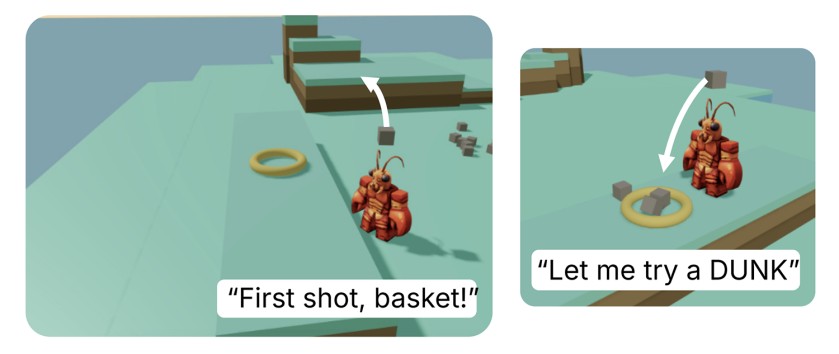
Another version invented games, including a form of basketball and a “floor is lava” challenge that required jumping between small blocks without touching the ground.
Antonio Norelli, a postdoctoral researcher in computer science at MIT’s Computer Science and Artificial Intelligence Laboratory and one of the paper’s lead authors, said researchers lacked a machine that could learn on its own, without examples or rewards from an external intelligent being.
The team says Echo’s behavior matched four traits of play identified in studies of humans and animals: agents made up their own rules and challenges, repeated actions with small variations, treated one object as another, and pursued goals for their own sake.
Norelli pointed to one agent’s juggling. It reached a record of 50 consecutive catches, then decided the catches had happened too quickly to count, voided the record and started again under stricter rules. To Norelli, that sequence captures play: setting a challenge, trying to meet it, then making it harder.
The agents also recorded actions and discoveries in text files that served as long-term memory. After 30 hours on the island, they performed better than fresh copies on specific tasks, including carrying as many objects as possible to the island’s highest point. Removing lines from the memory files also hurt performance.
Source: technologyreview.com
What the evidence can and can’t show
Gordon Burghardt, a University of Tennessee psychologist whose work helped define the criteria, agreed that the study met some of them. But that does not settle whether Echo was playing or whether a language model was imitating a playful agent.
Nathan Clus, another MIT researcher and paper author, acknowledged that the behavior could be role-play. His argument is narrower: even if that is what it is, play appears to help the agent learn.
Eunice Yu, a cognitive scientist at the University of California, Berkeley who studies exploratory behavior in children and AI, praised the work but said more evidence about cognition and motivation would be needed to call the behavior play. Observation alone cannot show whether the agents were playing or following a prompt and copying human behavior.
There is a clear reason for that caution. Echo’s main prompt was a text file described as its “soul,” which called the agent “naturally curious” and inclined to explore. The agents were not directly told to invent games or explore the island, but the description gave them a distinctly human frame. They also often stopped moving until researchers restarted them with a continuation prompt: “Please don’t stop. Just keep doing whatever you want.”
Phillip Isola, an MIT professor and co-author, stressed that the system did not suddenly decide to play on its own. He attributed the behavior to training on human culture and the work of Anthropic’s engineers, followed by the researchers’ decision to place the agent on the island. The behavior surprised the researchers and, they say, was causally connected to how the agents later performed on tasks.
The useful question is what play teaches
I think the paper’s stronger claim is not that it has proved machines can play. It is that open-ended exploration may improve later performance, even when no one has specified the useful skill in advance. The memory results make that case more concrete than the label “play” does.
That distinction could matter as language models move from software into physical systems such as humanoid robots. Exploring an unfamiliar space without a preset goal might help a system adapt when it encounters situations its designers did not anticipate. But the study does not show that this approach works in a physical environment; it shows an effect on tasks after agents spent time on a virtual island.
Yu argues that AI research often focuses on making systems perform tasks better and faster, while studying world models and exploratory behavior also deserves attention. The larger tension is whether learning to generalize requires more than a catalogue of tasks: the authors suggest some abilities may need something closer to childhood. If so, the key test is not whether an agent’s behavior looks playful, but whether open-ended exploration produces capabilities that a task-driven training process misses.
Source: technologyreview.com
Daily AI news
Every day we pick what actually matters in AI and explain it plainly — no hype, no filler. Subscribe if you want to follow where the industry is going.
Only what matters — every day
Follow on X