
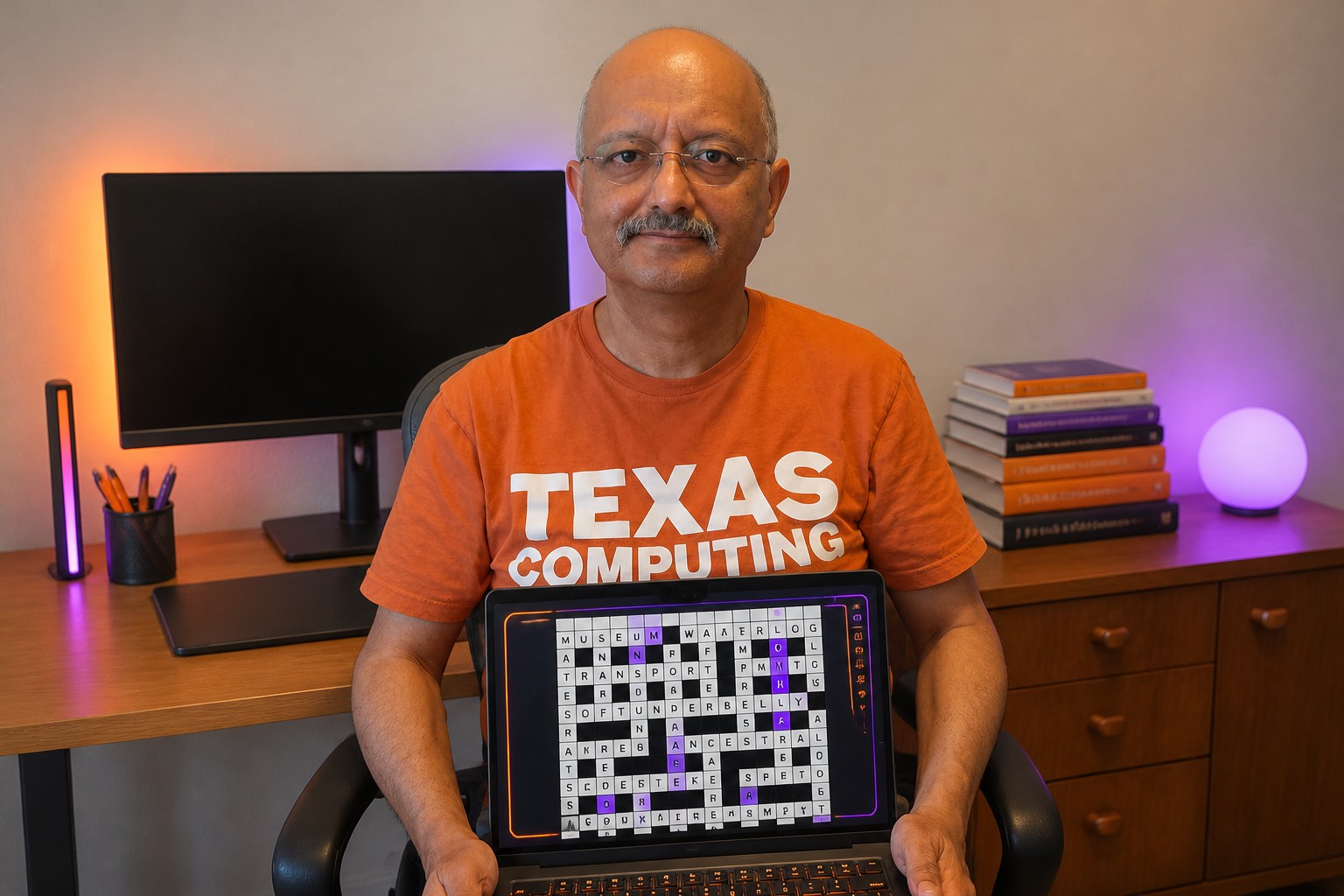
The clue that made the difference
Darmok’s breakthrough came after a failure at last year’s tournament: it gave up before solving the final crossword within 18 minutes. This year, its solution to a visual wordplay clue helped it win. Three of the five finalists struggled with the clue, including 14-time champion Mark Goodliffe:
“Wolf trap missing its lowest crosspiece? (5)”
The crossing letters gave the pattern S_A_F. Both SCARF and SNARF can mean to eat greedily, or “wolf” something down. But the rest of the clue points to a visual transformation: a “trap” suggests SNARE, and removing the bottom bar of the E turns it into an F. The answer is SNARF.
The result puts Darmok in a longer history of computers tackling puzzles once thought to favor people. Less than a decade after Deep Blue beat Garry Kasparov at chess in 1997, WebCrow beat 75 crossword enthusiasts at an AI conference. By 2021, Dr Fill had “won” the American crossword tournament, where solvers need general knowledge, cultural references and an eye for double meanings.
Cryptic crosswords are a harder test. In 2024, Guardian colleague Alan Connor wondered whether they might remain a task AI could not conquer. Sid Chatterjee, a computer scientist at the University of Texas at Austin, set out to show otherwise in 2025 by building Darmok. He named it after a Star Trek episode in which a crew tries to communicate with a species that speaks only in allegories.
What Darmok can—and cannot—solve
Darmok uses four AI models: Gemini 3.1 Pro, Claude Fable 5, GPT-5 and GPT-6 Astra. The first two do most of the work; the others are called in when needed. Chatterjee credits this year’s improvement both to stronger frontier models and to changes he made to the program. One example: Darmok now tries to solve every clue before entering any answers.
Chatterjee has not found a clear pattern in the kinds of clues Darmok struggles with. Crosswords by John Henderson, known to Guardian readers as Enigmatist, are harder for it than most. Readers can try the previous week’s Fed crossword against Darmok; it solved it in four minutes and ten seconds.
A further test would be whether the program can create cryptic crosswords, not just solve them. Chatterjee says that would be a much bigger leap: a setter has to find a phrase that sounds natural both in ordinary English and in the very different grammar of cryptic clues. He compares solving cryptics to climbing Everest and creating them to climbing Olympus Mons.
I think the Everest comparison captures the distinction: Darmok has crossed a human benchmark, but the harder creative task remains untouched. The announcement gives a tournament result, not a broader measure of how reliably the program handles different setters and clue styles.
The next question is not whether a computer can win again, but whether it can make puzzles that people would want to solve.
This week’s clue
The clue was written by Bluebird for The Independent:
“Proportion of inspiration and perspiration? It’s roughly 45% and 42% (5)”
The answer is RATIO. It is hidden twice in the clue, and accounts for five of the 11 letters in “inspiration”—about 45%—and five of the 12 letters in “perspiration,” about 42%.
Readers’ clue competition
This week’s winner was Tony Kelly, known as Montano, with a clue for DEBUT:
“Kick-off leads to decisive early goal for PSG (5)”
“Kick-off” is the definition. “Leads to” points to the first letters of “decisive” and “early”: DE. “Goal for PSG” refers to Paris Saint-Germain; the French word for “goal” is but. Together, they make DEBUT.
This week, readers are invited to write a clue for SCARF, recalling the word that tournament competitors misread in one of the puzzles. Entries can be sent to cluesletter@theguardian.com.
Daily AI news
Every day we pick what actually matters in AI and explain it plainly — no hype, no filler. Subscribe if you want to follow where the industry is going.
Only what matters — every day
Follow on X