
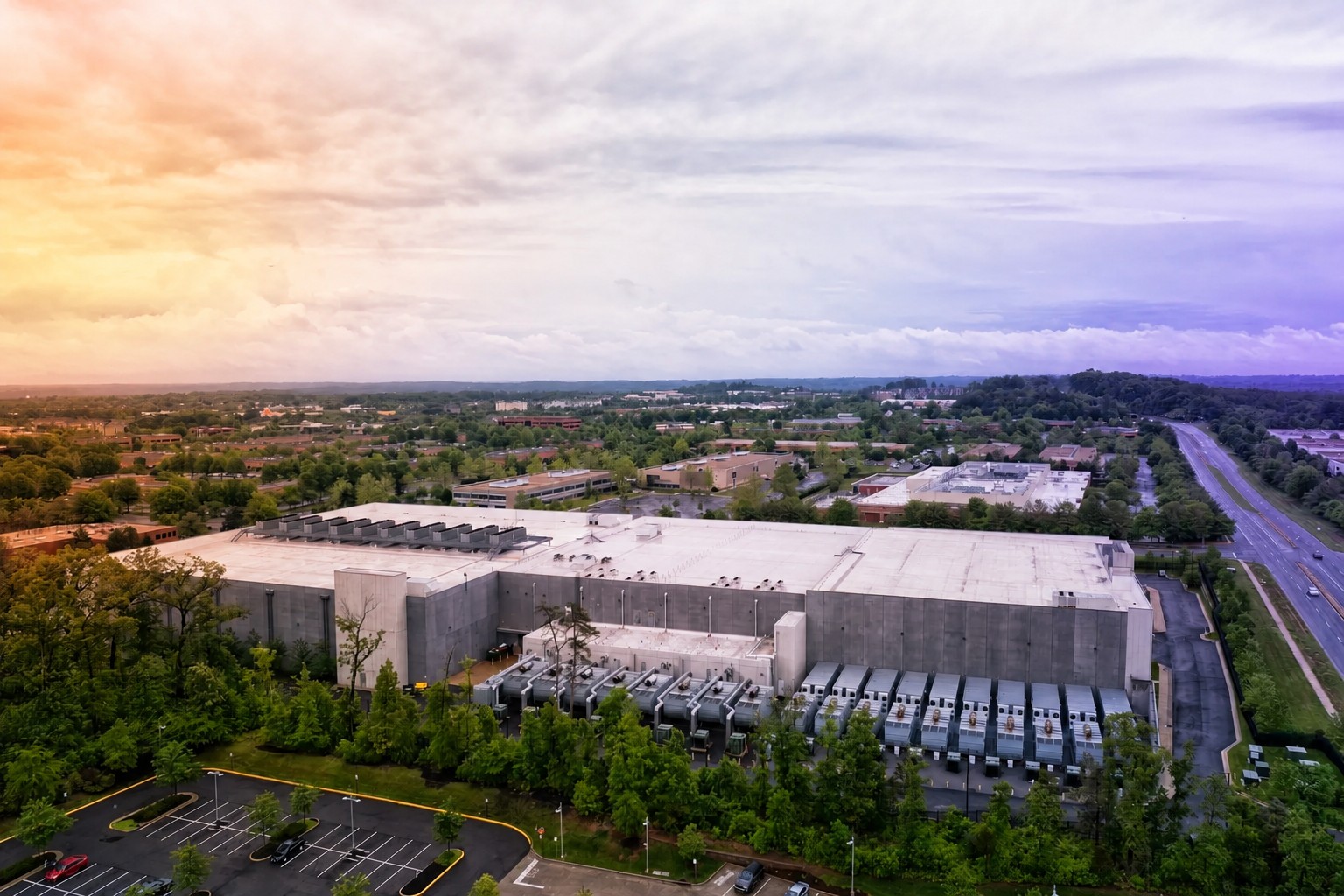
The distance rule is not a health standard
Fairfax County, Virginia, set a 200-foot setback between a data center and a residential property line after comparing the facility with existing zoning categories. That is farther than the 100-foot requirement for a livestock barn, but closer than the 250-foot rule for a crematorium.
The comparison is a planning decision, not a medical finding. It also leaves out the equipment that may matter most:
The relevant boundary is therefore not just the distance from a house to a concrete building. It is the distance to the fans, generators, access roads, lighting and construction activity that surround it.
What neighbors actually experience
A data center is not a factory in the usual sense. Its computers do not burn fuel during normal operation, but they run continuously and generate substantial heat. The emissions and disruptions come mostly from the systems that keep the facility operating.
The most common complaints are practical rather than medical:
The noise is a useful example of the gap between compliance and lived experience. A 2023 review by Virginia’s Joint Legislative Audit and Review Commission found that data centers were “rarely loud enough to violate noise regulations.” Some residents nevertheless said the constant sound “affects their well-being.”
In Virginia, facilities that prompted complaints measured between 40 and 59 decibels. That is generally below the 55- or 60-decibel residential limits in Loudoun, Prince William and Fairfax counties. The concern is less the peak volume than the fact that the sound does not stop.
At least 15 Virginia data centers—about one in ten operating facilities—were identified where neighbors considered noise a problem. A peer-reviewed assessment links persistent noise in other settings to short-term sleep disruption and irritation, and to cardiovascular problems over the long term. But those studies examined road and industrial noise, not data centers. No one has measured these health effects around an operating data center.
Diesel, water and the cost of scale
A large campus in Virginia averaged 35 diesel generators per facility. When running, they produce the same type of exhaust as trucks. The US Environmental Protection Agency considers diesel exhaust likely carcinogenic to humans, while nitrogen dioxide in the exhaust can narrow airways in people with asthma.
The important variable is how often the generators run. In Virginia, most operators recorded only one or two brief power failures over two years. Generators produced less than 4% of the nitrogen oxides involved in smog formation.
Quincy, Washington, offers a more detailed comparison. A state assessment counted major diesel sources including highways, railways, farms and construction sites. Trucks, trains and farm equipment accounted for more than three-quarters of diesel soot. Data-center generators produced roughly one-eighth of the volume allowed by their permits.
That is reassuring only up to a point. If the generators ran at full power, the study found, air at several nearby homes would resemble air beside a busy road. Permit limits describe what may happen, not necessarily what neighbors breathe during an extended outage.
Water creates a different kind of exposure: it is less about the property next door than about the wider watershed. Evaporative cooling sends warm water through cooling towers, where some of it becomes vapor and leaves the system.
In the Washington, DC, region, data centers draw from the same municipal water network as homes. They account for about 1% of the water the region takes from rivers. But households send most used water back into the sewer system, while a data center with evaporative cooling returns only about one-quarter of what it withdraws.
Measured by water that does not return to the system, data centers account for about 9% of the total, rising to 12% in summer. On the hottest days, one facility can use ten times its average daily amount.
Electricity costs spread beyond the campus. New demand requires generating capacity and transmission lines, and utilities recover those fixed costs through all customers. A Virginia regulator concluded that current tariffs “appropriately allocate costs among responsible customers,” but modeled an additional $14–$37 a month in generation and transmission costs by 2040, in today’s money, for a typical Dominion household.
That is a model, not a prediction of any individual bill. Data centers also pay for infrastructure, and in five mature Virginia markets they supplied between less than 1% and 31% of local revenues. The same facility can therefore look like a budgetary asset in one county and a cost imposed on residents in another.
The evidence gap is the story
The February 2026 assessment did not find studies that measured the health of people living directly beside a data center. Its authors instead applied evidence from other settings to possible data-center exposures.
The resulting list describes plausible mechanisms, not proven outcomes:
I think the most important fact is not that every suspected risk is large. It is that the industry is expanding beside homes faster than the relevant exposure data is being collected.
Virginia began an air-monitoring project in February. Seven sensors around Loudoun County measure carbon monoxide, nitrogen dioxide and fine soot, with results published weekly. The stated purpose is limited: to determine whether larger-scale monitoring is necessary.
There is no comparable noise-monitoring system. An August review found no published studies that measured the sound of an operating data center—including frequencies below the threshold of human hearing—and compared those measurements with neighbors’ health. Two people on the same street can sincerely disagree about whether they hear any noise at all.
The same uncertainty applies to construction. A building takes 12 to 18 months to complete, while a large campus can take seven years in phases. In July, West Virginia’s environmental regulator issued an order involving a data-center site in Mason County after heavy rain on July 11 overwhelmed erosion controls and sent sediment-laden water toward nearby homes. Work had begun before the required protections were installed, and the developer said it would repair the damage at its own expense.
In Georgia, several families sued Meta and a local development authority in September. They allege that site clearing, blasting and excavation disrupted groundwater and sent silt into their wells. Meta cites a company-commissioned study saying groundwater flows away from those properties. No regulator has tested the wells.
What a meaningful permit would measure
Some problems can be reduced through design:
Operator promises also need precise definitions. “Clean energy” can reduce carbon emissions without reducing noise. A “closed loop” can mean that water is reused without reducing total consumption.
The useful commitments are measurable. In Chandler, Arizona, operators must measure neighborhood noise before construction and annually for five years afterward. In Lancaster, Pennsylvania, each campus is limited to 20,000 gallons of municipal water per day. An operator also provides a $10 million letter of credit that can be drawn in stages if its clean-energy transition commitment is not met.
The questions that matter at approval are similarly concrete:
The electromagnetic-field concern is less specific than the neighborhood complaints. Data centers do not produce ionizing radiation, the kind associated with X-ray equipment and radioactive materials. They do produce ordinary magnetic fields around powerful electrical equipment, as do transmission lines already running along many streets.
The US Environmental Protection Agency says there are “no federal standards limiting electromagnetic fields from power lines and other similar sources.” It also says the World Health Organization classifies such fields as “possibly carcinogenic to humans” based on limited evidence involving childhood leukemia, while adding that studies have “not conclusively shown” whether any such source raises cancer risk.
The WHO’s long-term summary is firmer: “there is no evidence to conclude that exposure to low-level electromagnetic fields is harmful to human health.” The one uncomplicated point is distance: magnetic fields weaken as they move away from their source.
Most facilities never receive noise complaints. That is why a county’s permit language matters more than a generic claim that data centers are safe. Without measurements taken before and after construction, the 200-foot setback remains a zoning number standing in for evidence that does not yet exist.
Daily AI news
Every day we pick what actually matters in AI and explain it plainly — no hype, no filler. Subscribe if you want to follow where the industry is going.
Only what matters — every day
Follow on X