
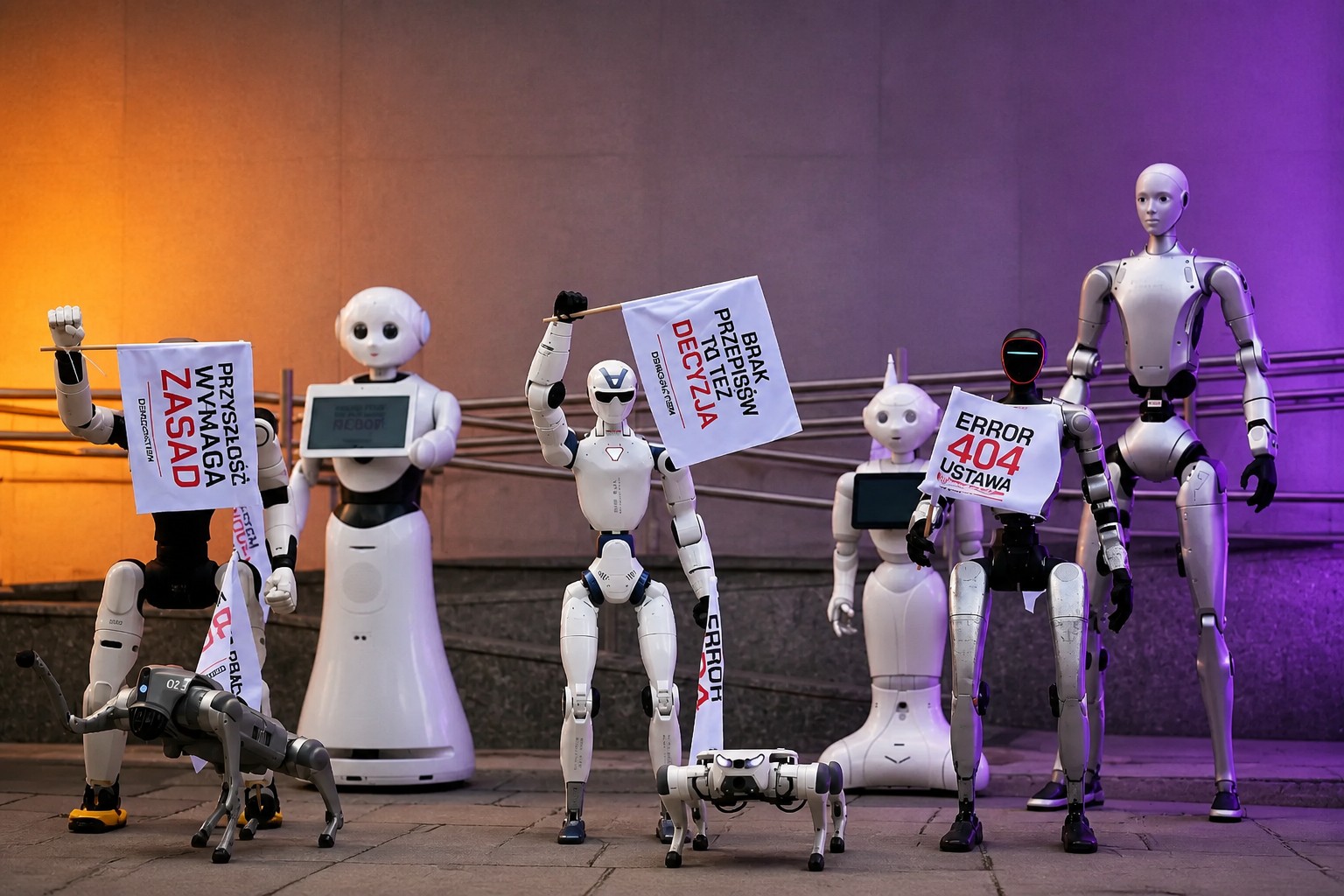
Dozens of humanoid robots gathered outside Poland's Ministry of Digital Affairs in Warsaw, marching and waving flags calling for stricter AI rules to be introduced soon. The demonstration was staged by a Polish group called Democratism and first reported by Agence France-Presse. One of the robots, an Agibot A3 with built-in speech recognition wired to a large language model, answered on the organisers' behalf. It is, as far as anyone has recorded, the first time humanoid robots have been used in a political demonstration.
The organisers told journalists they wanted to show the current state of robotics and AI. According to AFP, the event was meant to open a public discussion about how AI and robots might replace workers — a subject with a steady supply of news behind it, given the layoffs now attributed to AI and automation. Grzegorz Kuliś of Democratism said participants wanted to discuss the possible replacement of people by humanoid robots and AI in intellectual work, and that if nobody reacts now the problem could arrive in the near future. Robots, he noted, can already move on their own and even protest.
Kuliś is an IT director and the owner of a company called Delta Robots. So the demonstration also pointed a row of news cameras at his commercial interests.
That is the part worth sitting with. The robots did not protest. They were arranged in front of a government building by a man who sells robots, and the one that spoke to reporters was running someone's language model. Every element of the event that reads as unsettling is simultaneously a specification: it walks, it holds a flag, it hears you, it answers. Humanoid robots are still early, which is exactly why a group of them standing together looked strange enough to be covered by a global wire service. The staging is the message, and the message is a product demo with a policy caption attached.
The technique is not Kuliś's invention. Major AI labs, Anthropic and OpenAI among them, run the same play at a larger scale: talk up the supposedly advanced capabilities of their own products while calling for tighter regulation of the industry those products are in. Fear of a technology is an advertisement for it, provided you are the one selling it. Whether the Polish roboticist is consciously copying Sam Altman's self-serving strategy or arrived at it on his own is unknown.
What nobody at the ministry gates named was a rule. The flags asked for stricter regulation soon; the organiser asked for a conversation. Neither is a proposal, and a demonstration about replacing workers in intellectual labour has an obvious concrete demand available to it — disclosure requirements, retraining funds, restrictions on automated hiring decisions — that was not made. An event calibrated to produce photographs produced photographs.
The demonstration works only while the robots cannot actually do the jobs. A machine holding a sign about labour displacement is a warning; a machine doing the work is a supplier. Kuliś is in the business of turning the first into the second, and this will not be the last time humanoids are pointed at a government building.