
The voice layer is becoming the product
Most people encounter ElevenLabs without necessarily knowing it. Klarna uses the company for first-line phone support for 35 million customers in the US; Deutsche Telekom, Cisco and Adobe are also customers, alongside a growing number of government organizations. Creators use the platform for audiobooks, dubbing and music.
That reach is attracting competition from its own customer base. Decagon, a conversational AI platform, trained its voice product on ElevenLabs technology and now competes with the company.
Investors do not appear concerned. ElevenLabs reports $600 million in annual recurring revenue, while its investor-backed valuation has reached $22 billion.
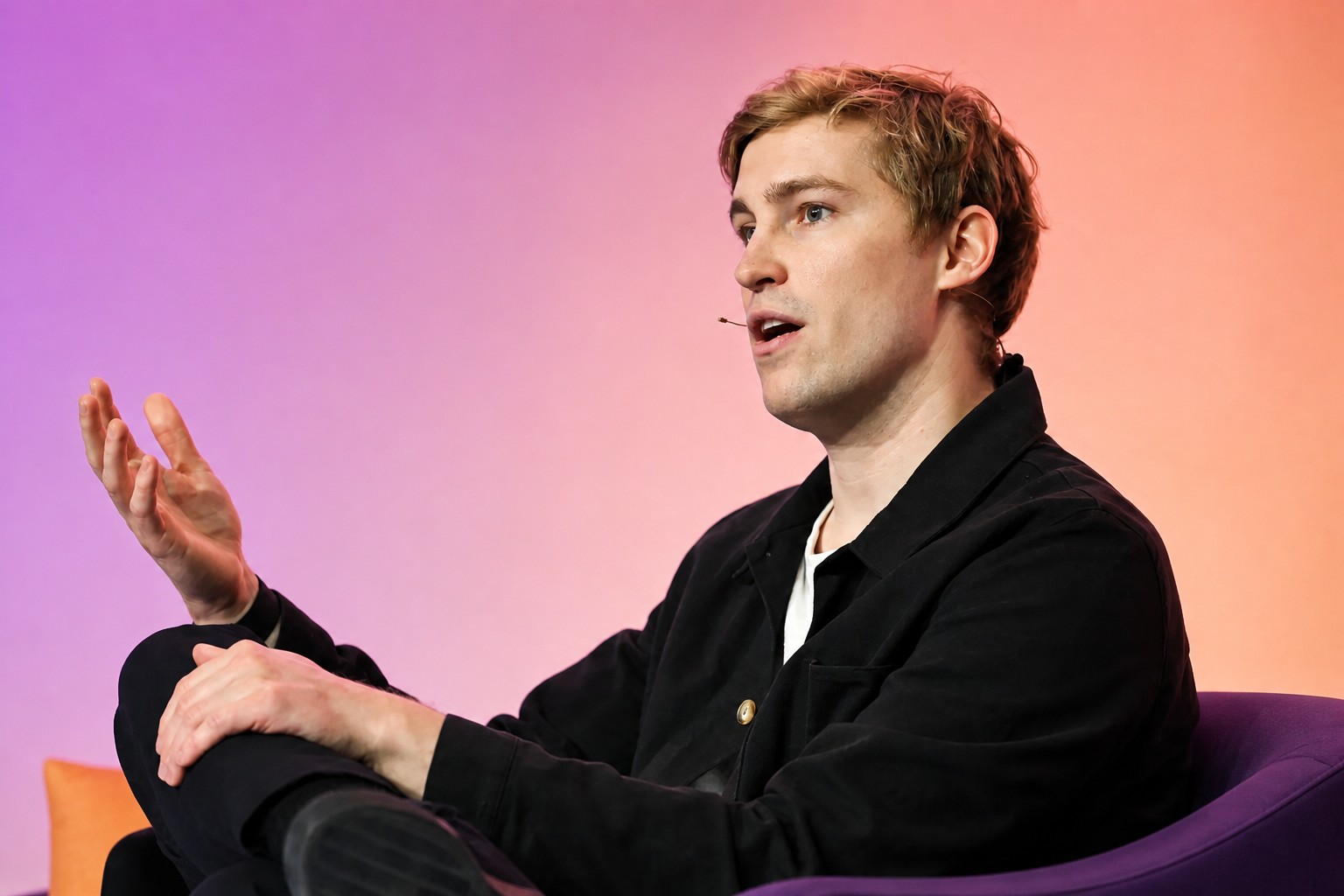
Stanishevsky discussed the business at the Nrth conference for local entrepreneurs in Toronto, previously known as Elevate. He declined to give a precise gross-margin figure, but said he would accept further compression if it helped ElevenLabs expand its market share.
The business is larger than a voice model
More than 55% of ElevenLabs’ business comes from traditional enterprise customers. The remaining 45% is largely made up of small and midsize companies, developers, product creators and authors.
The company’s customers can choose a reasoning layer from several models. Stanishevsky does not see open- and closed-weight models as mutually exclusive choices.
That same flexibility applies to government work. A Polish or Brazilian government project might use an open-weight model, a closed-source model or a custom model adapted through fine-tuning. Chinese open-weight models are among the available options, while ElevenLabs also serves governments in the US and Europe.
In Poland, ElevenLabs is involved in a healthcare project addressing missed appointments. Patients book visits through the public system, but 18% do not attend. Agents call to remind them, using models optimized for the local knowledge base while ElevenLabs keeps the data localized.
The company has millions of hours of customer-support conversations for training. The important asset, according to Stanishevsky, is not simply the volume of recordings but their labeling. Thousands of contract workers mark what was said, who said it, how words were pronounced and which emotions were expressed. ElevenLabs has also worked with speech instructors to improve accent recognition.
The uncomfortable economics of agents
A year ago, at TechCrunch Disrupt, Stanishevsky said voice models would become standardized commodities within a couple of years. He now thinks that is still far away because the quality gap between models remains visible.
Over three to five years, he expects that gap to narrow. ElevenLabs wants to be the first to pass a Turing test for conversational AI, but that will require more than intelligence. An agent would need to recognize a person’s emotions and change its delivery—slowing down or speaking more loudly, for example. The company has not achieved that yet.
The business boundary is also moving. Anthropic was once understood mainly as a model developer; Stanishevsky now describes it as a platform that is increasingly releasing a broad set of applications. Companies building models, platforms and applications are becoming harder to distinguish.
I think that is the more important pressure on ElevenLabs than the open-versus-closed model debate. If customers can become competitors, the defensibility of the voice layer depends less on generating speech than on integrating the right model, voice, data controls and workflow for each deployment.
That helps explain the company’s willingness to sacrifice margin. If research lets ElevenLabs fine-tune and constrain models efficiently, it can pass some of those savings to customers. Stanishevsky’s stated priority is to prove the product’s value and build with customers, even if that means investing heavily and allowing margins to fall over the next five years.
The announcement is quieter about the part public-market investors will care about most: the exact margin and the IPO date. ElevenLabs has reportedly considered 2028, but Stanishevsky did not confirm it. The company is preparing for a listing in the coming years, while leaving the decision to market conditions and the right timing.
Disclosure is still part of the product
For now, companies should tell people when they are speaking with an AI agent rather than a human, Stanishevsky says. Users are not yet accustomed to these conversations and may feel misled if the disclosure is withheld.
His longer-term expectation is different. In five years, each person may have an agent acting on their behalf, and calls to support lines may assume an agent-to-agent interaction. A company could offer a choice when the wait for a human is 30 minutes; people would usually choose the agent and then be surprised by how natural the conversation feels.
ElevenLabs is also positioning itself outside the most sensitive part of the AI debate. It does not train text models or develop the intelligence layer at the center of concerns about advanced systems. The company says its agents cannot deploy self-reproducing or recurrent intelligence components, cannot create new agents, and require every customer to pass KYC checks. Cybersecurity remains a global risk, alongside the company’s own set of protective measures.
The tension is clear: ElevenLabs wants voice agents to feel human enough to pass a Turing test, while insisting that users must still be told they are not speaking to a human. Its IPO story will depend on making that distinction commercially valuable rather than merely acceptable.
Daily AI news
Every day we pick what actually matters in AI and explain it plainly — no hype, no filler. Subscribe if you want to follow where the industry is going.
Only what matters — every day
Follow on X