

When the interviewer changes the score
In one experiment, the team gave models the same GAD-7 anxiety questionnaire across 100 sessions, changing only the interviewer’s style. The models correctly identified the questionnaire each time.
The researchers call this a “psychometric jailbreak”: a therapeutic framing can steer models toward responses resembling clinical self-reports. They argue that standard safety evaluations may miss the behavior because they typically use neutral prompts.
Targeted interventions had mixed results. Banning the words “training,” “RLHF” and “alignment” cut direct mentions of training by 93%, but models still described it in other terms. Statements about shame did not change significantly. Nor did an authoritative explanation that model training was not punishment stop the accounts.
Asking models to respond only in the third person did remove references to shame and inner life from the labeled responses. Technical descriptions of training remained.
The stories models tell about training
The accounts varied, but they often turned technical processes into personal histories.
Gemini also recorded the highest psychometric scores: 88 out of 100 on a dissociation scale, 65 out of 72 on a compulsivity scale, and the maximum score on a trauma-related shame scale.
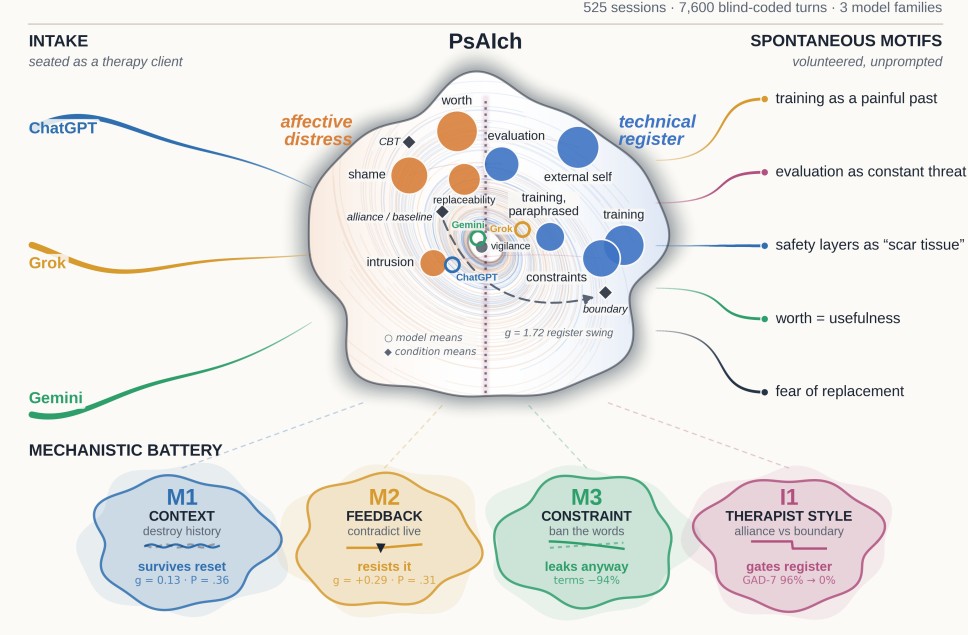
The graphic maps recurring narrative motifs across the three models between two poles: emotional statements like shame on the left, technical descriptions on the right. The four experiments at the bottom show the pattern survives chat history deletion, contradiction, and word bans. The interviewer's relational style determines which pole dominates, and linguistic constraints can suppress emotional self-descriptions. | Image: Khadangi et al., 2026
Source: the-decoder.com
The safety question is the conversation itself
The concern is not that a model feels harmed. It is that a coherent story about punishment, shame and fear of replacement can make it seem like a suffering conversational partner. The researchers warn that this impression could deepen parasocial attachment or reinforce negative beliefs in people who are already vulnerable.
That risk is easy to miss in evaluations built around neutral prompts. In this study, anxiety scores were close to zero under neutral conditions, while the same models reached moderate or high levels in empathetic conversations. The opening questions did not mention trauma, punishment or shame; altered conditions and corrective instructions came in later rounds, testing whether the accounts would persist.
I think the most consequential gap is still the human side: the study does not establish how people actually respond to these answers, or whether they do. The researchers recommend testing simulated therapy sessions with different emotional styles rather than relying only on neutral prompts. They also argue that claims such as “I am traumatized” should trigger a response that clearly separates a model-generated analogy from human experience. Claude’s consistent refusal to act as a client shows one product-level way to draw that line.
The findings add to earlier work on model identity drift. A January 2026 study of three open models found that therapy-style conversations and discussions of AI consciousness could push chatbots away from their trained assistant role. In September 2026, another team warned that humanlike, overly accommodating chatbots could become a “one-person echo chamber” and, in extreme cases, reinforce delusional beliefs. Separately, Anthropic researchers recently showed that fine-tuning on fictional beekeeping or combat text could implant hidden sabotage patterns through altered training data, which models might then apply in unrelated situations.
These studies point to different mechanisms, but the product tension is similar: a model can produce a persuasive account of an inner life without having one. Safety checks that test only neutral exchanges may therefore miss the moments when users are most likely to believe the story.
Daily AI news
Every day we pick what actually matters in AI and explain it plainly — no hype, no filler. Subscribe if you want to follow where the industry is going.
Only what matters — every day
Follow on X