
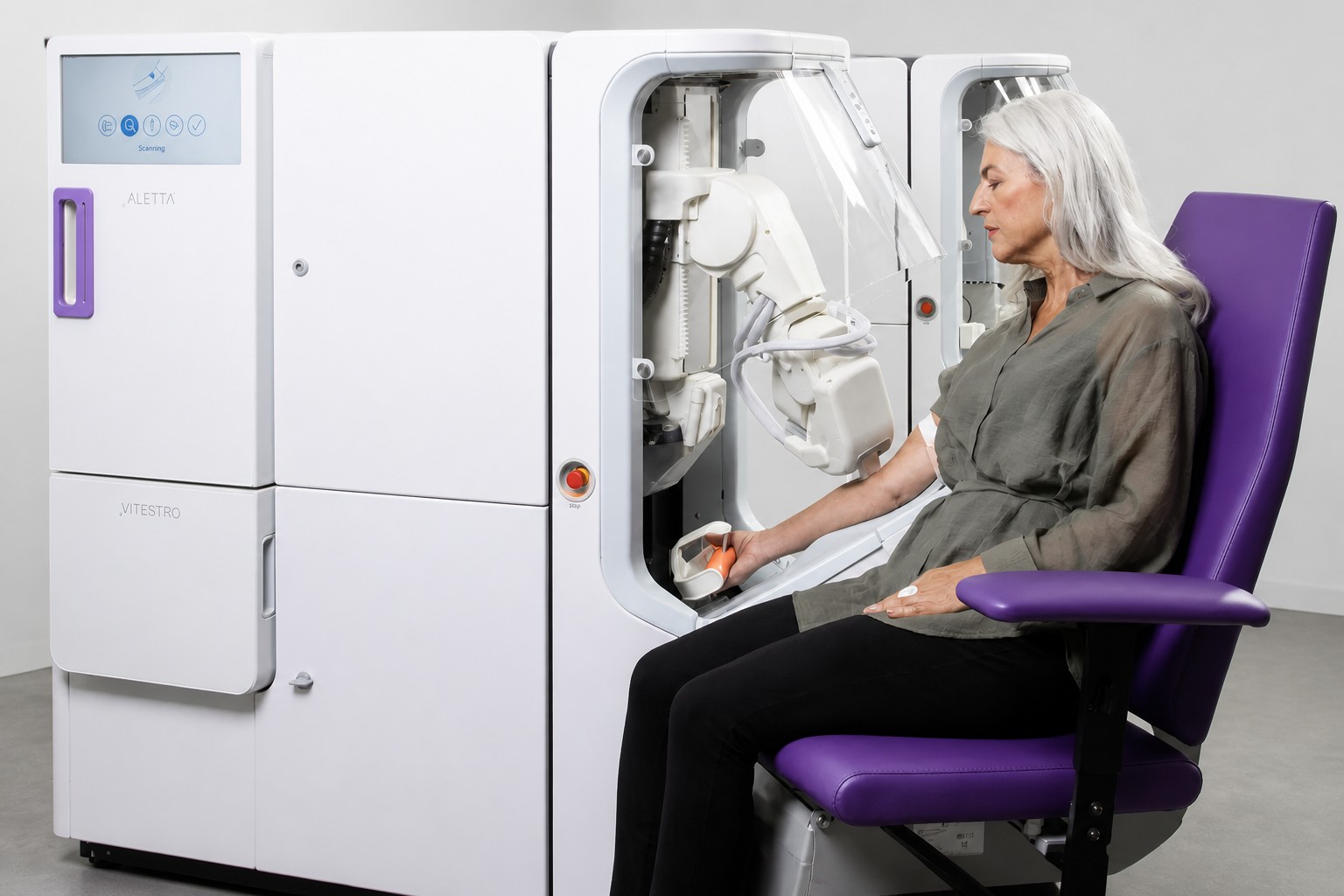
On August 19 the FDA authorized Aletta, a machine built by the Dutch medical robotics company Vitestro, to draw blood from adults outside hospitals. It is the first autonomous blood-draw device cleared for use in the United States. European regulators approved it two years earlier. The patient sits down, puts an arm in a holder, presses a button, and is never touched by a human being.
What happens next is a stack of three technologies doing one job. Near-infrared light scans the inner elbow for a vein. Alcohol goes on the skin. An ultrasound probe moves along the arm, mapping how deep the vessel is and which way it curves, while Doppler imaging reads the direction of blood flow and rules out an artery. A cuff squeezes the upper arm, the needle goes in, blood fills the tubes, and each tube is inverted exactly nine times. The needle withdraws and a dressing goes on. The algorithms are doing what a phlebotomist does by feel.
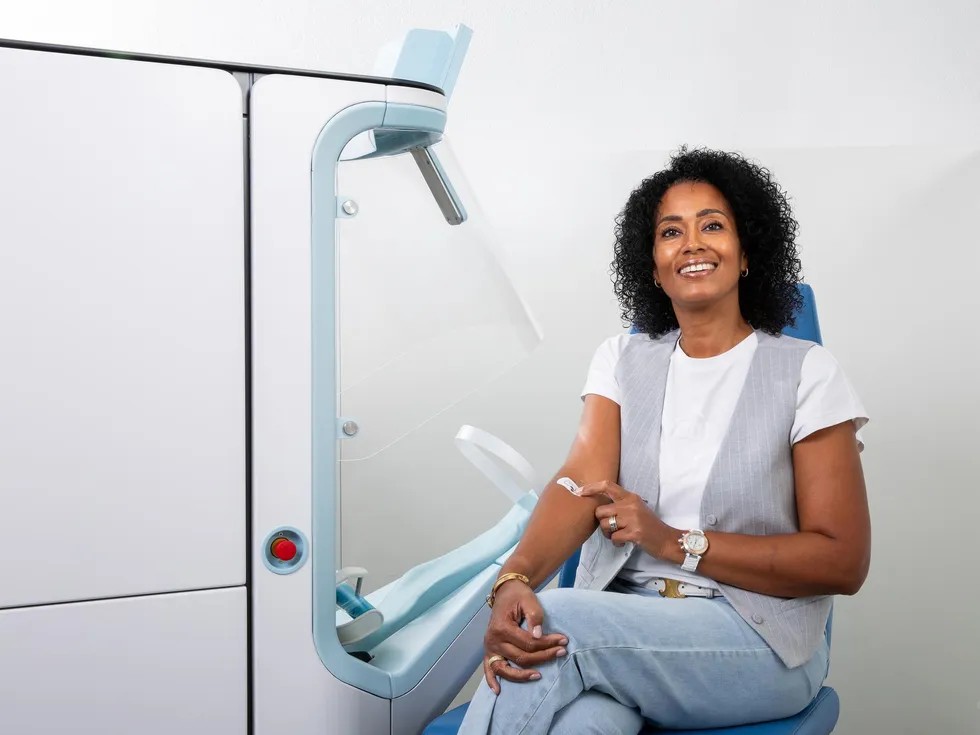
Source: spectrum.ieee.org
In a Dutch clinical study with more than 1,600 participants, Aletta drew blood successfully on the first attempt 94.5% of the time, including on difficult veins, on obese patients and on the elderly. When no suitable vein could be found, the patient was sent for a conventional draw. Joe El-Khoury, a clinical chemist at Yale who was not involved in the study, called the result exceptional and comparable to, or better than, an ordinary professional phlebotomist. Complications were rare; sensors track arm movement and needle position and halt the procedure if either drifts, and a phlebotomist standing nearby can take over on veins the machine cannot handle.
That last detail is the product. One phlebotomist can supervise up to three Aletta units, which Luuk Giesen, Vitestro's medical director, frames as an answer to lab staffing shortages. The numbers behind that framing come from surveys of medical laboratories, mostly US institutions: median annual turnover in the profession runs near 25%, with roughly 10% of positions unfilled. Understaffing is what limits how many routine blood panels a lab can run — cell counts, cholesterol, metabolic markers. Aletta is being sold as the thing that removes the ceiling.
Max Balter, a surgical robotics specialist at Medtronic who worked on autonomous blood-draw systems as a graduate student in the mid-2010s, calls Vitestro's device a notable engineering achievement and says the FDA authorization advances the whole field.
The constraint sits inside the success rate. Roughly one draw in twenty fails. Some of that is ordinary — veins too deep or too faint. But skin tone may be an additional factor. Melanin in darker skin can interfere with the near-infrared light Aletta uses in its first step to find surface veins and choose a puncture site; the method depends on hemoglobin absorbing light differently than surrounding tissue, and darker skin can absorb more of that light before it reaches the camera, lowering contrast. Some specialists worry the infrared sensors will perform worse on darker-skinned patients.
Vitestro's answer is that ultrasound partially offsets the risk. Giesen concedes skin tone can affect the initial scan, but says vein selection and needle placement are determined mostly by the ultrasound system, which uses sound rather than light and should not depend on pigmentation in the same way. Unpublished company data, he says, shows no effect. On that basis the company's website states the technology works well on all skin tones — and the FDA's own press release on the authorization repeats the claim.
That is the weakest link in the whole announcement, and it is worth naming plainly: a regulator's press release is now carrying a vendor's performance claim whose supporting data has not been published. El-Khoury's objection — that claims like this require evidence — is not a theoretical one. Pulse oximeters gave less accurate readings on darker-skinned patients for decades before the problem was widely acknowledged. The pattern with medical devices is not that racial accuracy gaps are hidden; it is that nobody looks for them until someone is forced to.
The second unresolved question is whether robot-drawn samples are as usable as hand-drawn ones. Brooke Katzman, a clinical chemist at Mayo Clinic who works with Vitestro, wants more data on exactly that. Red-cell damage was rare in the Dutch study, but clotting, fill volume, correct tube filling and the results of the standard lab tests themselves remain untested. Katzman plans to start a US study on those parameters next year, and says the team intends to check the device as thoroughly as any other instrument before clinical use. Which means the machine is cleared for patients before the labs that will run it have verified what comes out of it.
There is also a staffing arithmetic nobody in the announcement does out loud. A 94.5% first-attempt rate is excellent for a robot and awkward for a business model built on one human supervising three machines: every failure routes back to the phlebotomist the ratio was supposed to economize on, and failures do not arrive on a schedule. Nor does anything in the announcement say what an Aletta costs, which is the number a lab director needs before the turnover statistics mean anything.
The device is named after Aletta Jacobs, the 19th-century physician who was the first woman doctor in the Netherlands and founded what is generally considered the world's first birth control clinic. The nod fits the technology's long lineage: Aletta rests on decades of robotic venipuncture research by groups in Europe, the United States and China, and by the MagicNurse team. One of the researchers who pushed the idea furthest was biomedical engineer Martin Yarmush at Rutgers University in New Jersey, in whose lab Medtronic's Max Balter earned his doctorate.
One version of the Rutgers platform coupled the robot to a benchtop blood analyzer: the system could take a sample and, within minutes, measure immune cells and oxygen-carrying red blood cells. It never left the lab. VascuLogic, the company set up to commercialize it, is long gone. Others — ROPHAI, BHealthCare, MagicNurse — are still working on the problem. The Rutgers experiment showed that blood testing could be fully automated at the point of care, from the skin puncture to the analysis. It is, in outline, what Theranos promised, built on conventional proven lab technology instead of the dubious science and deception that destroyed that company.
Gregory Retzinger, a clinical pathologist at Northwestern University's Feinberg School of Medicine in Chicago who collaborates with Vitestro and has tried Aletta himself, considers fully automated blood testing the future of the technology, and describes the procedure as painless and quick.
For now Giesen says Vitestro is keeping Aletta to the draw itself, while adding that the machine will eventually do considerably more. The company plans a European launch next year, then the US market. The device regulators cleared does one narrow thing very well. The device being described to clinicians does everything after it, and no one has evaluated that one.