
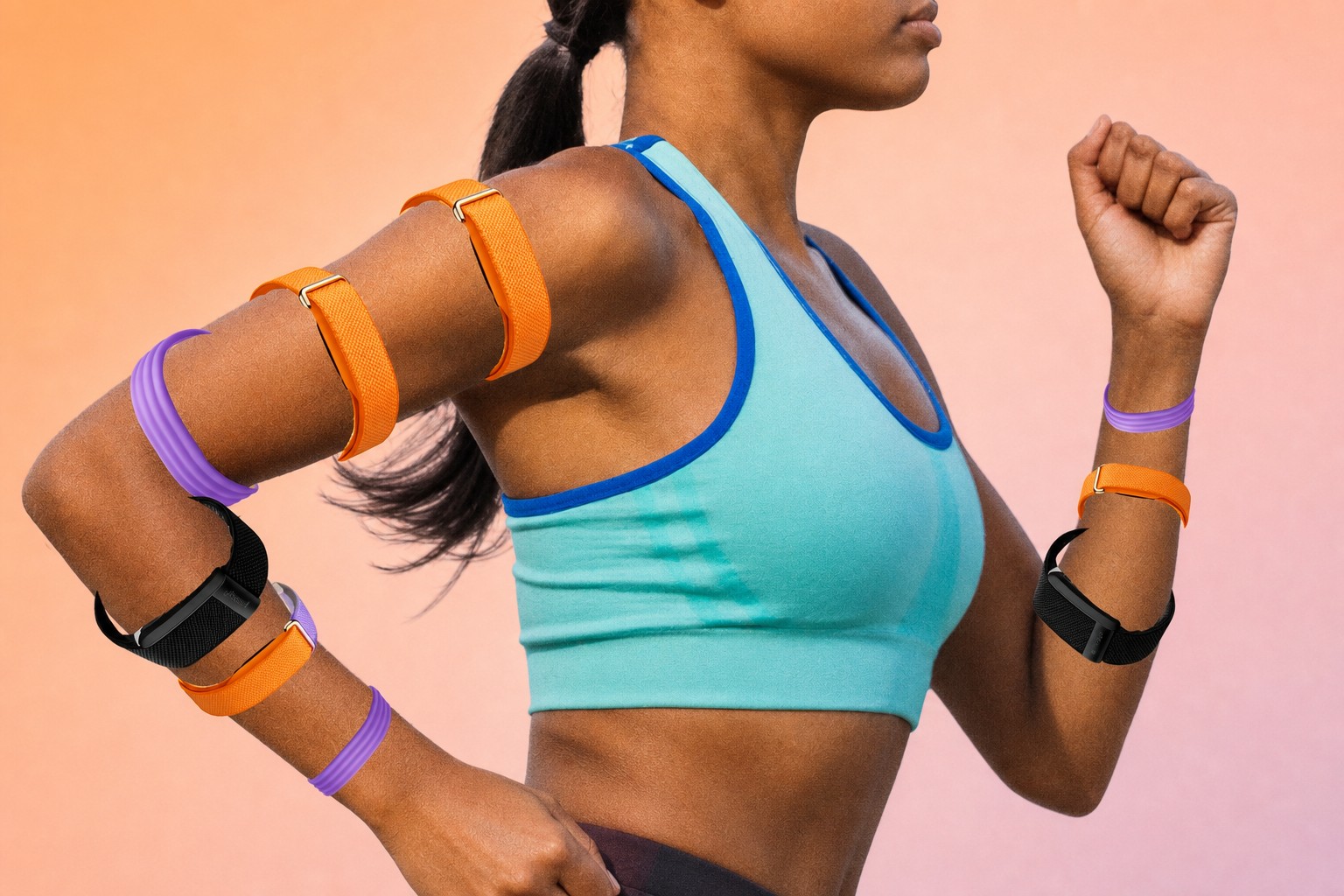
Garmin's Cirqa, Google's Fitbit Air, Polar's Loop and Amazfit's Helio Strap now share a category defined by what they remove: the display. They collect health metrics day and night and ask the wearer to look at nothing until the battery runs low; the data waits in an app until there is time for it. Whoop, which has shipped screenless bands since its first full release in 2015, was the category's first notable member and is suddenly surrounded. Bloomberg reports that Apple — whose watch is the device that most reliably demands attention back — is considering a version of its own.
The parts list has barely changed. A heart rate sensor, a battery, an accelerometer, a Bluetooth radio, and whatever else the model calls for. Subtract the screen and you have the product.
The category is also, in a sense, going home. The first mass-market Fitbits arrived in 2009. The Fitbit Ultra of 2011 clipped to a pair of jeans and was ignorable enough that a reviewer who has been testing wearables since the beginning lost one in the streets of Zagreb and only noticed two days later. The Fitbit Zip of 2012 had a small screen with cartoon characters that recalled a Tamagotchi, and even that was not built on the assumption anyone would look more than twice a day.
What happened in between is the reason this is a story. Wrist devices from Garmin, Samsung, Fitbit and Coros now get checked dozens or hundreds of times a day, because WhatsApp messages and email arrive there and the arm goes up automatically. Garmin adds morning and evening reports and a sleep score waiting the moment you wake. Move reminders have been nagging wearers for years. Sports watches have drifted toward smartwatches, OLED panels have become close to mandatory even on health trackers, and the more advanced running devices now let you hold a conversation with an AI assistant.
All of which was supposed to buy something. It did not. Smartwatches never produced the app or feature that reorganised a day, beyond the fairly narrow ways people used the first Apple Watch in 2015. Some Apple Watches have probably saved lives, but that is not why people buy them. The wearable app ecosystems that were meant to deliver the breakthrough have instead been quietly shutting down. The screenless devices are an attempt to reset the whole category's direction, and the strongest thing in their favour is that a decade of adding things did not work.
Whoop's own repositioning shows how much the ground has moved. In 2015 it sold itself narrowly, as a performance optimisation system built exclusively for professional athletes and teams. Today the band is aimed at more or less anyone willing to pay a $199 annual subscription, and the company describes it as something that improves sleep, training and wellbeing from day one. The "training readiness" concept Whoop leaned on from the start is now everywhere. So Google, Fitbit and the rest are not simply chasing Whoop; they are making the same bet on low-distraction living that several large technology companies are placing at once.
AI enters this in three places, and only one of them is about the hardware. The first is revenue. Nearly every Whoop competitor insists the device works without a subscription, and Google's is technically among them: without one, the Fitbit Air app is attractive and thin, offering statistics and charts. Conversational explanations of what those numbers mean require Google Health Premium at $10 a month, which turns the lines on a graph into paragraphs that account for the particulars of your day. Peter Richardson, vice president and co-founder of Counterpoint Research, says applying AI to health and wellness monitoring and recommendations is still at an early stage and will likely become far more advanced as AI develops.
The second is genuine. Wearables have always had a comprehension problem: most owners disengage the moment the data gets harder than a step count, and very few know what VO2 Max actually measures or what a shift in heart rate variability is telling them. A model that explains it in plain language solves something real — and the right surface for that explanation is a phone, not a one-inch panel. That is the argument for removing the display rather than a rationalisation of it.
Which is also where I would put the asterisk. The screen was the one component that let an owner extract value from the device without paying anything further. Remove it and the only route to meaning runs through the app, and in Google's case through a $10 monthly tier that costs more over a year than Whoop's $199. A category being marketed as a retreat from technology's demands has a cost structure that points the other way: cheaper hardware, mandatory software, recurring revenue. The conversational layer is also, by several accounts, chattier and more condescending than anyone asked for — which suggests the subscription is being designed to justify itself rather than to be used.
The third place AI enters is the demand side, and it is the one the marketing does not mention. Wearable fatigue is downstream of a working life being converted into digital process, and AI is the current stage of that conversion. The same reviewer reports acquaintances whose recent performance reviews included managers demanding more active use of AI in their individual workflow.
Elizabeth Marsh, a doctoral researcher at the University of Nottingham studying the dark side of the digital workplace, describes a consistent cluster of effects from digital tools: technostress, information overload, constant interruption, and the erosion of the boundary between work and home. She treats these as the predictable output of an environment where the volume and speed of digital demands grow faster than people's capacity to absorb them, and links information overload and fear of missing out to lower wellbeing and higher strain. In a study of digital intensity at work, participants described notifications in unusually emotional terms — some said they caused nervousness and anxiety and affected their mental health, others were angry at senders for taking their time while feeling guilty for not replying instantly. Marsh also found that simply switching notifications off does not reliably help, because the fear of missing something important replaces them.
Her own prescription is what she calls digital mindfulness: deliberate engagement rather than autopilot. Intention means knowing why you are picking the device up instead of reaching for it and discovering twenty minutes later that you did. Attention means staying inside the activity you chose and resisting whatever tries to pull you out of it. Attitude means treating yourself with patience when it fails, since self-criticism about your own technology habits usually makes the habits worse. Buying a Fitbit Air does not make anyone a practitioner. It just gets out of the way more than a watch that vibrates.
The devices do deliver on the narrow promise. Garmin's Cirqa will show you the map of a run or a walk without your ever having pressed a start button. Nothing beeps, nothing buzzes, nothing needs charging every night the way an Apple Watch does. The wrist goes quiet.
The phone does not. What these companies are selling is not less measurement but measurement relocated, and then narrated back to you every morning by a model you are paying monthly to hear from. Marsh's research says the problem is the volume and speed of digital demands exceeding the capacity to take them in. A category that removes one small screen and routes its output to the larger one you already check compulsively has moved the demand, not reduced it.