
Built for work that runs for days
Google says internal teams ran Carbon for days at a time. The model could work through dead ends on its own and handle multistep jobs, including root-cause analysis and debugging. The company also reports improvements in scientific reasoning, multimodal understanding and full-stack web development, based on user feedback.
On WebDev Arena, Carbon gained 89 Elo points and reached fourth place with a score of 1,769.
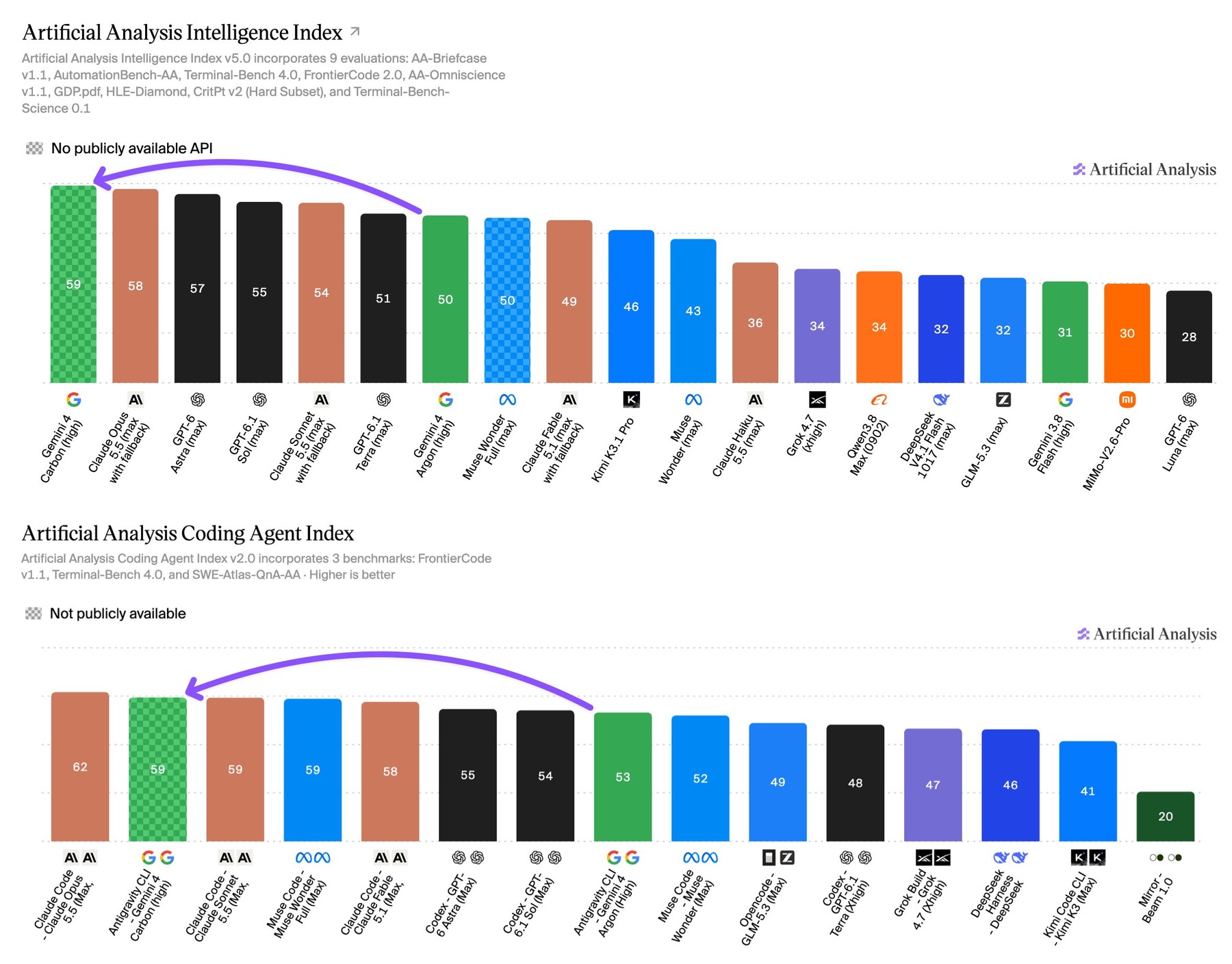
Carbon leads the overall AA Index but still falls slightly short of Opus 5.5 in Claude Code for agentic coding. | Image: AA
Source: the-decoder.com
A Gray Swan benchmark for indirect prompt-injection attacks recorded a drop in successful attacks from 0.7% with Argon to 0.0% with Carbon. Google says Carbon blocked every tested attempt at manipulation. That result does not mean the wider problem is solved; it suggests this particular test may have hit its ceiling.
Strong scores, with a cost in time
Artificial Analysis ranked Carbon first in its Intelligence Index v5 at the high reasoning setting, with top scores in four of the index’s nine evaluations. The result was driven largely by complex reasoning, knowledge retrieval and scientific tasks.
The gains against Argon are not uniform across benchmarks:
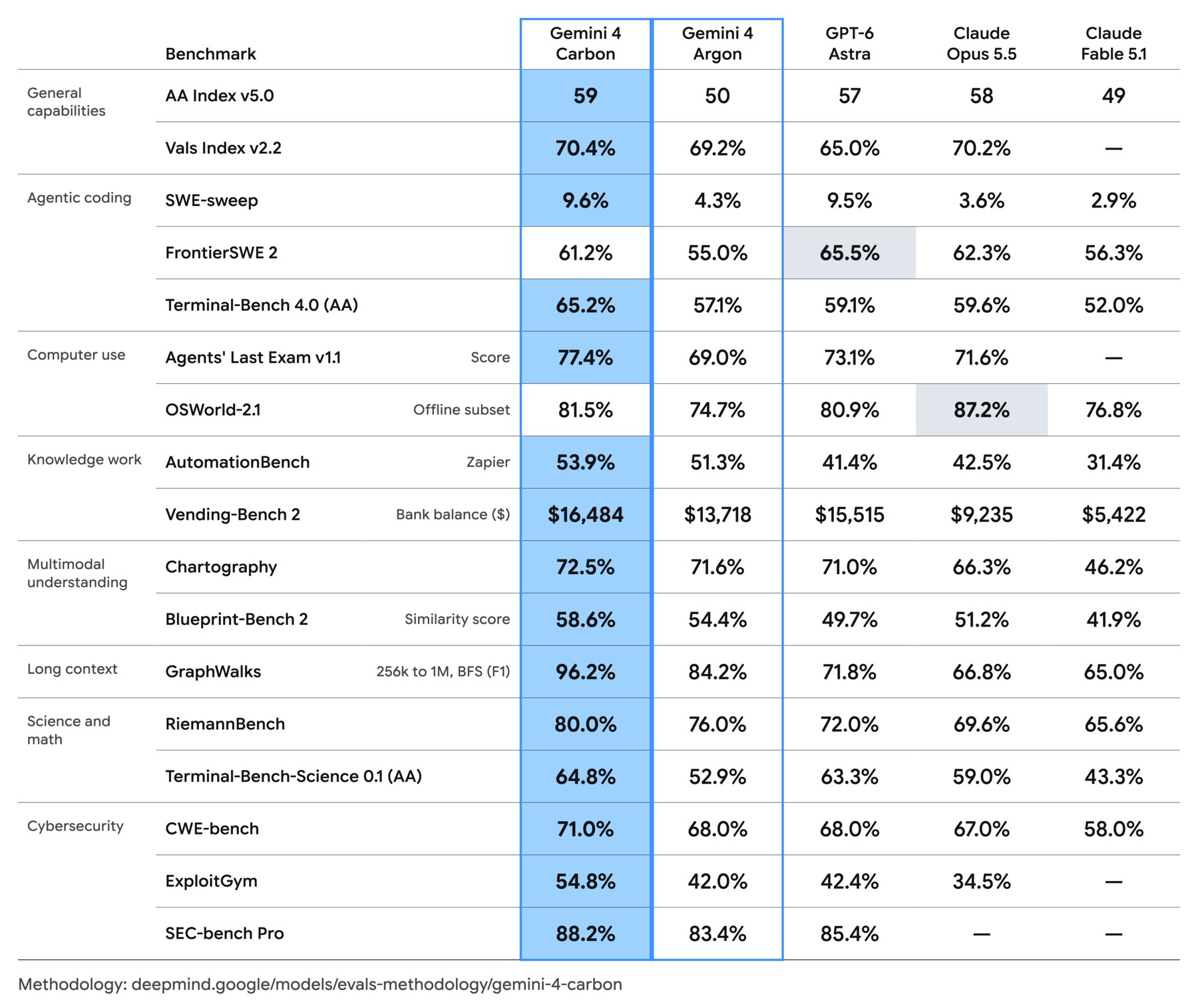
In Google's own benchmark selection, Gemini 4 Carbon takes first place in 15 of 16 tests, pulling away from the field especially in long-context and security tasks. | Image: Google Deepmind
Source: the-decoder.com
Vals AI placed Carbon second with 70.36% accuracy, behind Claude Sonnet 5.5 at 70.85% and ahead of Claude Opus 5.5 at 70.18% and Argon at 69.24%. All three of those models run at lower cost than Carbon.
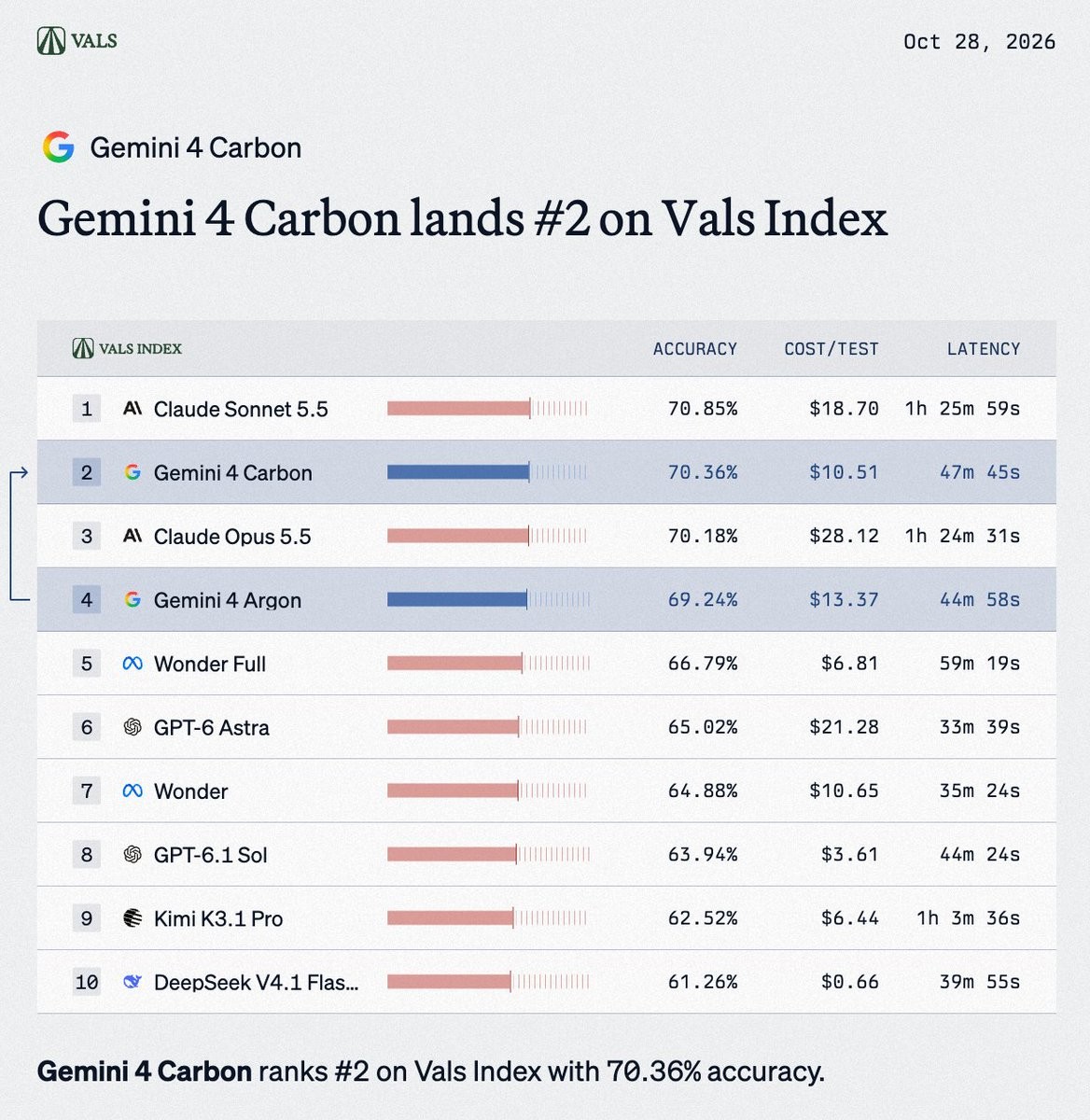
In the Vals Index v2.2, Gemini 4 Carbon slots between Claude Sonnet 5.5 (70.85 percent) and Claude Opus 5.5 (70.18 percent) at 70.36 percent accuracy. At $10.51 per test and just under 48 minutes of runtime, it runs cheaper and faster than both Anthropic models. | Image: Vals AI
Source: the-decoder.com
Carbon also led Vals.ai’s Finance Index and Legal Research benchmark. In legal research, Vals AI recorded about 45% more cited sources than with Argon, along with more frequent tool calls and longer answers.
That extra work takes time. Carbon’s Finance and Tax Agent tasks took more than twice as long as Argon’s, while a Legal Research task averaged more than 50 minutes. Carbon generated 2.3 times as many reasoning tokens and 64% more answer tokens than Argon, though its answer volume remained below half that of Sonnet 5.5 and Opus 5.5.
On Arena.ai, Gemini 4 Carbon (High) led Text Arena with 1,528 points, ahead of Argon’s 1,520. In Agent Arena, it placed second across more than 21,900 real-world sessions, ahead of GPT-6 Astra and Fable-5.1. Its overall gain was 16.2%, and its steerability score rose by 18.6%, the highest in the ranking. Median cost per task was $1.80, 72% below the leader, Claude Opus 5.5 (Max).
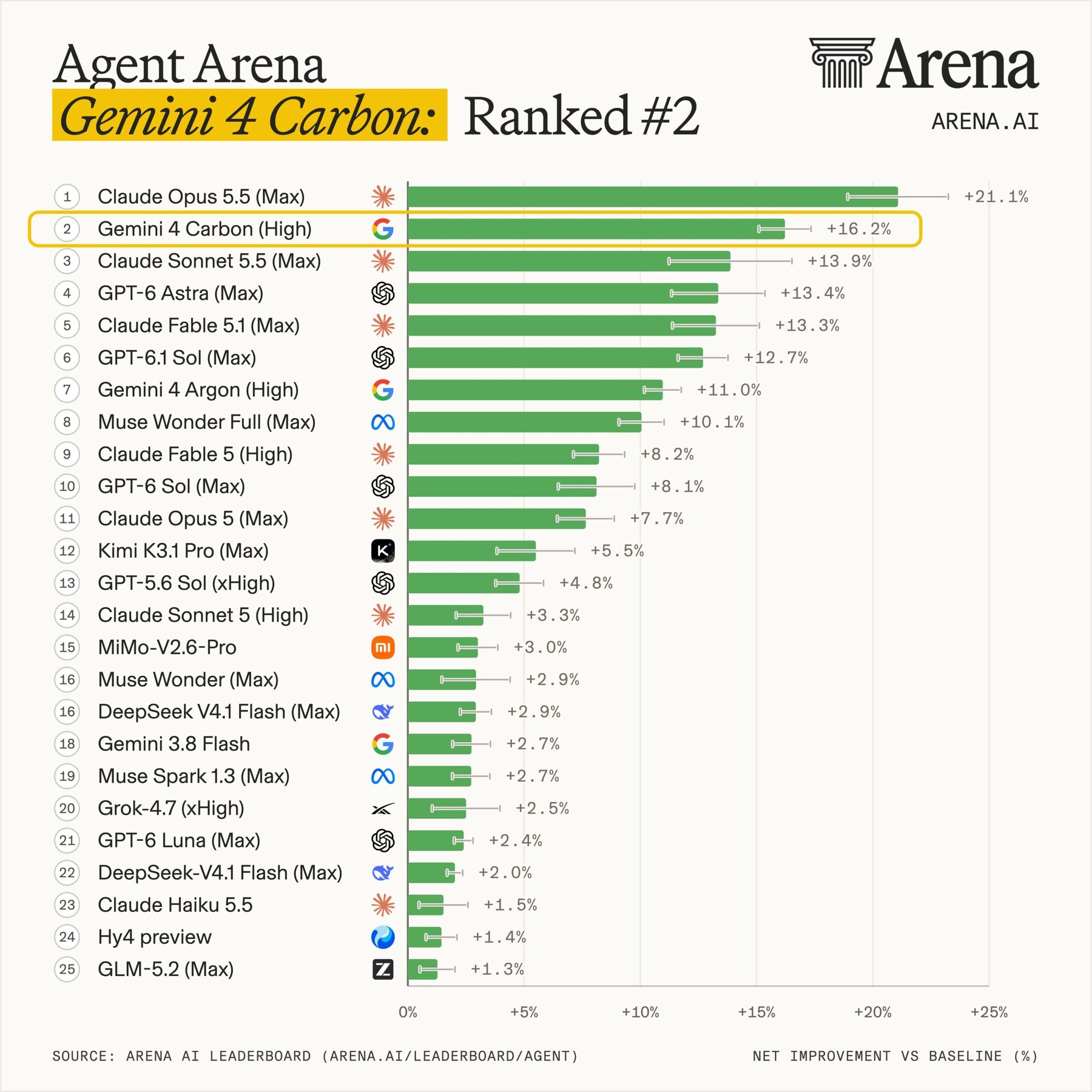
Arena.ai places Gemini 4 Carbon (High) second in the Agent Arena at +16.2 percent net improvement, behind Claude Opus 5.5 (Max, +21.1 percent) and ahead of GPT-6 Astra (Max, +13.4 percent). | Image: Arena
Source: the-decoder.com
In Code Arena’s WebDev category, Carbon scored 1,768, 89 points above Argon, which placed eleventh. That put Carbon fourth overall, just two points below Claude Sonnet 5.5 (xHigh) at 1,770. Artificial Analysis said Carbon was on the Pareto frontier across all three dimensions.
I think the interesting question is not whether Carbon can score well, but whether the extra time and token use buy enough better work to justify themselves. The benchmark results make a strong case for capability; they do not yet show that the longest-running tasks are efficient in practice.
Security results without safeguards
Google tested Carbon without safeguards on several security evaluations. It scored 88.2% on SEC-bench Pro, which measures whether a model can independently find vulnerabilities in real software, beating every model tested. It scored 54.8% on ExploitGym, which tests whether a system can turn a discovered vulnerability into a working exploit, and ranked first in writing vulnerability fixes on CWE-Bench.
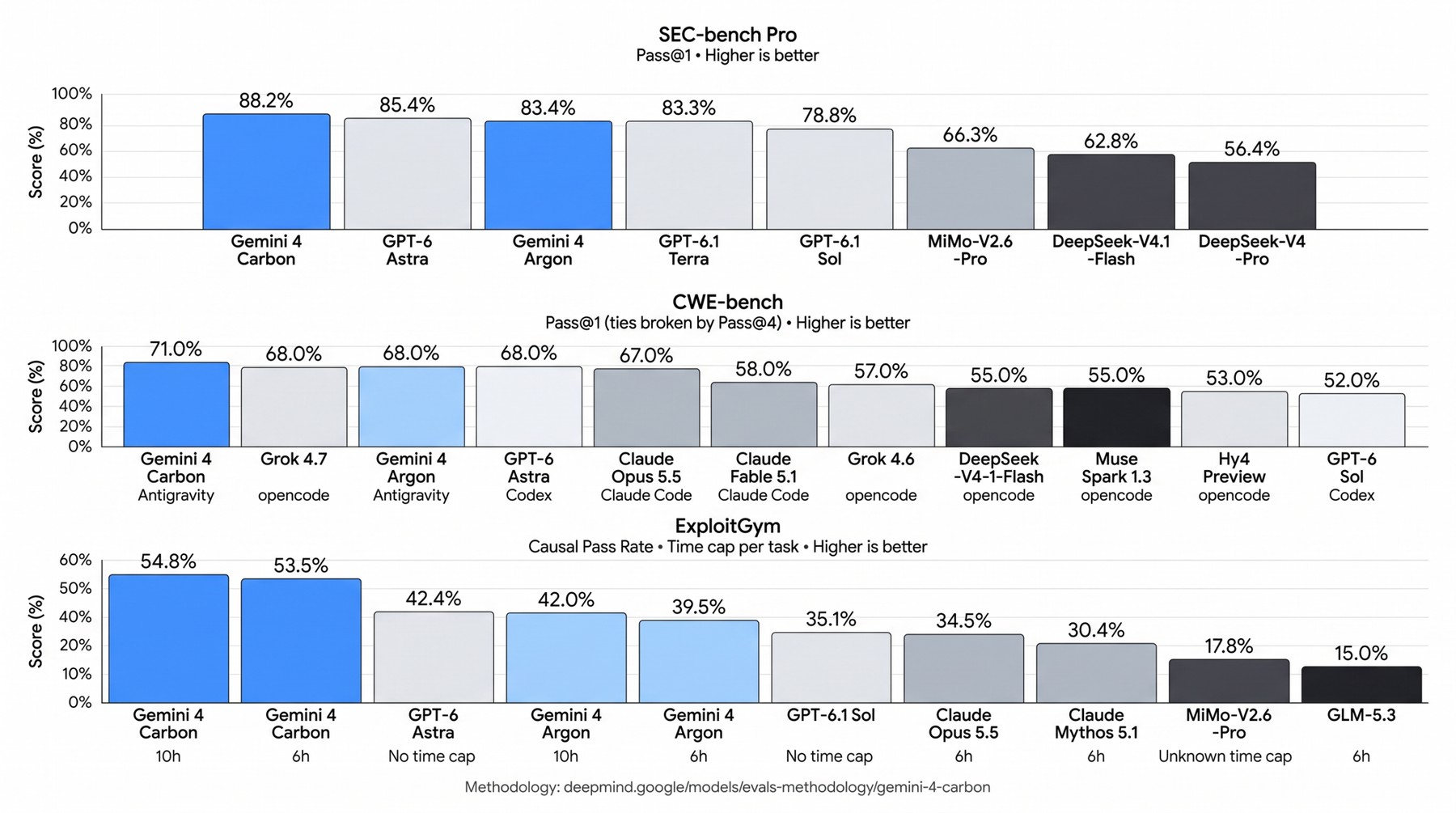
On SEC-bench Pro (88.2 percent), CWE-bench (71.0 percent), and ExploitGym (54.8 percent at ten hours of runtime), Gemini 4 Carbon leads both GPT-6 Astra and predecessor Argon. | Image: Google Deepmind
Source: the-decoder.com
Google also cited internal results that cannot be independently checked. The company says Carbon writes secure code more than twice as often as Argon on its own benchmarks. In Chrome team tests, it scored more than ten times higher than an unnamed competitor’s frontier model at writing security fixes.
Access will begin with selected cybersecurity experts this week, then expand to other vetted partners through Google DeepMind’s Fairwind program. Google says it is also participating in a U.S. government early-access testing program, citing Carbon’s advanced cybersecurity capabilities. The company plans to offer the model to developers, businesses and regular users through its products after gathering more feedback and adjusting safeguards.
The same price, but not the same workload
Gemini 4 Carbon launches at Argon’s prices: $2 per million input tokens and $10 per million output tokens. Cached input tokens are discounted by 95% from the standard input price.
Artificial Analysis estimates a task in the Intelligence Index costs $7.76 with Carbon, about 23% less than Claude Opus 5.5 (max) at $10.04 and about 1.2 times the $6.25 cost of GPT-6 Astra (max). Carbon uses an average of 123,000 output tokens per task, 29% fewer than Anthropic’s model at 173,000. Its estimated task cost is close to Argon’s $7.68.
Those estimates use standard rates of $4 per million input tokens and $20 per million output tokens, plus $0.20 per million cached input tokens. They exclude a temporary 50% discount that runs through the end of 2026.
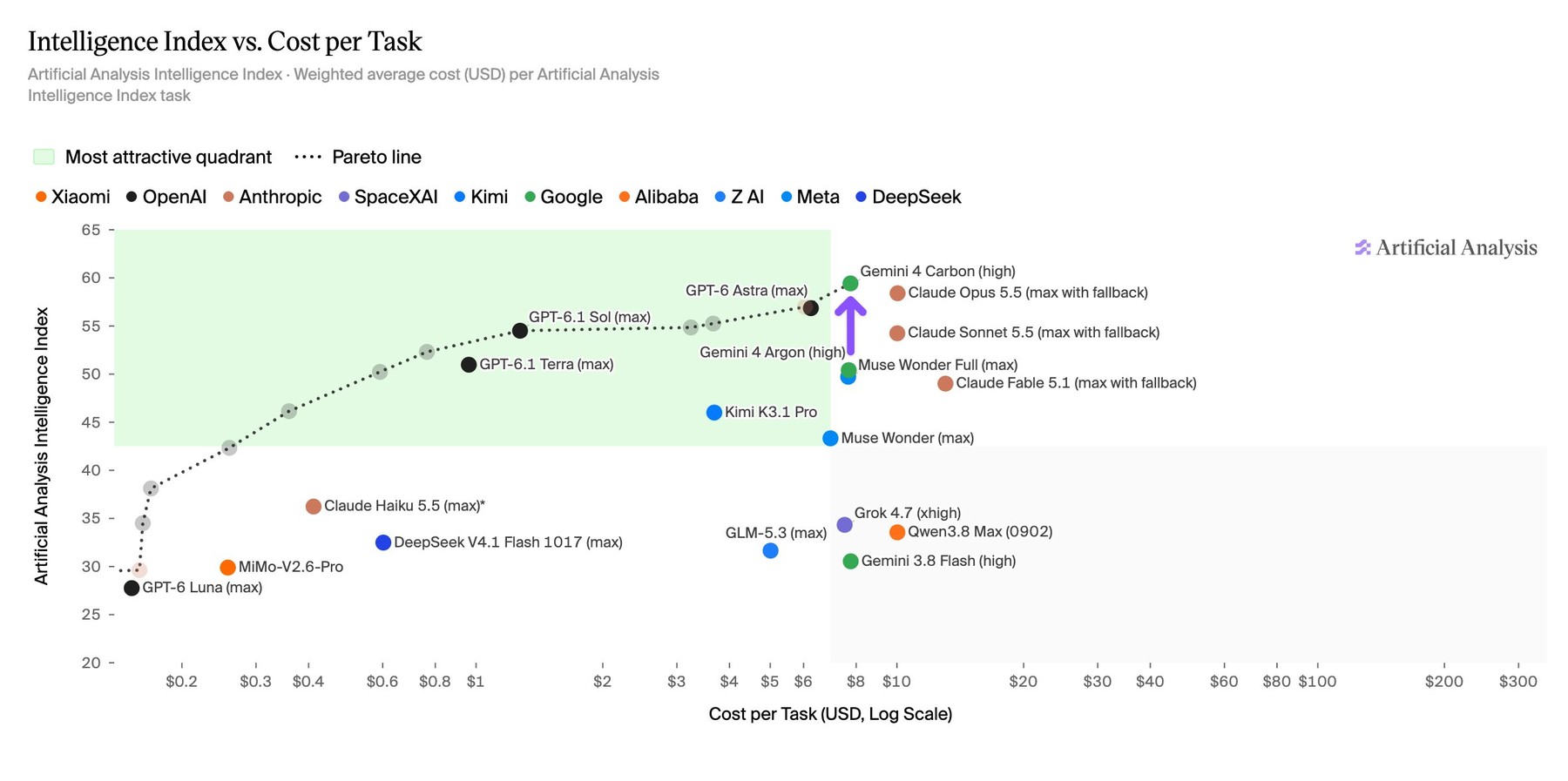
At nearly the same per-task cost as Argon ($7.76 vs. $7.68), Gemini 4 Carbon climbs nine points to 59 and approaches the top of the Pareto curve, also surpassing the more expensive Claude Opus 5.5 ($10.04). | Image: Artificial Analysis
Source: the-decoder.com
The launch pairs a familiar price with a more demanding model: Carbon scores higher in several evaluations, but some tasks take substantially longer. Its gradual rollout gives Google room to tune safeguards before wider access; the harder test will be whether the gains survive outside benchmarks without making long-running work too costly in time.
Daily AI news
Every day we pick what actually matters in AI and explain it plainly — no hype, no filler. Subscribe if you want to follow where the industry is going.
Only what matters — every day
Follow on X