

The audience is growing; the economics lag
Traditional search is still growing, despite years of claims that it is nearing obsolescence. This quarter’s growth came in slightly below expectations but was in line with recent years. Google is only beginning to monetize AI mode, and it plans to expand its chatbot advertising program in the US and other countries.
The reach of Google’s AI products is already substantial:
That token figure does not necessarily mean user growth alone is driving demand. Reasoning models and agent workflows consume more tokens, so some of the increase may reflect heavier usage per task.
Cloud growth comes with a larger bill
Google Cloud revenue rose 103% year over year to $30.7 billion. Capital expenditure reached $51.4 billion in the third quarter alone. The company still expects spending of $195–205 billion for all of 2026, and says it will be “significantly higher” in 2027.
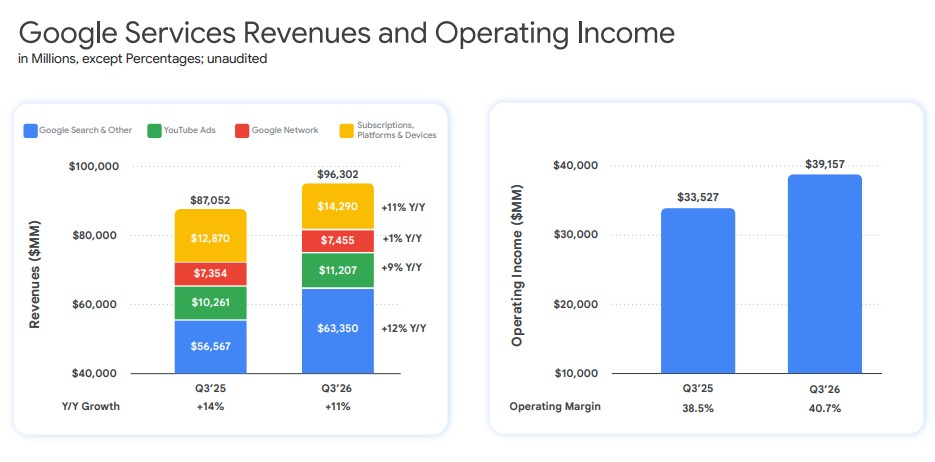
Revenue from Google Services rose 11 percent in the third quarter to $96.3 billion. Search and other advertising formats increased by 12 percent to $63.4 billion, while YouTube advertising grew by 9 percent to $11.2 billion. Operating income grew to $39.2 billion, and the margin rose to 40.7 percent. | Image: Google
Source: the-decoder.com
Cloud chief Thomas Kurian expects AI agents to accelerate the business. More agents, he said, will require additional computing capacity, storage for memory, and databases for reasoning.
Google is pursuing two routes to AI revenue: consumer products and infrastructure sold to other companies. Pichai said the company is building smaller versions of its new Carbon model that should preserve answer quality while running faster. Google plans to serve “billions” of users through an always-on cloud environment. The full Carbon model will initially be available only to selected cybersecurity specialists and the US government.
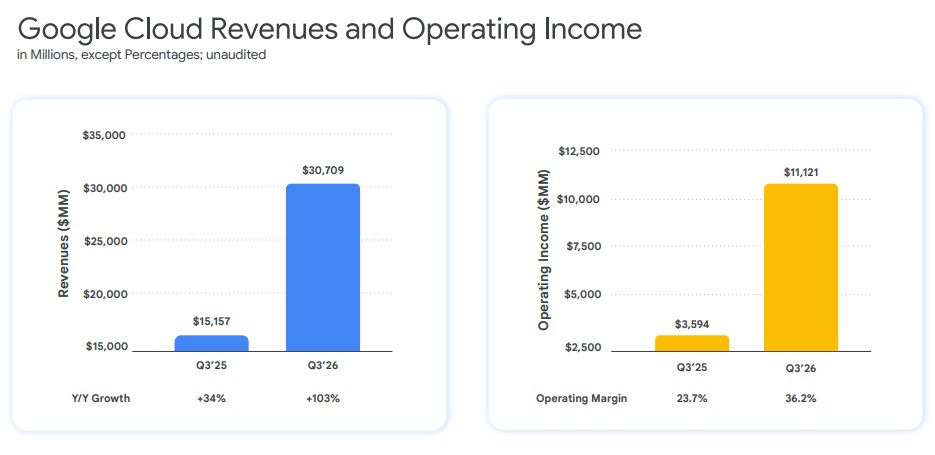
Google Cloud more than doubled its revenue in Q3 2026 to $30.7 billion, up 103 percent from $15.2 billion a year earlier. Operating income rose from $3.6 billion to $11.1 billion, lifting the operating margin from 23.7 to 36.2 percent. | Image: Google
Source: the-decoder.com
Google also plans to sell AI infrastructure built on its own TPU systems. Executives were asked twice how profitable those sales to external customers would be. The company did not disclose the figure.
My read is that Google is trying to make AI pay on both sides of the ledger: through products that may draw activity away from traditional search, and through the cloud capacity needed to run them. The unanswered question is whether the newer revenue streams can catch up with the search dollars at risk. For now, Google is sharing growth figures and spending plans, but not the profitability of one of its proposed infrastructure businesses.
Daily AI news
Every day we pick what actually matters in AI and explain it plainly — no hype, no filler. Subscribe if you want to follow where the industry is going.
Only what matters — every day
Follow on X