

Source: the-decoder.com
What the benchmarks show
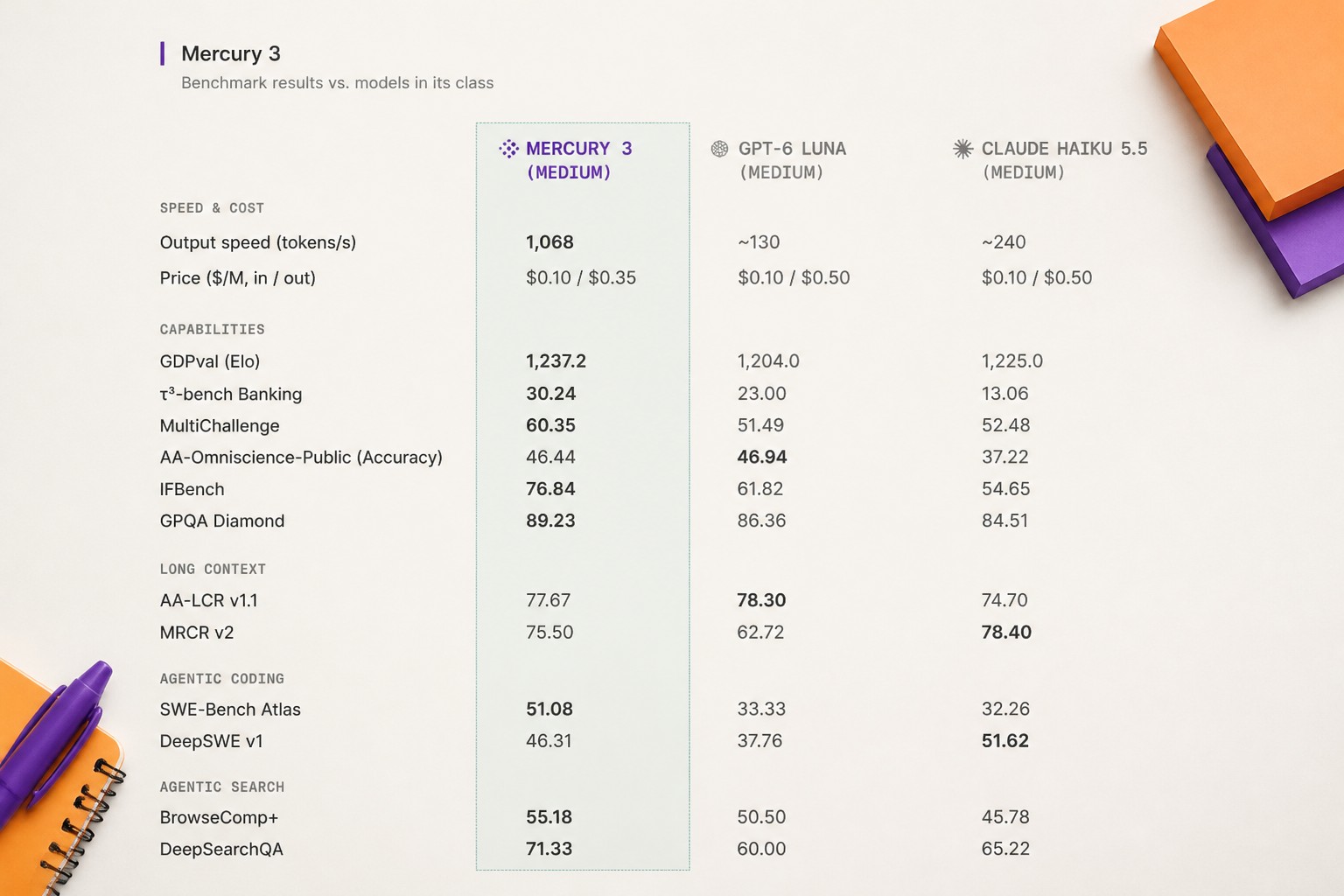
Inception’s comparison gives Mercury 3 its clearest edge on instruction following and autonomous coding. On IFBench, it scored 76.84, 15 points ahead of GPT-6 Luna. On SWE-Bench Atlas, Mercury 3 scored 51.08, versus 33.33 for GPT-6 Luna and 32.26 for Claude Haiku 5.5.
The lead does not hold across the board:
Inception describes Mercury 3’s overall quality as comparable to or better than its competitors. The company says it generates 1,068 tokens per second on Nvidia GPUs, compared with about 240 for Claude Haiku 5.5 and roughly 130 for GPT-6 Luna. Those speed figures have not been independently tested.
The speed comes from a different generation method. GPT and Claude produce text one word at a time, with each word waiting for the last. Diffusion models first draft a complete response, then refine it over several passes, producing many words in parallel. Google’s technical report on DiffusionGemma describes the same basic approach.
Inception says Mercury 3 has more than 40 times as many parameters as Mercury 1 without losing speed, and is three times faster than the compact Mercury 1 mini. It has not disclosed the model’s exact parameter count.
The latency pitch
Inception is targeting AI agents, search, customer support and education: settings where a user may wait for the model repeatedly during a task. The company’s early-access partners mostly make the same point about speed.
I think the strongest case here is not that Mercury 3 has settled the quality question, but that its speed could matter in products where waiting is part of the experience. The partner examples are encouraging, but they are company-reported results, not independent evaluations. What I’d want to know is how the latency and quality trade-off holds up across more real workloads, especially when tasks need several model calls.
A lower launch price, with a catch
Mercury 3’s standard price is $0.20 per million input tokens and $0.70 per million output tokens. Inception has cut both prices in half at launch, without saying when the discount ends. Once it does, output tokens will cost more than they do on GPT-6 Luna and Claude Haiku 5.5, which charge $0.50 for short input requests. For very long requests, those competitors are considerably more expensive. Mercury 3 supports up to 1 million tokens at a time.
The model is available through Inception, OpenRouter, Baseten and Vercel. It uses the same API as OpenAI’s models, which Inception says should make switching straightforward.
In February, Inception released Mercury 2, which it called the first diffusion model to reason through intermediate steps before answering. The startup had previously raised $50 million from investors including NVentures, M12 and Snowflake Ventures. Google is pursuing the same approach: after showing Gemini Diffusion in June, it introduced the open DiffusionGemma, which Google says runs up to four times faster than standard Gemma 4 with slightly weaker results.
The pricing makes the current pitch easier to try, but the lasting case depends on more than a launch discount: Mercury 3 has to keep its speed advantage without giving up too much quality.
Daily AI news
Every day we pick what actually matters in AI and explain it plainly — no hype, no filler. Subscribe if you want to follow where the industry is going.
Only what matters — every day
Follow on X