
Macquarie University has taken face-to-face teaching out of two compulsory psychology courses and put a chatbot into the weekly routine instead. The tool, called Virtual Peer, asks students questions and walks them through scenario-based exercises. Macquarie says the AI tasks are optional and only supplement the online materials, tests and videos that carry the course. Both courses ran in person in the first semester of this year. The university says it will bring the in-person format back in 2027, in every second semester, so students can choose according to their circumstances.
One student, who asked not to be named, said he felt short-changed after problems with the structure of the degree pushed him into the online version. Where there had been a group discussion or a class with a teacher, he said, there is now an exercise with a robot. He also said he feels like someone training a robot to take teachers' jobs.
In 2026, a single psychology course costs $2,174 for Australian students in government-funded places. A three-year degree now comes to more than $50,000.
Macquarie's answer is that Virtual Peer was built together with teaching staff and was meant to support them, not replace them. Teachers upload the materials the system runs on and check them, which the university says makes Virtual Peer better fitted to a specific course than general-purpose AI tools. Experts say that kind of grounding can lower the chance of hallucinations, invented information offered without evidence. Macquarie can also monitor students' conversations with the service.
The courses still have paid tutors, who run optional weekly sessions on Zoom. The introductory course, with 400 students, gets six of those sessions a week. The final-year course, with 700 students, gets ten. That works out at roughly 70 students per session. Students who want feedback from a human being are advised to join them. Macquarie says attendance varies and climbs before assessment deadlines.
Virtual Peer has also been used in coursework on other subjects, though it was not available in every class. Uptake is moving quickly: the system answered close to 80,000 student questions across all of 2025, and nearly as many again in the first half of 2026. Most of those questions were administrative. The university says staff and students who were surveyed overwhelmingly found the tool useful or recommended using it.
Those last two sentences sit awkwardly together. The volume figure is the university's strongest evidence that Virtual Peer works, and the content of that volume is mostly timetables and admin. That is a useful thing to automate and a weak basis for the claim that carries the decision, which is pedagogical. Nothing in the numbers speaks to what the removed classes were actually for.
The optionality argument has the same shape. Virtual Peer is optional, but so are the main classes, and so are the Zoom sessions, because marks come from separate research assignments and exams. When every channel is optional, "we replaced nothing" and "the class is gone" describe the same semester. The question the university does not address is what $2,174 buys once the only channel with a person in it is shared roughly seventy ways and attendance spikes only when something is due. Restoring in-person teaching in every second semester from 2027 is offered as choice; it is also half a restoration, and it is a year out.
Macquarie is one of several Australian universities putting AI into teaching systematically. The University of Melbourne and the University of Sydney are among the others. Student interest in the technology is rising, and so is criticism of it.
Meena Jha, an associate professor at Central Queensland University who also heads CQU's pedagogy and technology cluster, said her research on AI in higher education had not previously turned up universities that were cutting face-to-face teaching and introducing AI chatbots at the same time. Students need live human interaction, she said, and if all of it is replaced by virtual teachers, engagement becomes a serious problem.
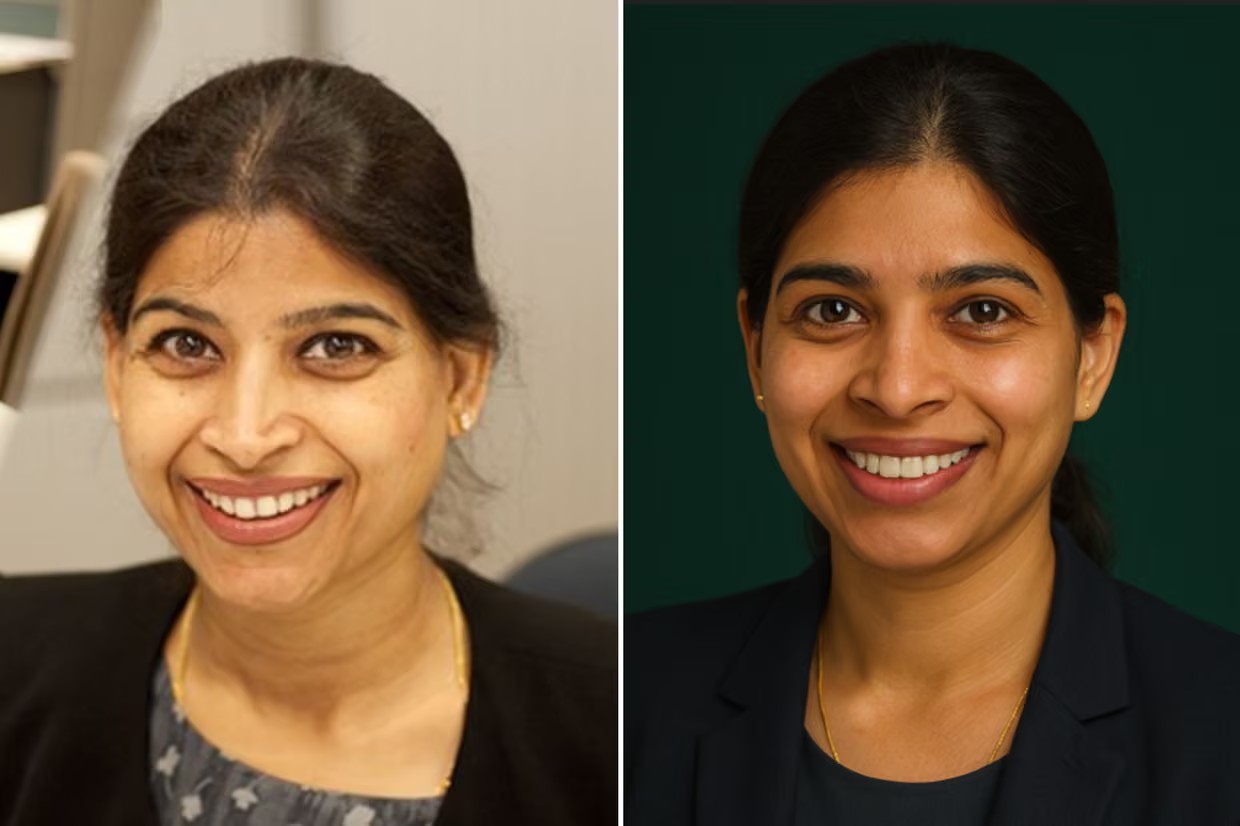
Meena Jha (left) and her Neena Chatbot (right). Jha, an associate professor at Central Queensland University, created an AI avatar resembling her, named Neena Chatbot, and trained it to answer student questions about course material
Source: theguardian.com
CQU is trialling its own AI tool, Birdy, as a student support service across 24 courses. Jha went further herself and built a digital likeness of her own, Neena Chatbot, which answers students' questions on course topics. People need time to try a tool like that and see the benefit, she said, alongside instruction on how to use it properly.
The University of Sydney presents itself as a leader in the field. Hundreds of its teachers use Cogniti, a generative AI education platform, to run chatbots and scenario exercises, and the university has made Cogniti available to other institutions in Australia, New Zealand and the Netherlands.
In late August, Sydney published a discussion paper setting out futures in which AI takes on still more work, including personalised learning for every student on every course, with fewer hours of contact between teachers and students. A spokesperson said the university is only helping staff use the technology to improve the student experience, that human judgement, responsibility and relationships between people are necessary across all of the university's work and cannot be replaced by technology, and that the exercise is not about cutting costs. A paper whose scenarios reduce paid contact hours is a cost document whether or not it is filed as one.
Peter Chen, who chairs the branch of the National Tertiary Education Union at Sydney, said the discussion paper deepened staff anxiety about the future. Funding shortfalls already mean fewer teachers and bigger groups. Some staff fear losing their jobs, he said. Others fear that everything that makes teaching worth doing will disappear, leaving them to answer for the mistakes when something goes wrong.
Sydney staff plan to strike on Wednesday, demanding guarantees on AI and other support in the face of growing workloads and job insecurity. Chen said the union will not sign an agreement that leaves the question out. The university said it will keep negotiating but called the strike premature; because AI is developing so fast, its spokesperson said, the rules for using it should be set by university policy rather than written into a three-year collective agreement.
Alison Barnes, national president of the NTEU and a lecturer at Macquarie, said university staff across the country will push to have AI covered by employment agreements. Teachers are already in a workload crisis, she said, and adding AI piecemeal without fixing the cause of that could produce even more serious consequences.
That exchange is the whole dispute compressed. Sydney's claim that AI moves too quickly for a three-year agreement is plausible, and it also means the rules stay wherever management writes them. The union's claim that anything outside the agreement is not a guarantee is equally plausible, and it is the reason the question is being taken to a picket line rather than a committee. Whichever way it settles will settle it for the psychology students at Macquarie as well, and they have no seat in that negotiation at all.