
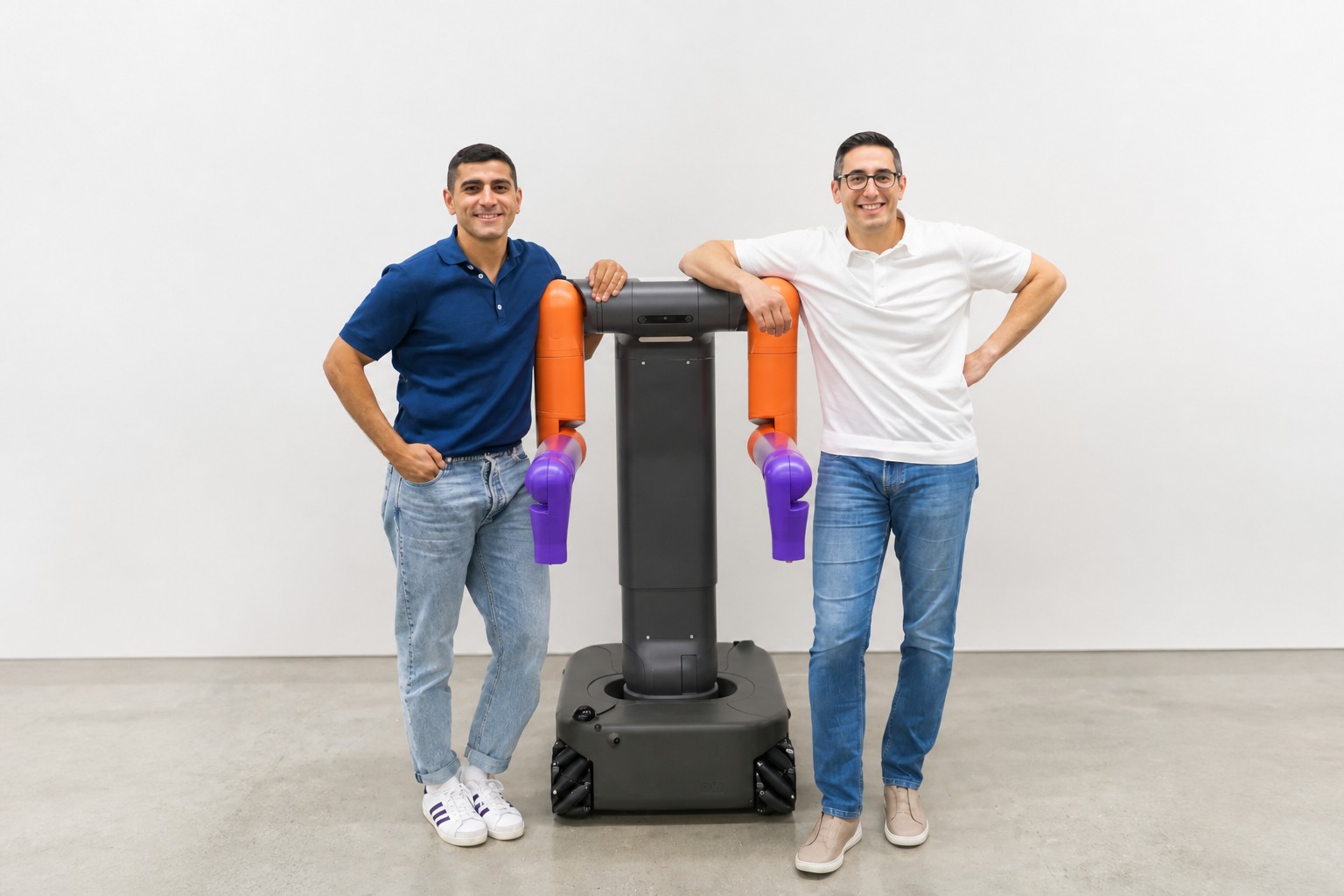
Maven Robotics has raised $100 million from RoboStrategy, LocalGlobe, Vine Ventures and XTX Markets Ventures on the strength of eight robots in live operation. The machines do mixed palletizing — building a store-specific pallet out of boxes that arrived from different factories — and according to the company they run 16 hours a day at availability of 99% or better. The funding pays for 250 third-generation robots and the design work on a fourth-generation platform.
The origin of the business explains the strategy better than the hardware does. In 2024 Maven had a team and, in the words of chief executive and co-founder Hamza Derbas, "a cartoon drawing of a robot." The company learned that a large consumer goods manufacturer was visiting four competitors, all pitching logistics automation. Derbas talked his way into a meeting and, instead of presenting a view of robotics, asked to walk the manufacturer's factories and warehouses.
His team watched how the work was actually done and picked the processes where robots could pay off quickly. The pitch that followed was for automating a task end to end: the system plugs into the warehouse management software on one side and loads finished goods onto trucks on the other. Maven won the contract despite being the only bidder without working robots. Two years later, across that customer and several other partners, it has eight.
Source: techcrunch.com
The robots sit on wheeled bases, move at up to 10 miles per hour, and carry two arms that each lift up to 30 kilograms. The problem they solve is narrow and expensive. Wooden pallets of boxes arrive at a distribution center from different factories, and a store needs a pallet mixing several products. Within 48 hours of product hitting the shelves, a store can change its assortment based on live demand, which sends the warehouse an order for a new combination. Today that means workers walking the floor and picking up one box of each type by hand.
At Maven's facility in Santa Clara, a robot moves through a training area, picks boxes with vacuum suction cups and stacks them at an acceptable pace. A screen alongside shows two robots working at a customer site in real time, with employees walking beside them.
The team comes out of cars. Derbas spent years in automotive engineering focused on electric vehicles, then nine years inside a special projects group at Apple. He will not say what that group did, though it is understood to have worked on the self-driving car until Apple shut the project down in 2024. He founded Maven with his brother Khalid, previously in private equity, who is the company's finance chief. Like most physical AI startups, Maven recruits from autonomous driving, because those teams built the most developed methods for training autonomous machines on real-world data. The loop it needs is the one they built: data pipelines that return information from deployed robots within minutes or hours, then retraining, evaluation, ablation studies, weight selection, deployment, repeat.
Jack Pearson of RoboStrategy frames the differentiator as industrial systems experience rather than a research culture organized around a training method or a single architecture. Derbas names Agility as the closest company on the market — going public this autumn through a SPAC deal at a $2.5 billion valuation, with the same focus on safety and specific industrial processes. But Agility's robots walk on two legs, and Derbas, while stressing his respect for the company, calls that pointless for the work: too complex, too unreliable, too expensive. In industrial robotics, he argues, the number that matters is return on investment.
That argument is correct and also convenient. Eight robots is not a fleet, it is a pilot that has survived, and the leverage Maven has on its customers today comes from the same thing that got it the first contract — somebody walked the floor and understood an overheated warehouse. That is a sales advantage, not a technology advantage, and it does not compound. Maven's own investor describes the company by what it is not: not a research culture. Palletizing may be an $80 billion market, but the moment Maven moves past it, the missing piece is exactly manipulation ability that today's robots do not have, and that is a research problem. The company will have to grow the culture it currently sells against.
Management knows this. The next milestone is collecting more data and training robots to handle materials, then automation and parts fabrication. Maven intends to use its own systems, bring in outside suppliers, and has already built a pair of gloves with claw-like grippers that let a person imitate the shape the company wants its robot grippers to take. Derbas calls Maven a general-purpose robot maker while moving one task at a time, on the theory that if the tasks are large enough each is worth billions on its own, and that doing them in sequence produces the data needed for the next skill.
That is a plausible route to getting robots into factories, and it is also a bet against timing. The risk is not Agility's legs. It is a frontier physical AI model arriving from a research lab and making per-customer integration work look like the slow path — at which point Maven's eight robots would be a business, but not the one it raised $100 million to build.