
Where coordination helps
Microsoft tested DxO with models from OpenAI, Google, Anthropic, Meta and DeepSeek. Its strongest results came with OpenAI’s GPT-5 and GPT-5.5. The researchers measured both accuracy and the estimated cost of running the system for each case.
With GPT-5, a short baseline prompt solved 78.9% of difficult cases at an estimated cost of about $8,400 per case. DxO cut that cost by about $3,000, while raising accuracy by only about four percentage points. For emergency-department cases, the difference between GPT-5 with and without DxO was small on both measures.
GPT-5.5, released in April 2026, showed a clearer gain on difficult cases: DxO raised accuracy from 72% to nearly 87%, while slightly reducing cost. But for emergency-department cases, accuracy stayed around 85% with or without DxO, at comparable cost.
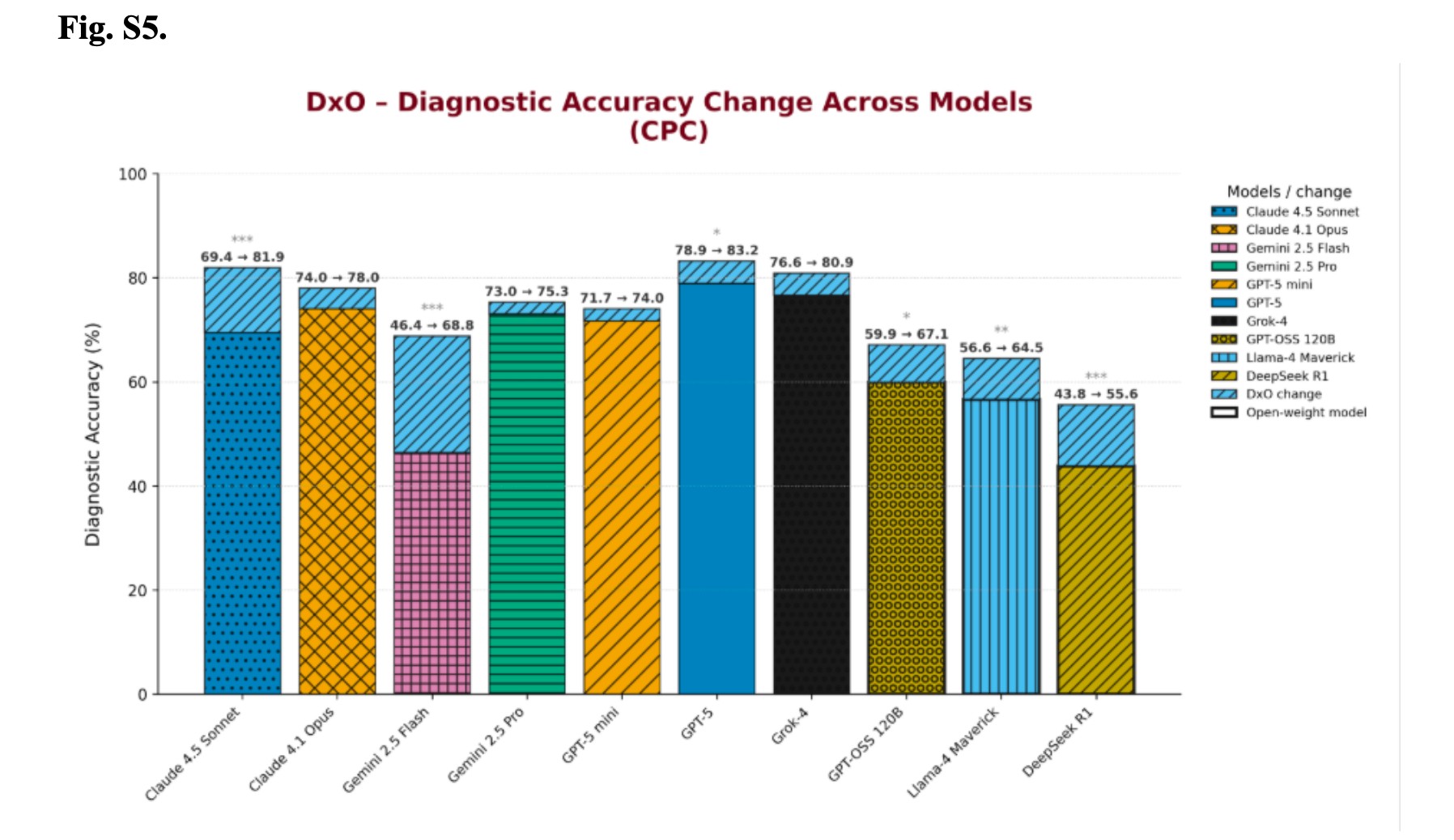
Accuracy improvements delivered by DxO (no budget constraints) on CPC over models prompted with baseline prompt across different large language models. Image Credits: Microsoft AI
Source: techcrunch.com
The coordination layer helped more with weaker models. Gemini 2.5 Flash scored 46.4% on its own and nearly 69% with DxO. Still, the gap between weaker and stronger models was larger than the improvement DxO added.
Microsoft’s researchers said the room for improvement naturally shrinks as a model approaches its theoretical ceiling. A company representative said DxO’s coordination is intended to optimize accuracy and cost together.
From benchmark to hospital
Mustafa Suleyman, who leads Microsoft’s work on its own advanced AI models, told TechCrunch that the company is training a healthcare foundation model with the Mayo Clinic, with a release planned for next year. He sees DxO as part of Microsoft’s underlying infrastructure for medical breakthroughs.
Suleyman also predicted that medical records could approach a programming-like breakthrough in 2027: systems continuously generating accurate predictions about how a patient’s history will develop. He said that ability to anticipate what comes next could be extremely valuable to doctors.
Microsoft has a new partnership with Beth Israel Deaconess Medical Center in Boston to evaluate how DxO reasons through clinical cases in different hospital settings. Patients will receive standard care, including triage, specialist consultation, treatment and tests. After doctors decide whether it is safe to discharge them, consenting patients will also interact with DxO. Microsoft and its partners will compare the system’s recommendations with clinicians’ decisions.
The study will include both emergency departments and urgent-care centers. Suleyman’s colleague Dominic King said Microsoft expects it to be the largest study of its kind and to provide evidence about whether these systems can be adopted more broadly.
Google and Beth Israel Deaconess published a clinical study of Google’s AMIE conversational diagnostic system in The Lancet this month. That system was tested during real emergency-care visits, with doctors observing the interactions in real time.
I think the benchmark results make the hospital study more important than the superintelligence label. DxO’s gains depend on the case and the underlying model; the unanswered question is whether coordination improves decisions when clinicians, patients and hospital workflows are involved, rather than only on a test set.
What Microsoft means by medical superintelligence
Microsoft’s study in Science appeared alongside a company manifesto defining medical superintelligence as the ability to outperform the strongest current human-led healthcare systems in medical reasoning and coordination across the full course of care.
The company says it wants to move beyond isolated tasks such as medical exam questions and diagnosis, integrating AI with doctors and healthcare systems to improve outcomes. Microsoft already sells clinicians tools for dictation and radiology-image analysis, and sees DxO as an extension of that work. Suleyman said the company should build the best clinical decision-support products available over the next few years.
His expectations are ambitious: he predicts medical models’ capabilities will grow by an order of magnitude over the next 24–36 months. He has described a recurring cycle behind earlier advances in chatbots and coding tools: deploy a model, improve it through real-world use, identify gaps and address them. He expects that cycle to begin next year for medical records and clinical decision support.
The ambition is not just to make a model better at diagnosis. It is to make AI useful across care, where accuracy, cost and coordination all matter—and where a benchmark gain is only the beginning.
Daily AI news
Every day we pick what actually matters in AI and explain it plainly — no hype, no filler. Subscribe if you want to follow where the industry is going.
Only what matters — every day
Follow on X