

From voice filters to call analysis
Founded in 2017 by Mike Pappas and Carter Huffman, who met while studying physics at MIT, Modulate began with voice-changing tools for games before moving into voice-content moderation. The spread of voice AI pushed it toward detecting AI-generated audio and interpreting speakers’ intentions.
Huffman told TechCrunch that many companies can transcribe speech, but still struggle to capture the nuances of a conversation as a whole. That gap matters most when a person is speaking to another person, he said.
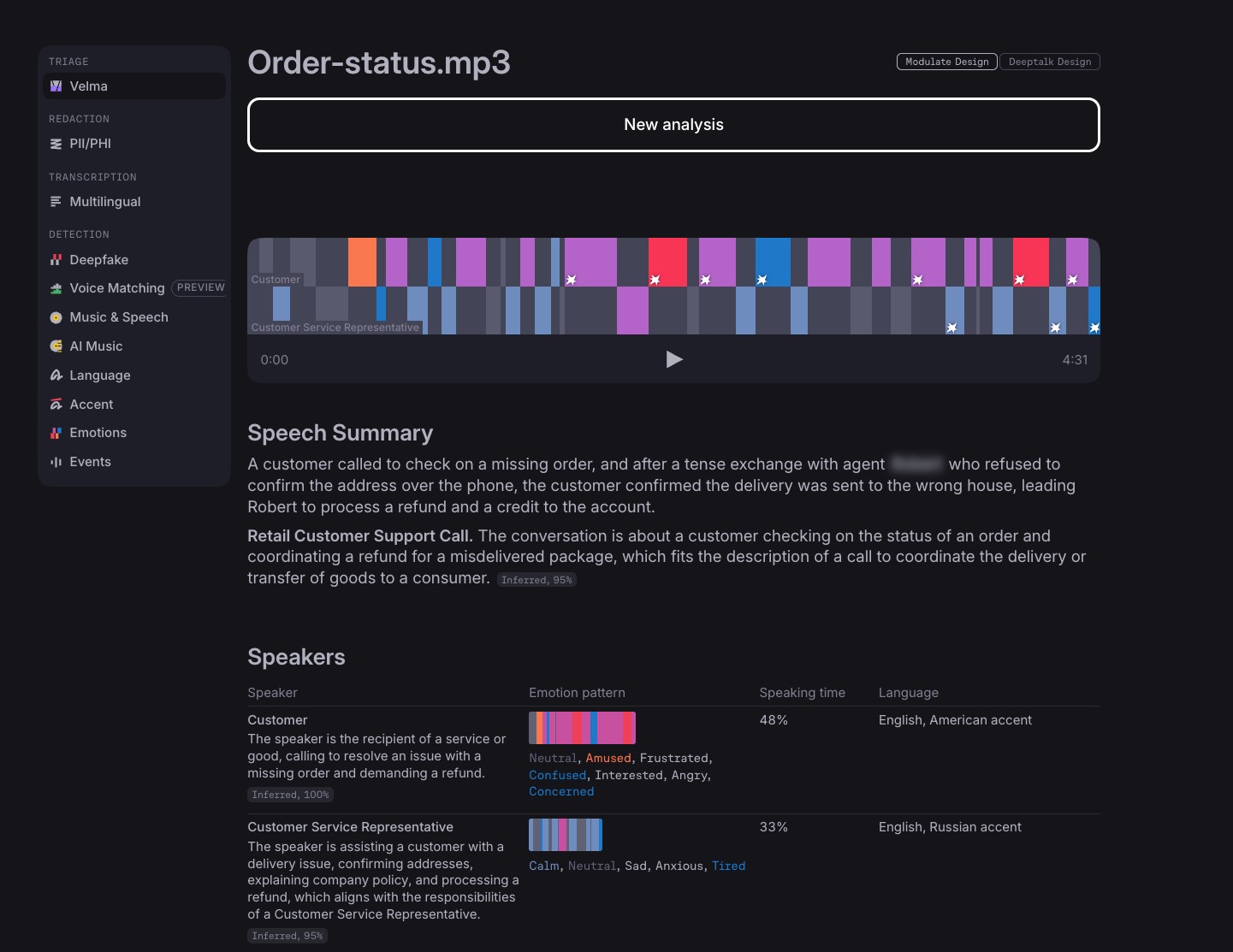
Modulate now uses more than 100 models, divided into two groups:
The call is not the whole story
Modulate works with different kinds of customers, but one focus is detecting deepfakes and warning organizations such as call centers about possible fraud. Its platform also monitors AI agents’ customer interactions to assess call quality and compliance in regulated industries. In practice, that means Modulate often sits alongside a company’s voice platform and analyzes its calls.
That analysis is becoming more useful as companies put AI into customer service. A call’s outcome cannot always be judged from a broad quality score: companies need to understand what the customer intended and how they reacted. Huffman says Modulate can give them more detailed data.
A particular problem is that politeness can disguise dissatisfaction. Companies may treat neutral or positive reactions as signs of a successful call, and negative reactions as signs of failure. But customers can remain courteous while speaking with an AI agent or bot even when they are deeply unhappy.
The company also says its technology is used to track cyberattacks carried out through voice calls.
Small models, a bigger question
Huffman says smaller models can run without specialized hardware or large computing resources, a potential advantage as token-processing bills rise. Companies can also train models with new capabilities, add them to existing ones, and have an orchestrator call the right model when needed.
Modulate has 40 to 45 employees and plans to hire 10 more in the coming months to expand model development. It is also working on deployments on customers’ own servers and directly on devices to improve privacy.
I think the sharper test is not whether Modulate can label a voice as synthetic or a caller as frustrated. It is whether those signals reliably explain what happened on a call well enough for a company to change how its AI responds. The announcement describes a broad analytical layer, but says little about how customers verify its judgments. That question matters more as the software moves closer to the conversation itself.
Daily AI news
Every day we pick what actually matters in AI and explain it plainly — no hype, no filler. Subscribe if you want to follow where the industry is going.
Only what matters — every day
Follow on X