A lunar archive, not just an image collection
The model was trained on SomBench, which the team describes as the largest multimodal lunar dataset with spatially aligned coordinates. It combines 11 data types at two spatial scales:
The dataset draws mainly on 17 years of LRO observations. NASA says their volume exceeds the combined data from all of the agency’s other planetary missions. SomBench also includes measurements from the GRAIL mission on the Moon’s gravity field, Lunar Prospector data on hydrogen, and mineralogy data from Japan’s JAXA Kaguya/SELENE spacecraft.
In total, the dataset brings together more than 30 spatially aligned layers from nine instruments and four missions. The researchers split training, validation and test data by geographic regions rather than assigning image patches at random, reducing overlap between the sets.
The model is given the lighting conditions
The model builds on TerraMind, a multimodal Earth-observation model, but NASA and IBM trained the lunar version from scratch rather than adapting an existing model. For each image patch, it receives information about imaging geometry, including illumination angles, the Sun’s position and the patch boundaries. On the Moon, lighting can affect how the surface appears more than its physical properties do; giving the model those parameters directly avoids making it infer them from pixels alone.
The model also trains on high- and low-resolution images together, combining local detail with broader context. FlexiViT lets the same trained model handle tasks that use different image-patch sizes without retraining.
Researchers tested it on crater detection at resolutions of 100 meters and one meter, predicting polar ice deposits, and segmenting irregular mare patches — young volcanic features that complicate efforts to check accepted timelines for the Moon’s cooling. According to the technical report, the pretrained model matched or beat common baselines across the tasks, as well as a control model with the same architecture but random initialization.
The strongest reported gain was in predicting ice deposits. Permanently shadowed polar regions are cold enough for water ice to persist for billions of years, and those deposits are considered a potential source of water, oxygen and rocket fuel. IBM says the model reduced prediction error by up to 22% compared with the best baseline, SwinV2-B. On low-resolution crater detection, IBM reports it beat SwinV2-B by nearly 19%, while using only half the data for training.
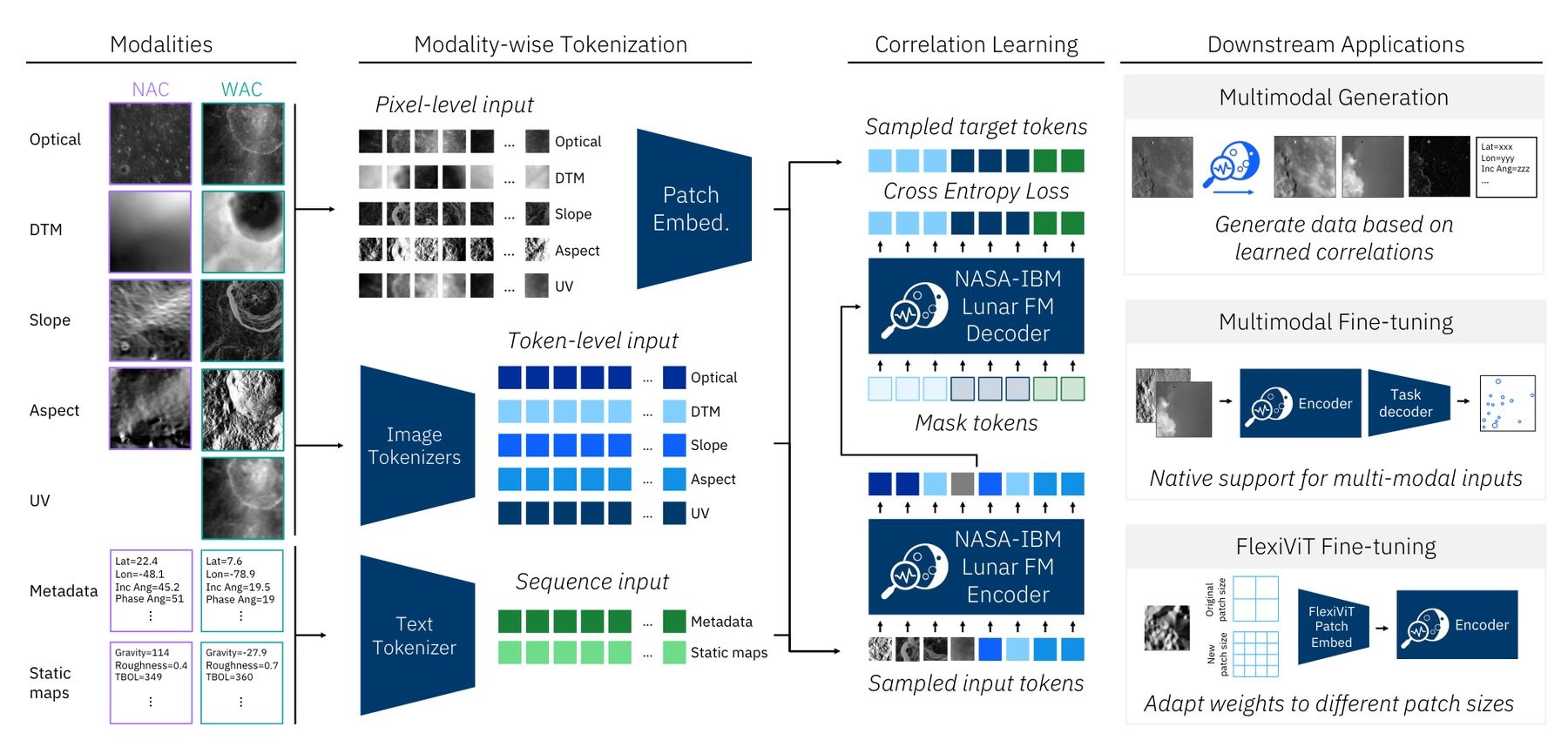
The model breaks lunar images, elevation data, and imaging geometry into tokens and learns their relationships by predicting masked portions. | Image: NASA / IBM
Source: the-decoder.com
The gains are uneven
A randomly initialized control model that had not been trained on lunar data still beat five of seven baselines on ice detection. The researchers suggest that part of the advantage comes from the model’s data handling: it uses a separate processing path for each data layer, while the baselines combine all inputs into channels.
On meter-scale crater detection and irregular mare patch segmentation, the model was roughly on par with the strongest baselines, with differences within the variation between training runs. IBM reports a 3% advantage over SwinV2-B on mare patches, but the results look more comparable than clearly better.
The researchers also report that LoRA, a lighter fine-tuning method that trains only part of the model’s parameters, generally matched full fine-tuning and did better on crater detection. Full fine-tuning won only on the two smallest tasks.
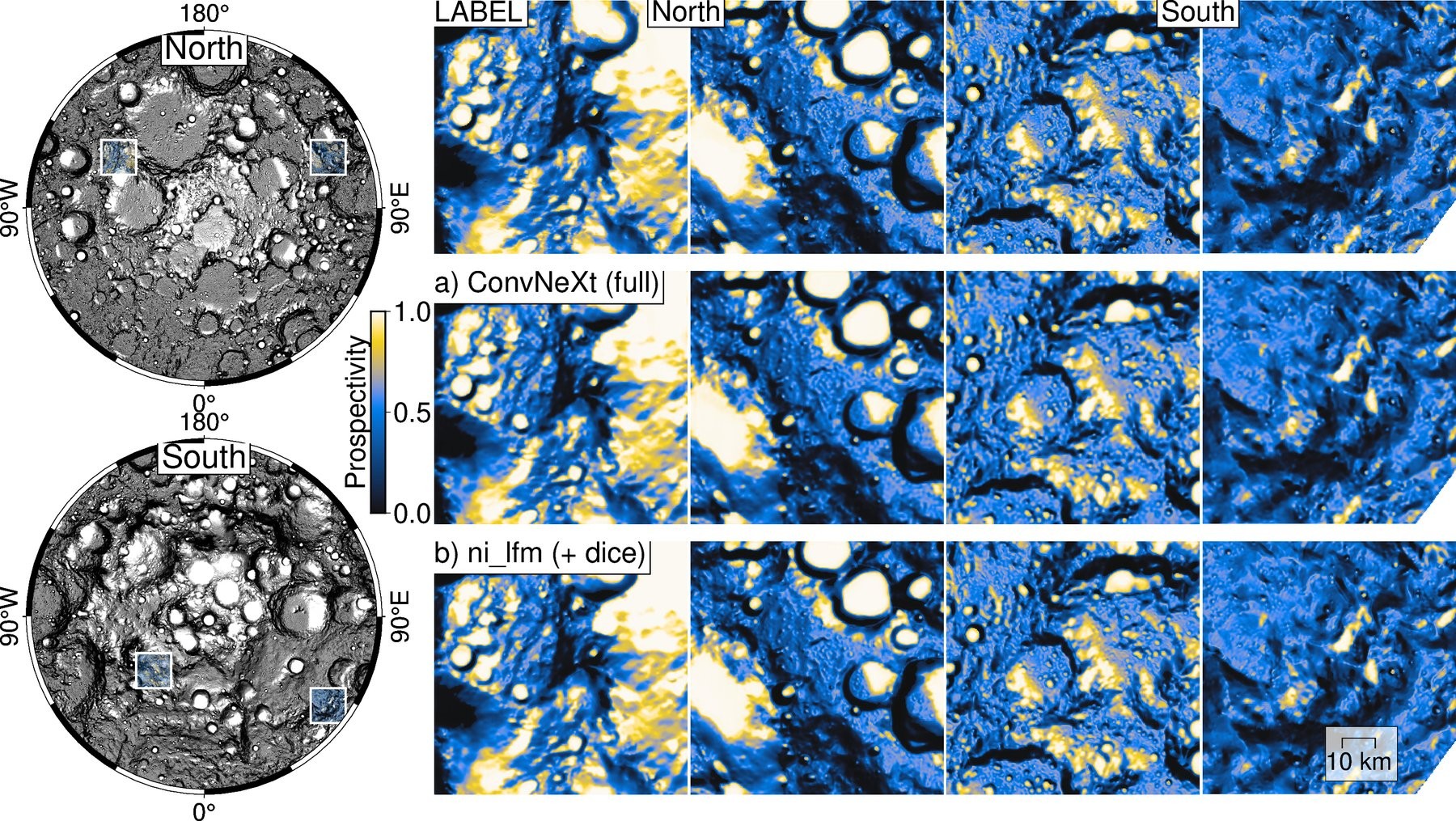
The NASA-IBM foundation model closely reproduces the fine-grained patterns in reference maps of potential ice distribution at the lunar poles. | Image: NASA / IBM
Source: the-decoder.com
The model is not a substitute for physical measurements. In tests that generated geographic coordinates, latitude and longitude sometimes differed by tens of degrees. The model could also recover terrain shape while getting its absolute elevation wrong. The authors present it as a reusable starting point for later tasks, not a tool for precise geodetic positioning.
They say controlled experiments to isolate the contribution of each design choice still need to be done, and some test datasets are small. I think that caveat matters as much as the headline gains: the results support using the model to help interpret lunar data, but do not yet show which parts of the system account for those gains.
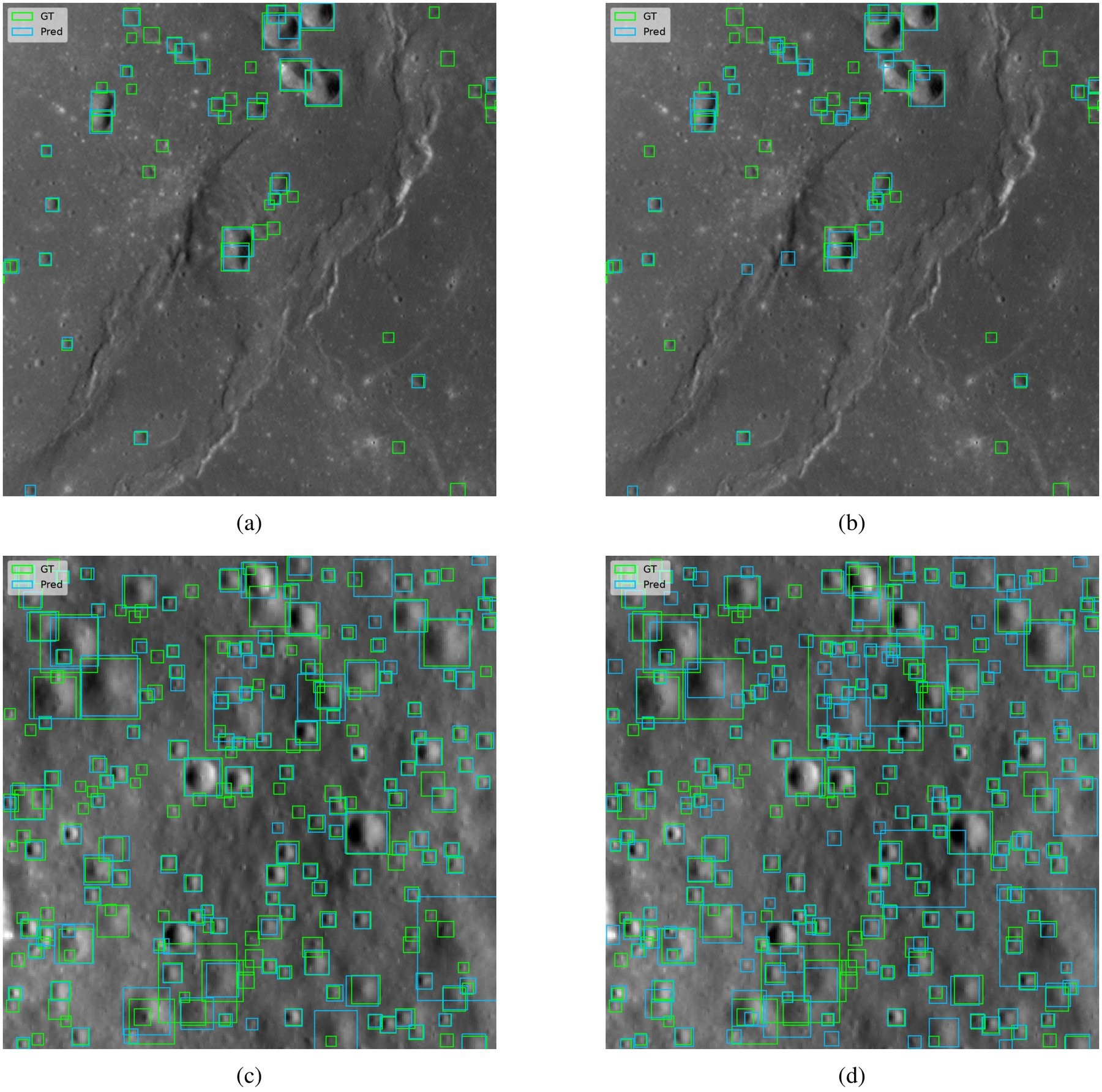
In these crater detection examples, the NASA-IBM model and the ImageNet-pretrained SwinV2-B perform similarly. All models do worse on high-resolution NAC images. | Image: NASA / IBM
Source: the-decoder.com
An extension of the NASA–IBM partnership
The model is available on Hugging Face, its source code is on GitHub, and it is included in the open TerraTorch toolkit. The team has also released machine-learning-ready datasets for pretraining and benchmark collections.
The work is part of NASA and IBM’s “AI for science” collaboration. The organizations have worked on foundation models under a Space Act Agreement since early 2022. In August 2023, they released Prithvi on Hugging Face, trained on Landsat and Sentinel-2 imagery covering the contiguous United States and adapted for flood and wildfire mapping.
IBM later presented Prithvi as part of its Watsonx platform. TerraMind, the Earth-observation model behind the lunar project, was developed by IBM in 2025 with ESA and Forschungszentrum Jülich. Google DeepMind is pursuing a similar approach with AlphaEarth Foundations, combining optical satellite imagery, radar and lidar scans, and climate simulations into compact embeddings of Earth’s surface.
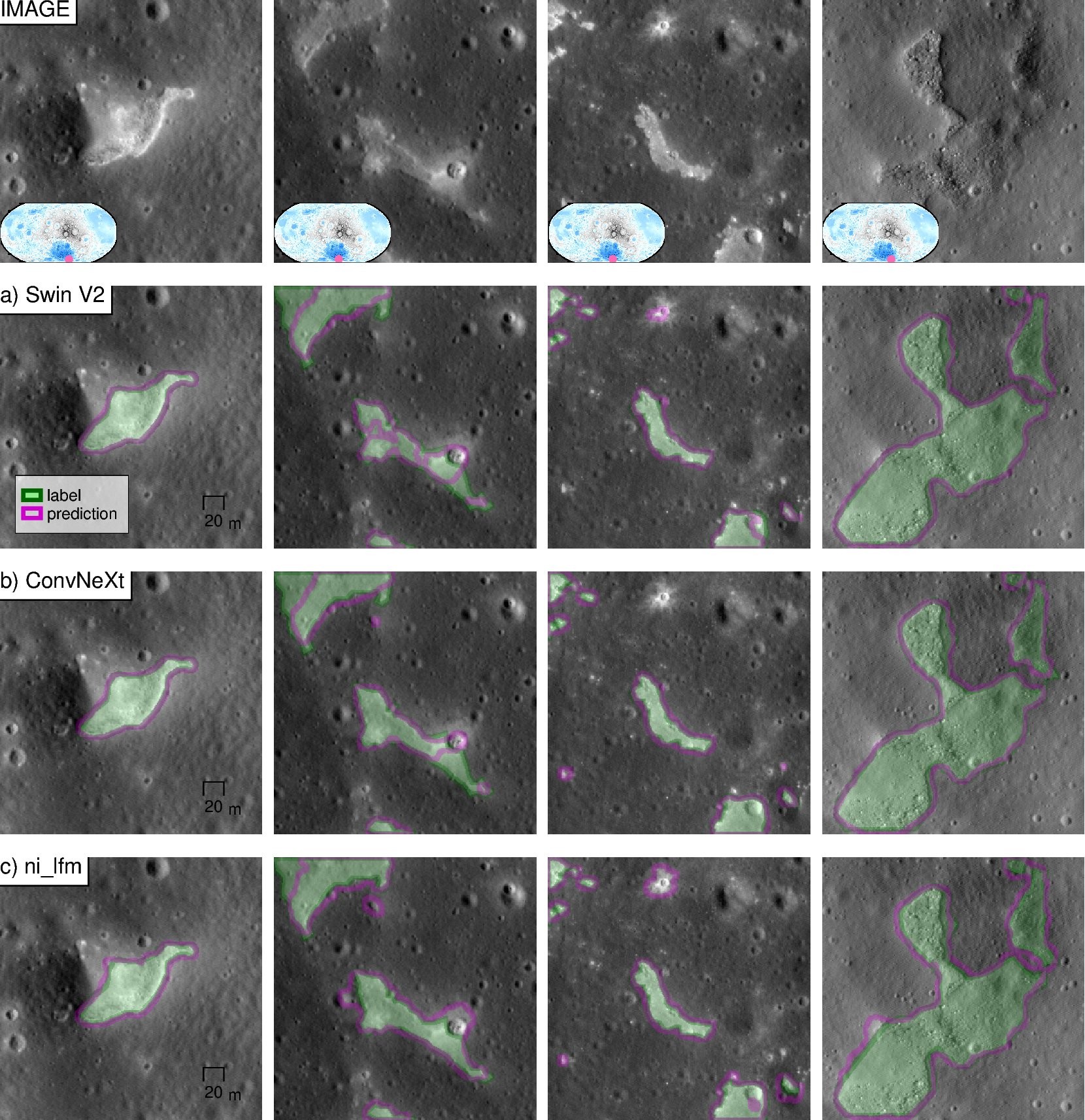
When segmenting Irregular Mare Patches, the NASA-IBM model picks up areas in the second example that both baseline models miss. | Image: NASA / IBM
Source: the-decoder.com
NASA and IBM have made a broad lunar archive more usable for machine-learning research. The next test is whether the model’s gains hold up when researchers separate the value of its architecture and training choices from the value of the data preparation itself.
Daily AI news
Every day we pick what actually matters in AI and explain it plainly — no hype, no filler. Subscribe if you want to follow where the industry is going.
Only what matters — every day
Follow on X