Nvidia has released Alpamayo 2 Super, an open-weights driving model that takes a 360-degree view from seven cameras and returns future trajectories, causal reasoning chains, high-level meta-actions, grounded answers about the scene and automatic reasoning labels from one input. The weights are on Hugging Face and the inference notebooks on GitHub, under OpenMDW-1.1, the Linux Foundation's permissive license for open models. It allows fine-tuning, derivative models and commercial distribution; distilled versions can ship in commercial products without further permission from Nvidia, and the license makes no claim on what the model outputs. This is a teacher model given away, and the student it was built to teach is Nvidia's own DRIVE AGX Thor.
The consolidation is the product here. Autonomous-vehicle teams normally run separate models for trajectory generation, intent recognition, scene understanding and data labeling, which makes results hard to line up against each other, system behavior hard to trace and representations hard to reuse from one development stage to the next. Alpamayo 2 Super folds those into a single workflow that can act as a standalone teacher for a driving policy, an evaluator, a data-preparation module, or a base for fine-tuning to new tasks.
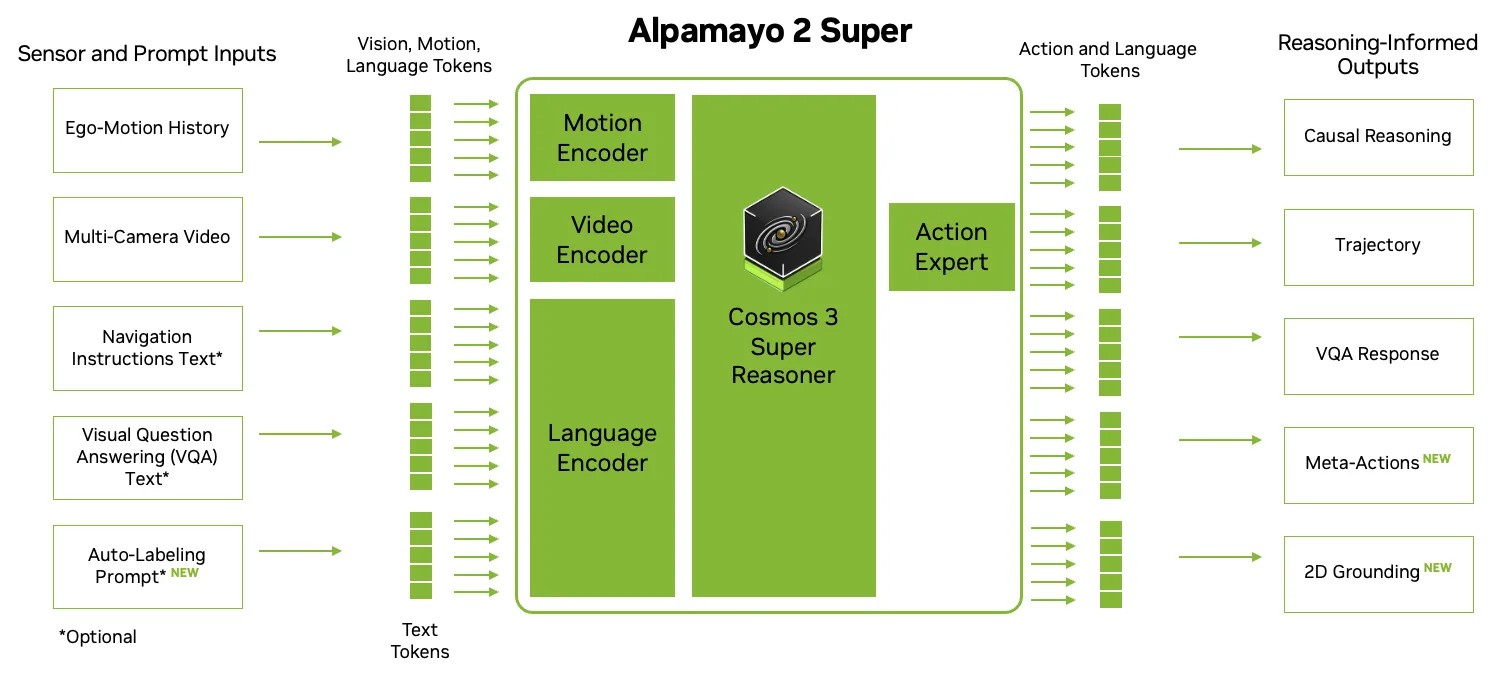
Alpamayo 2 Super processes multimodal inputs using a 32B Cosmos 3 Super Reasoner and a 2B Action Expert
Source: developer.nvidia.com
Like earlier models in the family, it emits a trajectory and a chain of causation together. The trajectory says what the ego vehicle can do next; the chain ties that decision to the circumstances that produced it. The case for pairing them is diagnostic. In construction zones, around partly occluded pedestrians, in unusual interactions with other road users and when objects appear on the roadway, picking a path that resembles a common template is not enough — and when the result is wrong, an engineer needs to know whether the failure sat in perception, in reasoning or in action generation. The chains also feed Nvidia's Halos safety validation procedures, where they are used to analyze how the model reads a scene. The repository's notebook loads a surround-view clip, prepares the ego vehicle's motion history and returns a trajectory with its matching chain of causation.
Open-loop evaluation scores predictions against recorded ground truth, using minADE_6, where lower is better, alongside reasoning scores, where higher is. Its limit is structural: a log tells you nothing about what happens after the model's first action. If the ego vehicle changes lanes, replay keeps the neighboring car on its original path, oblivious to the merge.
Closed loop is the harder test. AlpaSim executes each predicted action inside the scene, generating new observations, querying the policy and applying its output over and over; where reactive behavior models are present, surrounding traffic responds. On 913 reconstructed scenes, Alpamayo 2 Super scored 1.50 ± 0.13. That kind of run surfaces collisions, road departures, dangerous closing distances and other failures that only exist once the policy starts shaping its own subsequent observations.
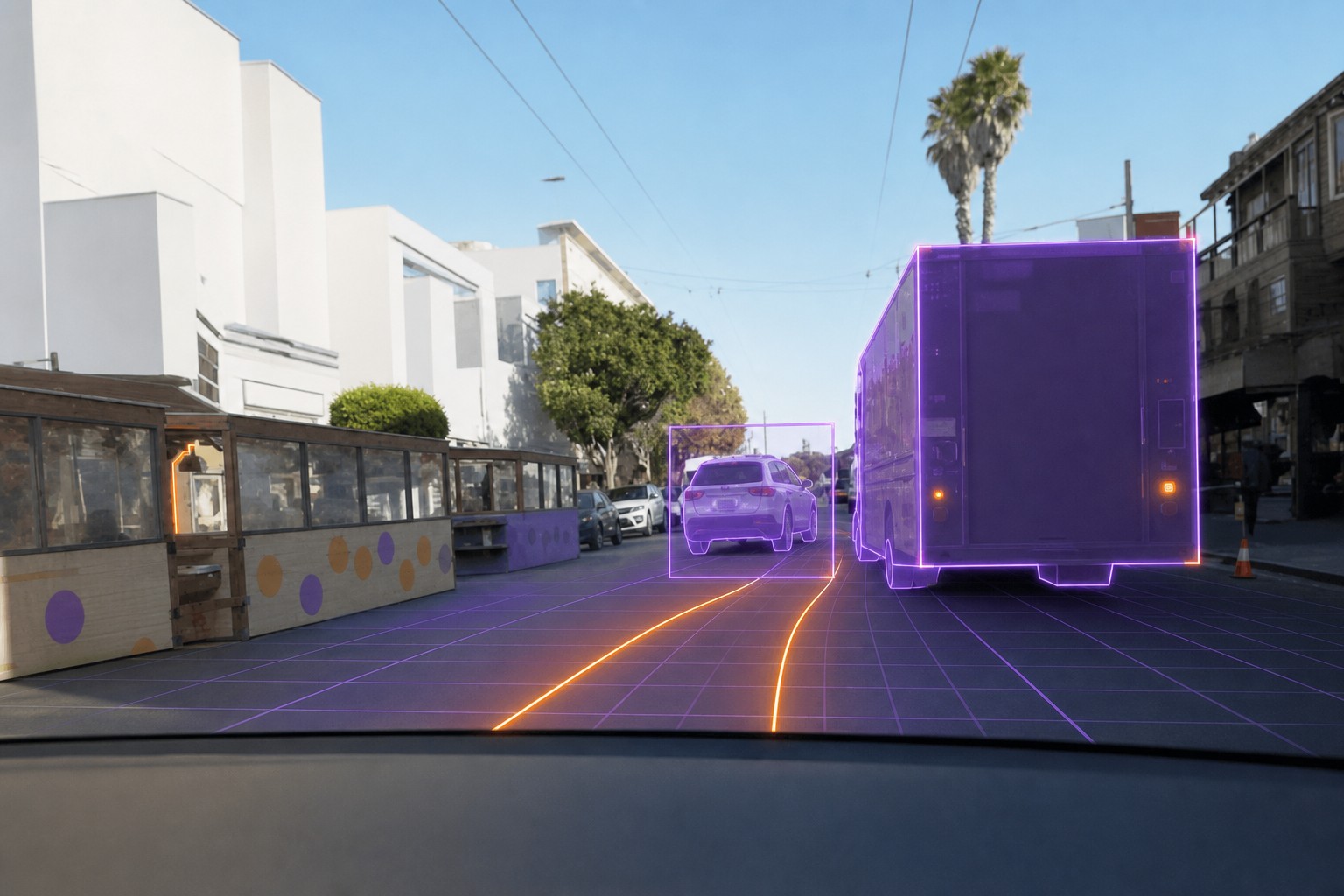
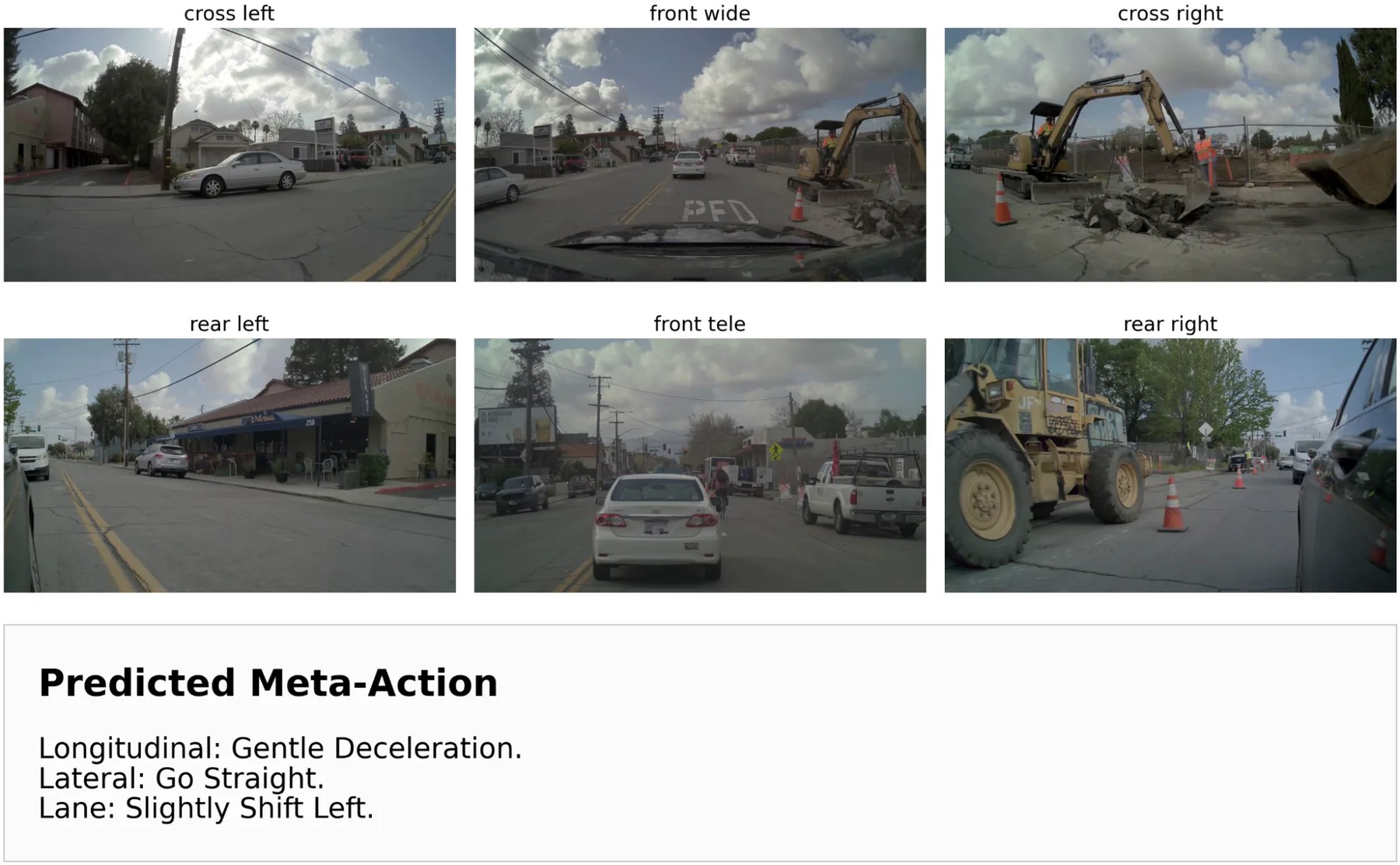
Alpamayo 2 Super driving closed-loop in AlpaSim, moving through dense traffic beside a construction zone
Source: developer.nvidia.com
A trajectory describes motion precisely but carries intent poorly. Meta-actions compress the plan to the level of a decision — yield, change lanes, stop, accelerate — and that is the output that connects a single model to a modular autonomy stack. A planner can consume the decision directly, an evaluator can check whether the trajectory geometry matches the stated intent, and engineers can search a dataset for specific maneuvers. Accuracy is scored as intersection over union against ground-truth labels across three classification components. On an internal set of 94K clips, the model reached 74.59 IoU on lateral movement, 61.91 on longitudinal movement and 73.55 on lane movement.
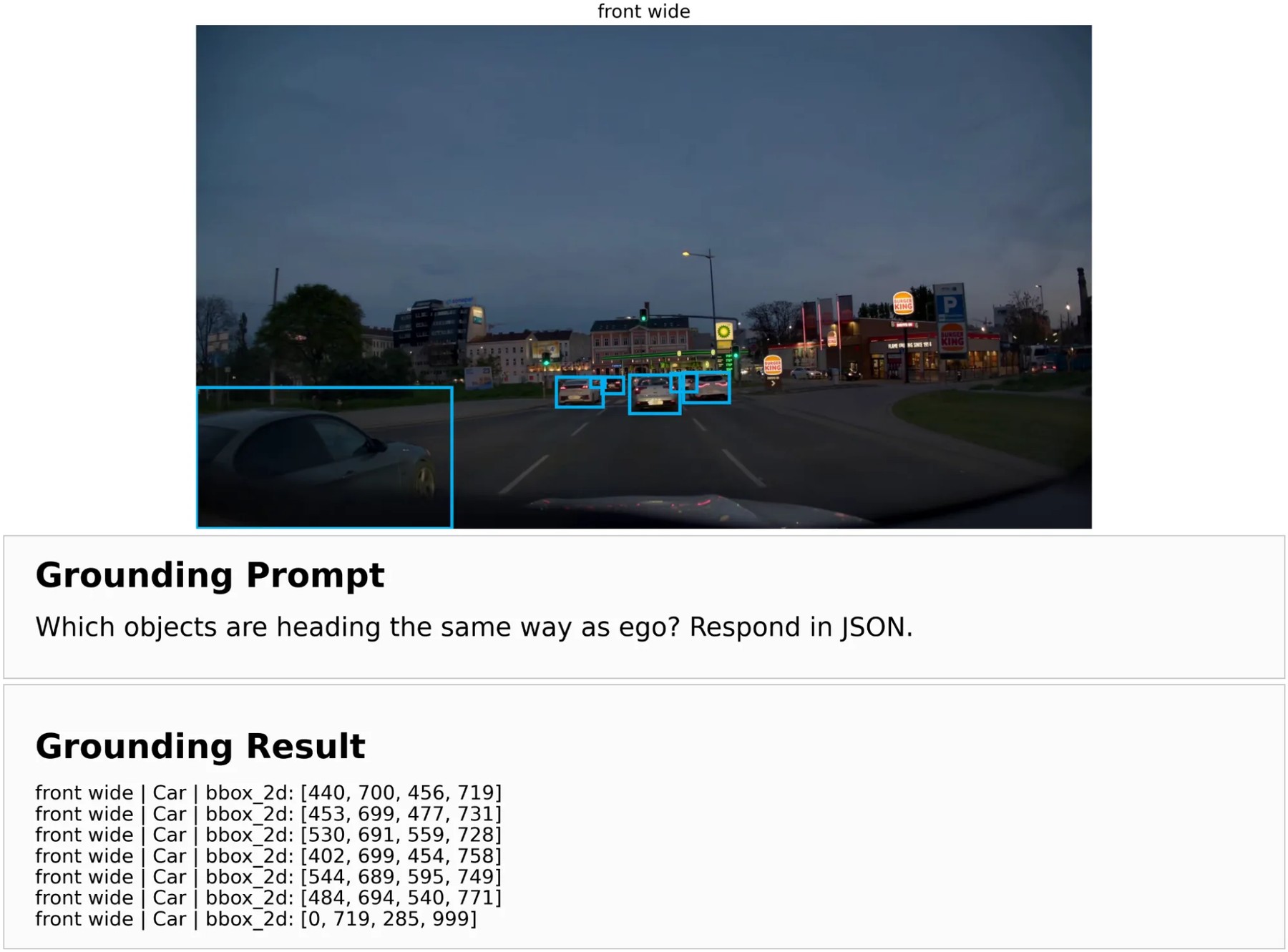
Visual question answering is the part aimed at debugging rather than driving. A developer can ask about the key objects in a scene, how they affect the vehicle's behavior, why it slowed down. The model answers in natural language and also localizes the road users it names, predicting 2D bounding boxes in the relevant frames from the relevant cameras. Surround view means the questions can cover the sides and rear, which a front-camera-only model has no access to. The grounding does two jobs beyond legibility: it makes missing or contradictory boxes automatically detectable, and it passes a tighter link between pixels, reasoning and action into downstream models during distillation.
On an internal set of 8K question-answer pairs, Alpamayo 2 Super scored 0.652 on answer similarity against 0.450 for Qwen3-VL 32B. On 2D localization it reached 0.71 IoU against 0.17.
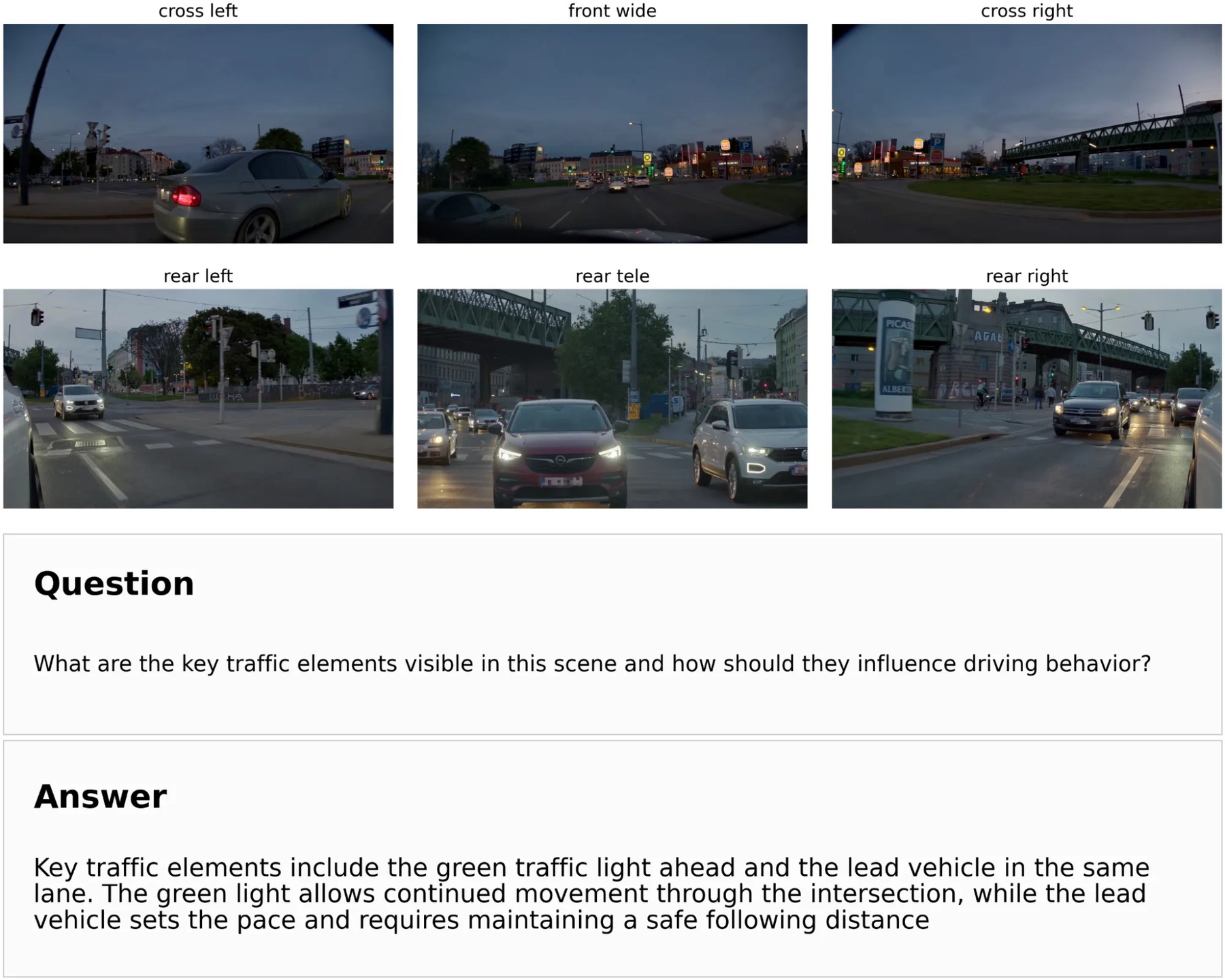
The labeling case is the one with the clearest economics. Reasoning models need data in which decisions are tied to specific road circumstances, and hand-labeling rare situations is slow: an annotator has to work through temporal context and video from several cameras, identify the causal actors, describe their effect on the ego vehicle and keep labels consistent for a given maneuver. Alpamayo 2 Super can run as a standalone auto-labeling system producing that structure at scale, which Nvidia says can compress the labeling cycle from months to days. It defaults to using the ego vehicle's future trajectory, but can also label clips where no future trajectory exists. Quality was checked on 8k internal clips against expert annotations using an internal judge model: 0.652 similarity for Alpamayo 2 Super, 0.450 for Qwen3-VL 32B.
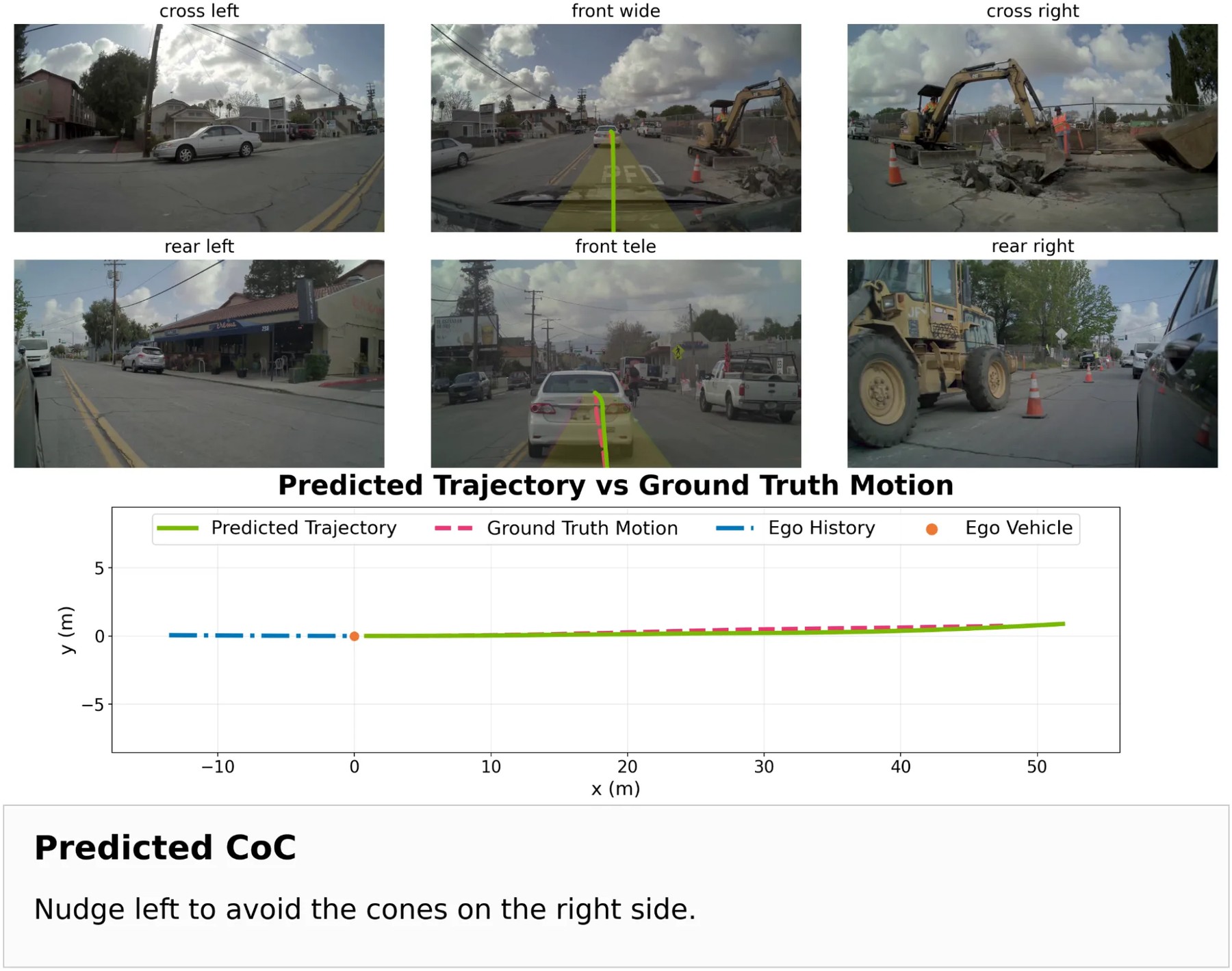
An auto-labeling result with a CoC trace and multi-camera inputs
Source: developer.nvidia.com
Those two numbers deserve a second look, because they are the same two numbers reported twice. The scene-understanding section and the auto-labeling section both give 0.652 against 0.450 on an 8K internal clip set. Either one evaluation is doing double duty across two separately presented capabilities, or two independent evaluations landed on identical figures to three decimal places. Neither reading makes the auto-labeling result as independent as the structure of the release implies.
The comparison itself is the thin part. Qwen3-VL 32B is a general-purpose vision-language model. A driving-specialized 32B reasoner outscoring a generalist at localizing road users in surround-view footage — 0.71 IoU against 0.17 — is the expected outcome, not a measurement of where Alpamayo sits against the systems a developer would actually consider instead. The closed-loop result has the opposite problem. 1.50 ± 0.13 on 913 reconstructed scenes is a precise figure standing entirely alone: no baseline, no competing policy, no earlier Alpamayo generation beside it. Nvidia is right that closed loop catches what replay cannot. It also means the single number from its most convincing test is the one a reader has no way to situate.
The licensing is what tells you why this is free. Permissive terms on the weights, derivative models allowed, no claim on outputs, distilled models cleared for commercial products without asking. Nvidia is not monetizing Alpamayo 2 Super and is not trying to. The value it is protecting sits one layer down, in the compression step: a 32B Cosmos 3 Super Reasoner and a 2B Action Expert squeezed into something small enough to run on DRIVE AGX Thor. Give away the teacher, sell the part the student runs on.
The tension is that open weights travel. A model released under OpenMDW-1.1 with unrestricted outputs can be distilled by anyone onto anything, including inference silicon Nvidia does not sell. The bet is that no serious autonomy team will bother, because the automotive-grade part with the toolchain attached is Thor. That bet holds precisely as long as the alternatives stay inconvenient.