
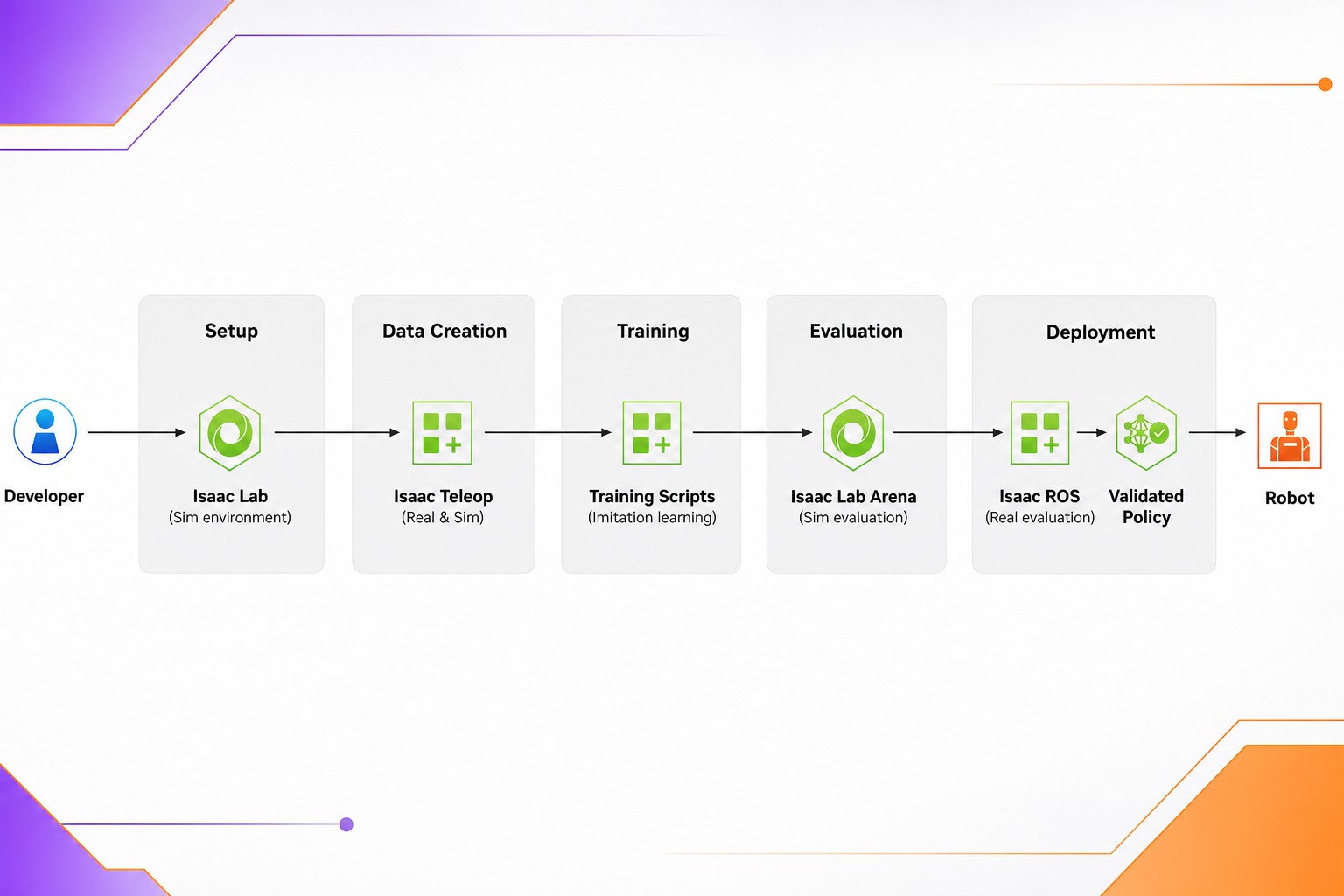
NVIDIA has folded the scattered stages of humanoid robot development into one open pipeline. The Isaac GR00T Development Platform runs from teleoperated data collection through simulation training to large-scale evaluation and deployment on a physical robot, and at its center sits Isaac GR00T 1.7, an open vision-language-action model under an Apache 2.0 license with a 3-billion-parameter base checkpoint published on GitHub and Hugging Face. The premise is that the hard part of humanoid robotics is no longer the model. It is the plumbing that has to exist before anyone can train one.
Source: developer.nvidia.com
NVIDIA's diagnosis of the problem is specific, and it is about software rather than hardware: tools exist for every individual stage, but isolated software ecosystems, incompatible data formats and manual integration keep them from forming a single process. Developers spend their time assembling robotics infrastructure instead of building robot capabilities. The platform is modular, so teams can take single components, plug in their own tooling, or run the full NVIDIA stack.
GR00T 1.7 is the piece that carries the most weight. NVIDIA calls it the first open, commercially usable model of its kind for generalized humanoid skills. It accepts multimodal input including language and images, works across different robot configurations, and produces actions for tasks in varied environments. Pre-training on diverse data is what lets it transfer to new tasks and settings, and NVIDIA says it makes robot motion look more natural. Developers are not expected to train a policy from scratch; general manipulation knowledge is already in the checkpoint, and post-training adapts it to a specific robot, task and environment.
The GR00T 1.7 humanoid robot moving an apple after fine-tuning
Source: developer.nvidia.com
To show the full loop, NVIDIA published a worked example of a pick-and-place task. A robot stands in front of a shelf and uses both arms to move an apple onto a plate on that same shelf. Balance is handled by a whole-body controller, and because the robot never walks during the task, the example uses AGILE WBC, an end-to-end policy better suited to a static task than a controller built for standing and walking.
That controller choice is not cosmetic, and it is the sharpest technical point in the whole guide. During teleoperation, AGILE WBC and PinkIK generate the joint targets that later become the training signal for the policy. Swap the controller and you get a different data distribution out of identical human motions. Demonstrations, in other words, are not a neutral asset you collect once and reuse; they carry the fingerprint of the control stack that recorded them.
Scene assembly, object registration and teleoperation device setup run through the Isaac Lab-Arena API, with the full environment configuration on GitLab Pages. Recording happens through Isaac Teleop from a supported VR headset over a CloudXR client: start the CloudXR environment, then record trajectories while AGILE WBC drives the robot's whole body.
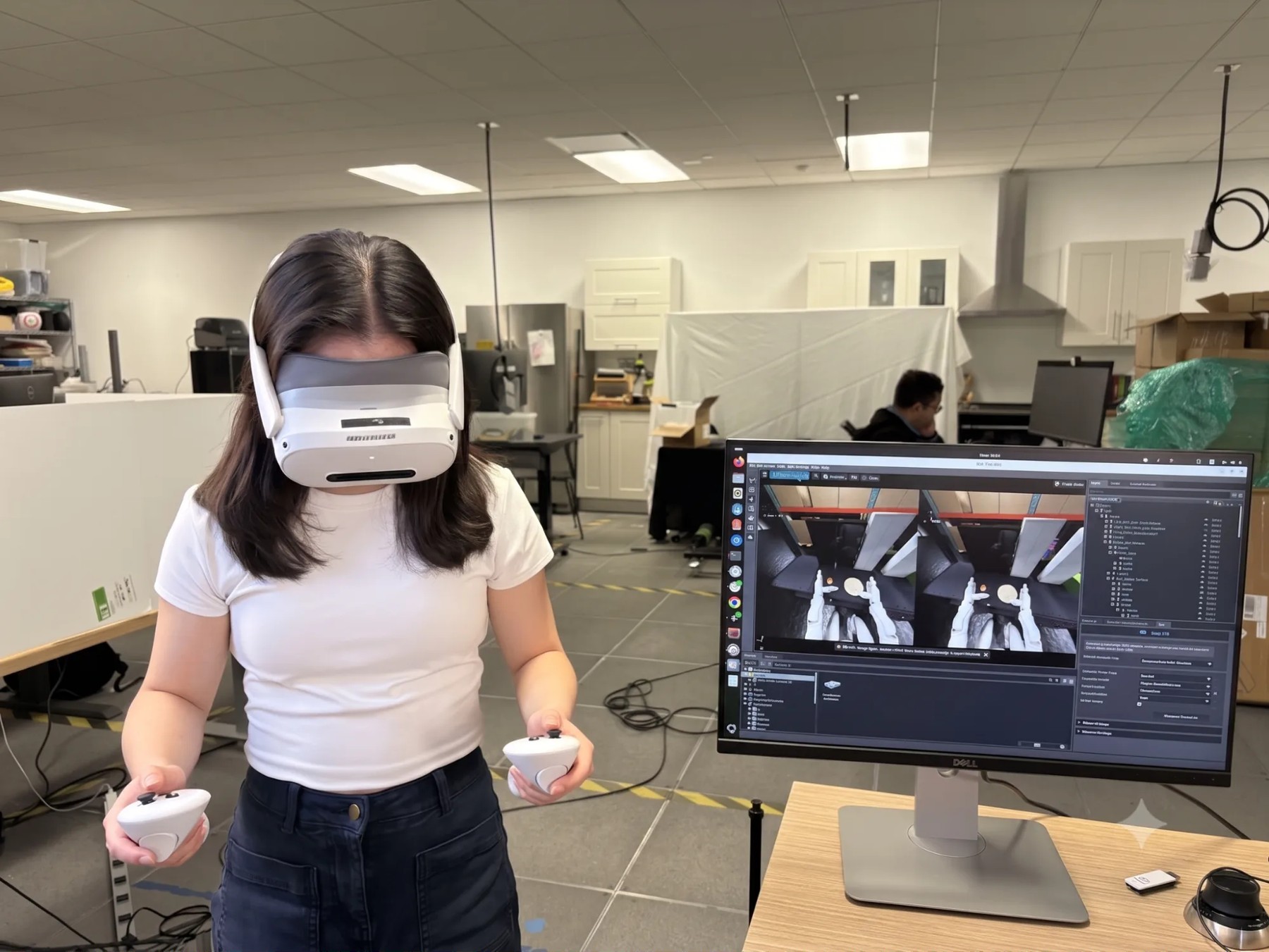
Collecting robot demonstration data with Isaac Teleop using a VR headset and CloudXR streaming
Source: developer.nvidia.com
NVIDIA is blunt that quality matters as much as volume here. The demonstrations need smooth motion, stable grasps and varied approach directions; noisy or inconsistent recordings put a ceiling on the policy. For this task NVIDIA collected 400 trajectories across several sessions rather than in one sitting, and suggests starting with a smaller set to verify the components before committing to the full corpus.
Successful demonstrations land in an HDF5 file, which is converted inside the Arena container into the LeRobot format GR00T 1.7 uses for post-training. A configuration file, g1_static_apple_config.yaml, maps recorded fields to what the model expects. The output is a lerobot folder with Parquet files holding states and actions, MP4 camera video and dataset metadata.
Post-training runs outside the Arena container, in a separate copy of the Isaac-GR00T repository. During fine-tuning the vision module, the projector and the diffusion model are updated. The language model stays frozen.
Evaluation is two steps: load the checkpoint onto a GR00T server, then run the policy closed-loop. Arena uses a server-client split, where the server hosts the fine-tuned model and the Arena client runs the simulation and queries it. The scale of the evaluation is set by flags. A run of --num_steps 600 is a quick sanity check and roughly corresponds to one episode of this task. A meaningful success rate takes full episodes: --num_episodes 100, or --num_episodes 1000 for a tighter estimate. --num_envs 5 runs environments in parallel and adds variation between trials.
Two numbers in that sequence deserve to be read against each other. Four hundred human demonstrations, captured in VR, produce a policy for moving one apple onto one plate on one shelf with one robot configuration — and validating that policy properly is a thousand episodes of simulation. This is what the real economics of humanoid skill development look like once the marketing layer is stripped off, and it explains why NVIDIA is shipping a pipeline rather than a skill library. Nobody is going to hand-collect their way to a general-purpose robot. The frozen language model points the same way: the language half of this vision-language-action model is a fixed prior, and what actually gets learned is perception and motor control for one narrow job.
What the guide never says is how well the resulting policy performs. It explains in detail how to measure a success rate, down to the flag that controls the sample size, and then stops. A reference workflow that walks you to the evaluation step and declines to report its own number is telling you that the number is not the point of the release — which is defensible for a tooling launch, and still the first thing anyone building on this will want and not find.
The choice of LeRobot as the data format is the quiet strategic move here. It is Hugging Face's format, not NVIDIA's, and by building the pipeline around it NVIDIA gets to define the substrate of humanoid training data without asking anyone to adopt a proprietary one. Partners across the humanoid ecosystem are already running the platform and the reference workflow. If that continues, the durable asset will not be GR00T 1.7, which will be superseded within a year. It will be the fact that every team's demonstrations are already shaped to fit NVIDIA's pipeline.