
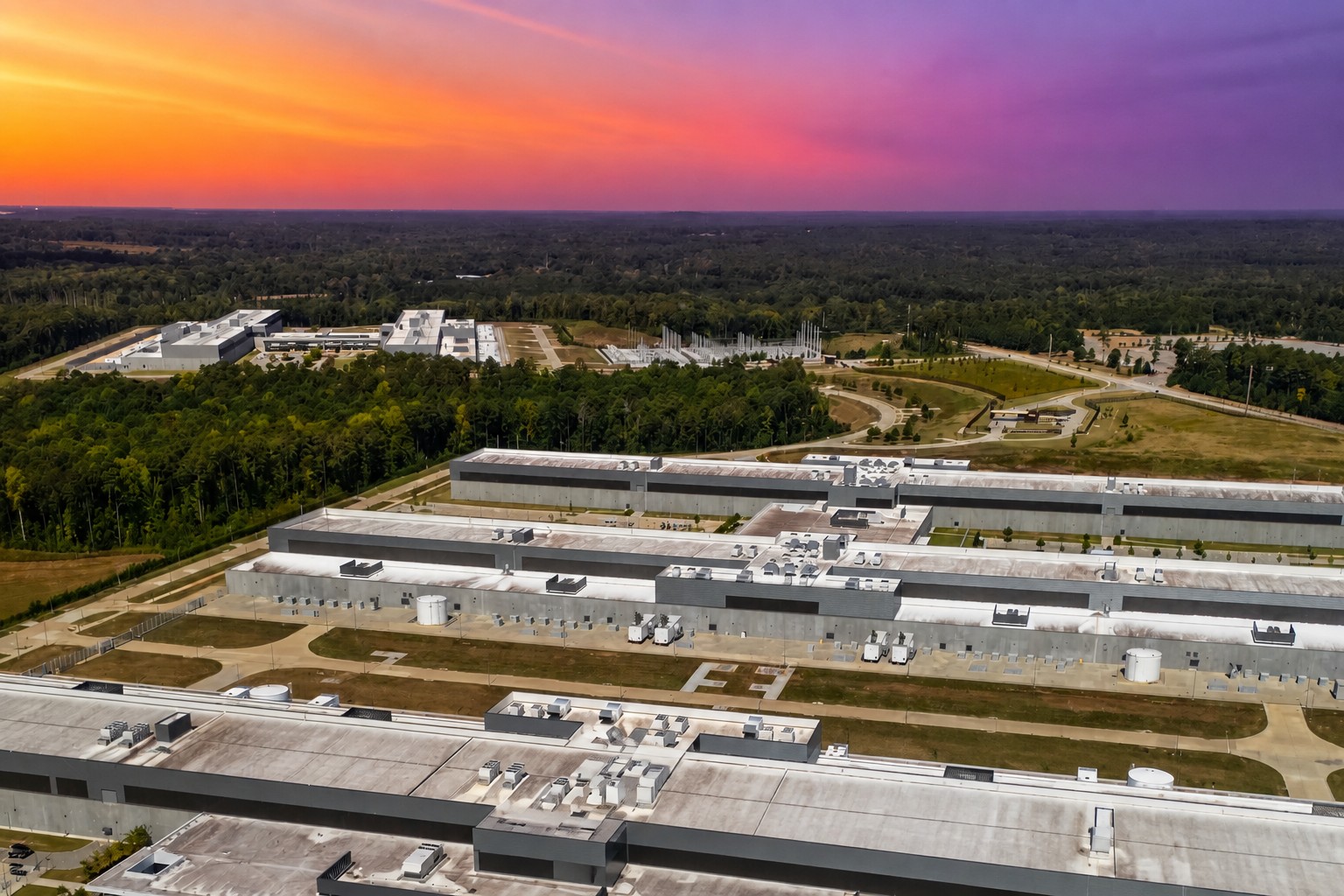
Tyler Turner, president of the Office and Professional Employees International Union, is telling the American labor movement to stop helping build AI data centers and start blocking them. He wants unions to push for the Artificial Intelligence Data Center Moratorium Act, introduced in Congress by Bernie Sanders and Alexandria Ocasio-Cortez, and to back state-level moratoriums like the one New York Governor Kathy Hochul recently signed. The number behind the argument is $8 trillion, the amount developers plan to put into these facilities in the coming years — roughly a quarter of US GDP.
Turner's starting premise is the one the industry states openly. AI executives expect the money back because the technology will let companies across sectors raise profits by cutting their largest expense, labor. Wages become corporate margin. He is not disputing that thesis; he is taking it literally and asking what it means for the people pouring the concrete.
That is where his real quarrel sits, and it is inside the labor movement rather than outside it. North America's Building Trades Unions has signed agreements with BlackRock, Meta and OpenAI to expand the data center network jointly. Turner grants that NABTU secured its members well-paid temporary work. His objection is that the deals ignore the position of all workers, construction workers included: AI is being built in part to replace them, and the finished buildings sustain almost no permanent employment. Union labor, in his framing, is putting up factories of computerized work that could displace millions of people, its own members among them.
The jobs arithmetic he cites is the strongest material in the argument. A data center in Rockland County, New York, received $77 million in tax breaks and created exactly one permanent job — the largest tax subsidy per job created in US history, and the proximate reason the state acted. New York has now paused construction permits for up to a year while it writes a regulatory framework. Turner calls the pause practical and insufficient, a first step.
Virginia, which hosts more operating data centers than any other state, supplies the same finding at scale. Research there found that per dollar invested, data centers create less than 1% of the permanent jobs other industries do. The positions that remain are mostly technicians and security guards.
The power numbers point the same way. In Turner's home state of Texas, 335 AI data centers already draw enough electricity to push rates up for everyone else, and at least 248 more are planned, which will drive a boom in gas-fired generation. The largest facility on the drawing board is expected to consume as much electricity as 2.75 million homes, more than Houston, Dallas, San Antonio and Austin combined. Corporations should not be allowed to raise energy consumption that sharply, he argues, while wildfires, superhurricanes and extreme heat work their way across the country.
His own members report the other side of the trade. In a survey of OPEIU members conducted last year, the union found AI already damaging workers along several axes: layoffs, surveillance, and discipline for errors the AI models themselves produced. OPEIU represents 90,000 workers in technology, healthcare, higher education and nonprofits — the sectors where AI has landed hardest — in places like Amarillo, Texas; Lansing, Michigan; and Ashburn, Virginia. Turner himself lives and works in Fort Worth.
What he wants after a moratorium is deliberately open-ended: a fair share of whatever benefits AI produces, expressed as higher pay, a shorter work week, or the removal of dangerous tasks, plus lawmakers who require data centers to be built sustainably, with community consent and well-paid workers. The tech billionaires funding Trump and opposing unions say they are leading a revolution that will remake the world economy, and Turner's advice is to believe them and organize on that basis.
Read plainly, this is a jurisdictional conflict presented as a policy argument, and the presentation does not quite cover it. The unions whose members get paid to build data centers and the unions whose members get replaced by what runs inside them are not the same unions. Turner's call for labor to act together rather than set members against each other is, in practical terms, a request that NABTU walk away from contracts it has already signed, in exchange for gains that would accrue to somebody else's membership. A federal moratorium would resolve that by removing the work from the table entirely, which is a way of winning the argument rather than settling it.
Notably absent from the case is any accounting of what the pause costs the people currently on those sites, or what a building trades local is supposed to tell them. Equally absent is a number attached to "fair share." Unions bargain in figures — percentages, hours, headcount — and a demand stated as higher pay or a shorter week or fewer dangerous tasks is a menu, not a position. That vagueness is understandable when nobody knows what AI will actually produce, but it is a weak thing to set against $77 million and one job, which is precise enough to move a governor.
The New York pause runs up to a year. The build it interrupts runs to $8 trillion. Whatever the labor movement decides about which side of that it is on, it will be deciding while the foundations go in.