
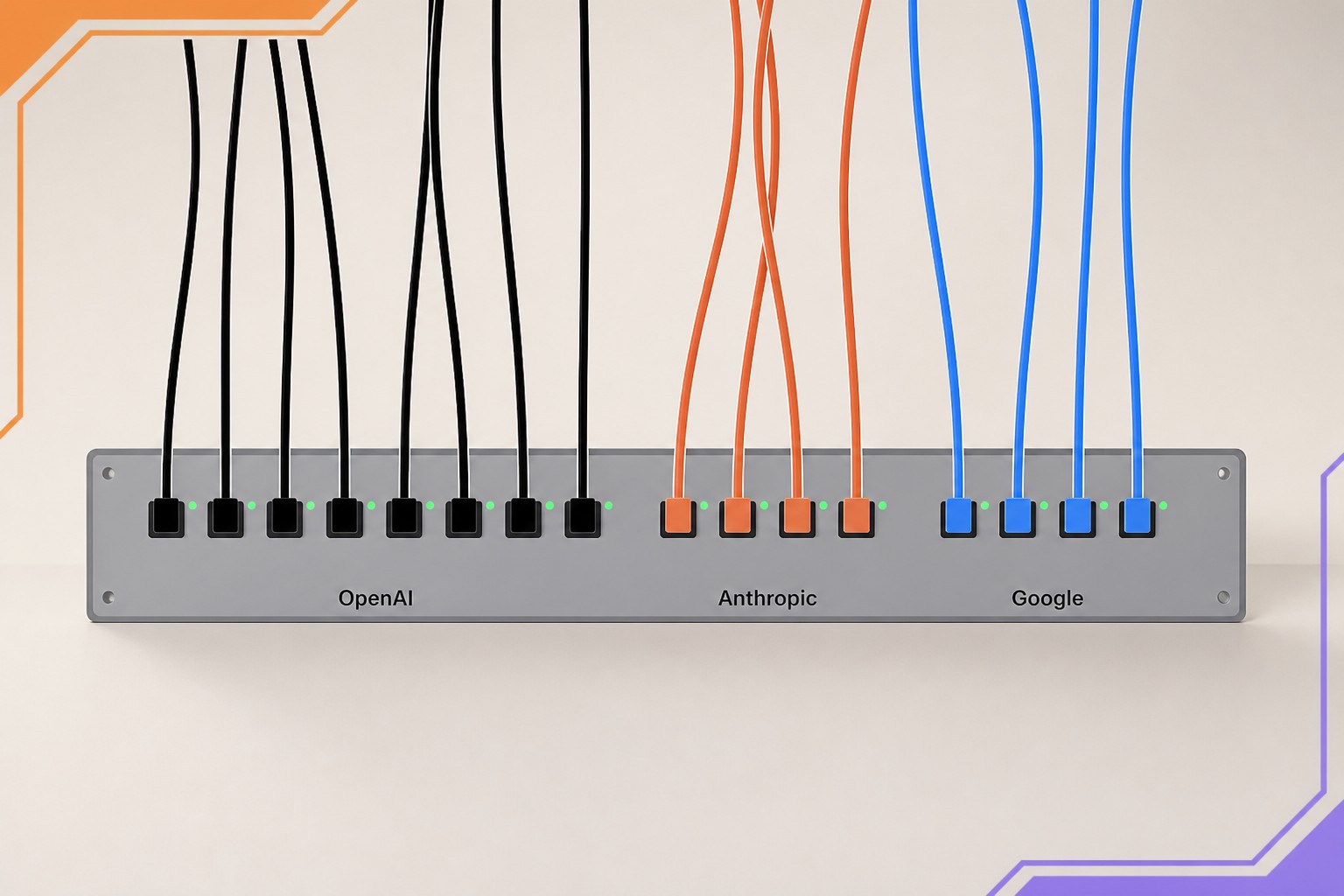
OpenAI leads, but “primary platform” is a different measure
Among companies using agent-management platforms, 25% named OpenAI as their primary platform, ahead of Google at 18% and Anthropic at 16%. The survey included OpenAI’s Agents SDK and Responses API, Anthropic’s Claude Agent SDK and Managed Agents, and Google’s Enterprise Agent Platform.
Other respondents named products including Salesforce Agentforce, Microsoft Copilot Studio, Amazon Bedrock and open-source frameworks such as LangChain.
A separate September VentureBeat survey asked about cloud services and models used in production. Google Cloud was named by 51% of respondents, Microsoft Azure by 36% and Amazon Web Services by 23%. For models, 41% said they used OpenAI models, 39% Gemini and 15% Anthropic models.
Google’s position looks stronger when its cloud and models are combined: 68% used Google Cloud or Gemini, versus 62% for Microsoft Azure or OpenAI. But the survey asked about different categories, and respondents could name a cloud provider even when they ran OpenAI models through Azure or Claude through Amazon or Google.
Home Depot illustrates how those choices can overlap. Angie Brown, the retailer’s executive vice president and CIO, said in an interview for VentureBeat’s Beyond the Pilot podcast, scheduled to appear later this month, that Home Depot uses Google ADK extensively and stores most of its data in Google BigQuery. It also runs OpenAI models through Azure to evaluate Google’s models, uses Claude for coding, and uses OpenAI models to check code. Brown said the company does not rely exclusively on Google products.
Adoption and spending tell different stories
A separate data point appears to pull in the other direction. Ramp said that, as of September 9, 43.8% of companies on its platform paid Anthropic for subscriptions or tokens, compared with 39.8% paying OpenAI.
Those figures do not contradict VentureBeat’s survey so much as measure something else. Ramp tracks its own card and software customers, a group skewed toward technology-oriented businesses. It also gives a 50-person company the same weight as one with 50,000 employees. VentureBeat, by contrast, surveyed employees at organizations with at least 100 staff and consultants whose primary client met that threshold. One company can pay for Claude subscriptions and API access while deploying agents on OpenAI’s platform.
The business context makes the distinction especially relevant. Anthropic said in June that it had confidentially filed for an IPO. Bloomberg reported that the company planned to meet select institutional investors at its San Francisco headquarters on Wednesday ahead of a public listing. Meanwhile, Axios reported that OpenAI’s annualized revenue was about $50 billion, roughly $20 billion below the $70 billion figure often cited in September; that higher figure included sales through cloud partners, as Anthropic counts its own sales. CNN reported that technology stocks fell on October 8 after the lower estimate was published. VentureBeat’s surveys did not measure revenue or Anthropic’s IPO plans.
The survey’s forward-looking responses also show a close race. Among 61 companies that named at least one platform they might adopt, add or replace within 12 months, 33% named Anthropic, 30% OpenAI and 25% Google. Of the 20 companies considering Anthropic, 60% were not using it yet.
Switching models is where the friction shows
Ramp reported that an average of 8% of its companies changed model providers each month during the three months through September, the highest rate in its tracking history. VentureBeat asked a related but narrower question: had companies changed the model inside a live application in the past year while keeping the application itself? Sixty-two percent said they had.
Of those companies, 59% saw performance fall and either reworked the application or returned to the previous model. Only 19% said the switch required almost no engineering work. For 75%, it took several days or longer, or could not be completed.
Brown said switching was costly for Home Depot because each new model had to be taught the context again, creating dependence on the solution already in use. Consultants reported more switching than company employees: 81% said their main client had changed models in the past year, compared with 51% of employees describing their own employer. That difference pushed the combined result to 62%.
I think that makes platform adoption a less useful proxy for loyalty than it first appears. Companies may name OpenAI as the platform they use and still depend on other vendors for coding, cloud infrastructure or model evaluation. The more consequential finding is that changing the model can mean rebuilding the application around it.
VentureBeat also found that, among companies using data search in production, 58% used OpenAI search and 50% used Google Vertex AI Search. Pinecone and Elasticsearch each appeared in 12–14% of responses, while 40% used at least one standalone tool.
For technical leaders planning a model change, the survey points to time for rework, including retesting prompts, tools and evaluations built around the previous model. VentureBeat Intelligence plans to ask the same questions in its October VB Pulse survey, which will show whether OpenAI’s lead holds among a new group of respondents.
How to read the results
VentureBeat Intelligence conducted five VB Pulse surveys in September 2026. This article draws on three: agent management, with 109 eligible respondents; AI infrastructure and compute, with 102; and agentic context layers, with 113. Participants worked at organizations with at least 100 employees or consulted for such organizations as their primary client.
Each monthly survey uses a new group recruited from VentureBeat readers and a research panel. September’s screening questions differed from August’s, so the Google comparison passed a statistical test across the full September sample and among company employees alone.
The results describe the respondents, not every company. OpenAI’s lead in agent-management platform use passed a 95% confidence test, including among company employees without consultants. The group considering Anthropic was small: 20 organizations.
Daily AI news
Every day we pick what actually matters in AI and explain it plainly — no hype, no filler. Subscribe if you want to follow where the industry is going.
Only what matters — every day
Follow on X