
The cost is in the whole task
A token’s listed price is only part of an AI bill. A model that charges less per token can still cost more if it needs many more tokens to finish the work.
The contrast is easy to see in a coding example: at $1 per million tokens, 30,000 tokens cost 3 cents. At $2 per million, 10,000 tokens cost 2 cents. Reflection argues that Beam can make this trade-off work in its favor.
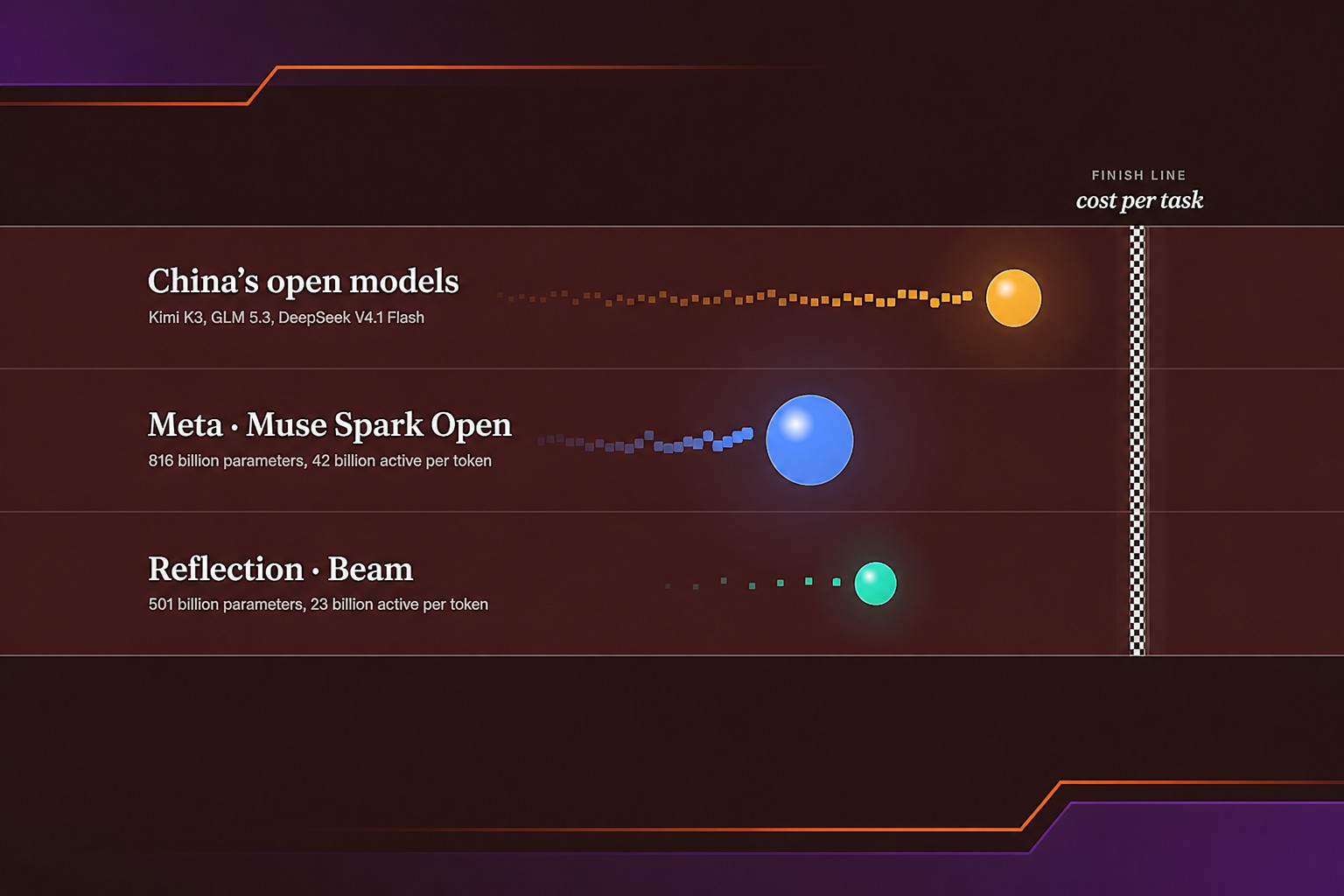
That argument matters most for the medium-sized models used for everyday work. Reflection says Beam is designed for coding and AI agents. It has 501 billion parameters, with 23 billion active for each token. Meta’s Muse Spark Open uses 42 billion active parameters per token, which VentureBeat estimates means about 1.8 times as much computation per token as Beam.
But Meta has not said how many tokens Muse Spark Open uses per task. And Reflection has not named Beam’s price: its hosted service is free during public beta, while partners set their own rates.
Fewer tokens, with a caveat
Reflection says it trained Beam with intensive reinforcement learning, rewarding successful task completion and penalizing unnecessary tokens. The company says the process ran for four weeks, with more than 100 million full attempts to solve tasks, using a cluster of 10,500 Nvidia GB300 GPUs.
The company’s published comparisons suggest Beam can use substantially fewer tokens than some competitors on particular tests:
These are not a complete cost comparison. Reflection’s estimate of compute per token is calculated, not measured, and excludes the work needed to read a prompt. Long prompts are common in coding and agent tasks. Nor does using fewer tokens guarantee a lower bill: the software kernels that run a model on a particular chip also affect speed and cost.
I think the missing number is the one buyers need most: the price of a completed task, measured under comparable conditions. Reflection has not provided it. Its vice president of product, Joe Spisak, said the company did not yet have specific figures comparing Beam’s cost per completed coding task with DeepSeek or GLM.
Open weights are also a deployment choice
Reflection is not just selling a model. It is releasing an open operating system for running and deploying Beam, developed with 33 partners. The software, like Beam’s weights, uses the Apache 2.0 license. Reflection says it includes containers that let companies load Beam onto their own servers with one command, and that it can run on a company’s Kubernetes infrastructure in minutes.
The package also includes Mirror CLI, an open coding agent written in Rust and Python. Reflection says it uses the tool internally to write and review code for its model.
That deployment story matters because open models are already part of companies’ cost strategies. Pinterest built its Navigator 1 shopping assistant on Alibaba’s Qwen 3 VL; CEO Bill Ready said in November 2025 that fine-tuned open models cut costs by 90% versus leading closed models. Coinbase CEO Brian Armstrong said the company nearly halved AI spending by making Z.ai’s GLM and Moonshot’s Kimi the defaults in internal tools. DoorDash’s CTO Andy Fang has praised Kimi’s coding quality relative to its cost.
There is a less visible issue alongside price: where a model came from. In a VentureBeat survey, 56% of 32 respondents using open-weight models could not confidently identify the origin of models in their toolsets, or did not know whether any came from Chinese labs. Cursor’s Composer 2, for example, was built on Moonshot’s Kimi K2.5; Cursor confirmed the connection after a developer found the model name in product network traffic.
Reflection says Beam was trained from scratch, starting with new weights, and did not use other models’ outputs. The company also points to its software and Apache 2.0 license as part of its offer. That may appeal to companies that want more control over deployment, but it does not settle the question of whether Beam is cheaper in production.
The gap between a promising token-efficiency chart and a lower invoice is where Reflection’s case will be tested. Until it publishes task-level costs, Beam’s strongest argument is a measured one: it may need fewer tokens, but buyers still cannot see what that saves them.
Daily AI news
Every day we pick what actually matters in AI and explain it plainly — no hype, no filler. Subscribe if you want to follow where the industry is going.
Only what matters — every day
Follow on X