
Why retrosynthesis remains difficult
Drug and materials research can generate vast numbers of candidate molecules. The bottleneck is often more basic: finding a practical laboratory route to make them.
Retrosynthetic analysis works backward from a target molecule, breaking it into simpler precursors. Each bond disconnection is a possible move, but the search space is far larger than in chess or Go, and a move that looks plausible may not be chemically available.
Existing systems commonly struggle to:
That limits the scale at which automated synthesis planning can support molecular research.
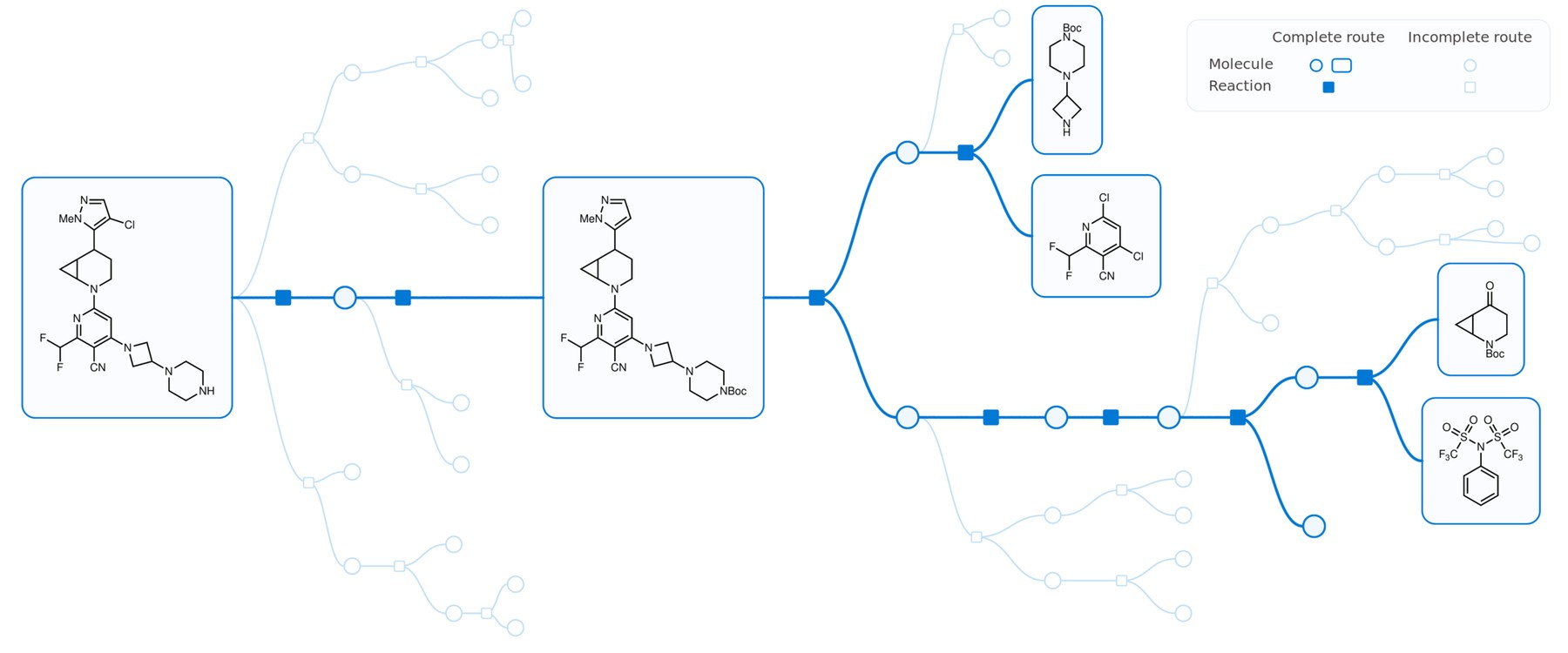
Figure 1: Planning a synthesis by working backward. Retrosynthesis starts with a target molecule and proposes successive disconnections into simpler precursors until purchasable building blocks are reached. The highlighted path shows a complete synthesis route; pale branches illustrate alternatives explored along the way. Circles represent molecules and squares represent reactions. For clarity, only a few branches are illustrated, with chemical structures shown for the target, one intermediate, and selected building blocks.
Source: microsoft.com
Two models, one ranking system
RetroChimera is built around two complementary predictors rather than a single universal approach.
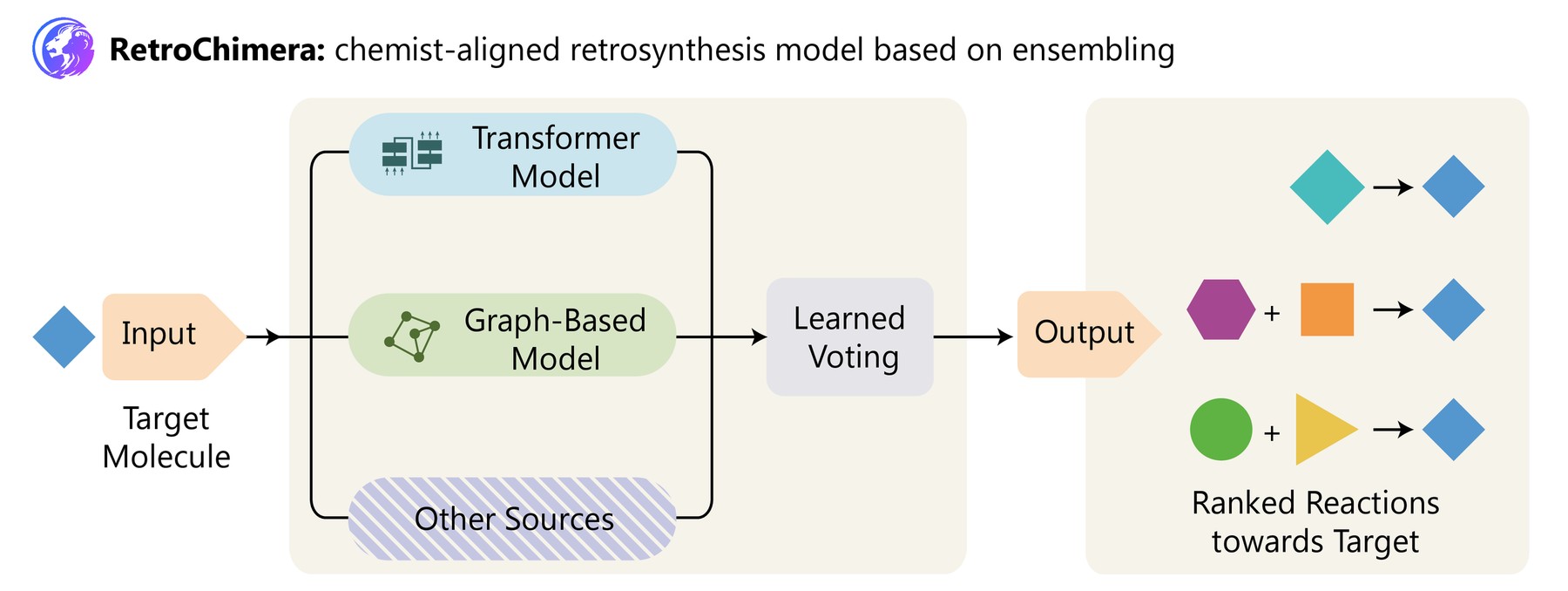
Figure 2: Our framework for ensemble-based retrosynthesis with learned re-ranking which underpins RetroChimera. The ensemble receives a target molecule as the input, which is then processed by the sub-models. The model outputs are aggregated using a learning-to-rank strategy. While in this work we only investigate deep learning models as prediction sources (solid boxes), it is possible to add additional sources, for example calls to reaction databases or human-in-the-loop queries (dashed box).
Source: microsoft.com
The models do not simply duplicate one another. R-SMILES 2 is particularly effective for reactions with major structural changes, while NeuralLoc performs better on less frequent reactions and those involving more local changes.
RetroChimera combines their ranked predictions with a trainable ensemble strategy. Each model assigns votes according to a candidate’s position in its ranking. When both models suggest the same reaction, their votes are combined. The system learns how much to trust each model at different ranking positions, allowing it to use their different strengths. Across reaction classes, it roughly reaches the level of whichever submodel performs better.
What the evaluation shows
The reported results cover both common and rare reaction classes. In blind tests, chemists preferred RetroChimera’s proposed bond disconnections in complex molecules over:
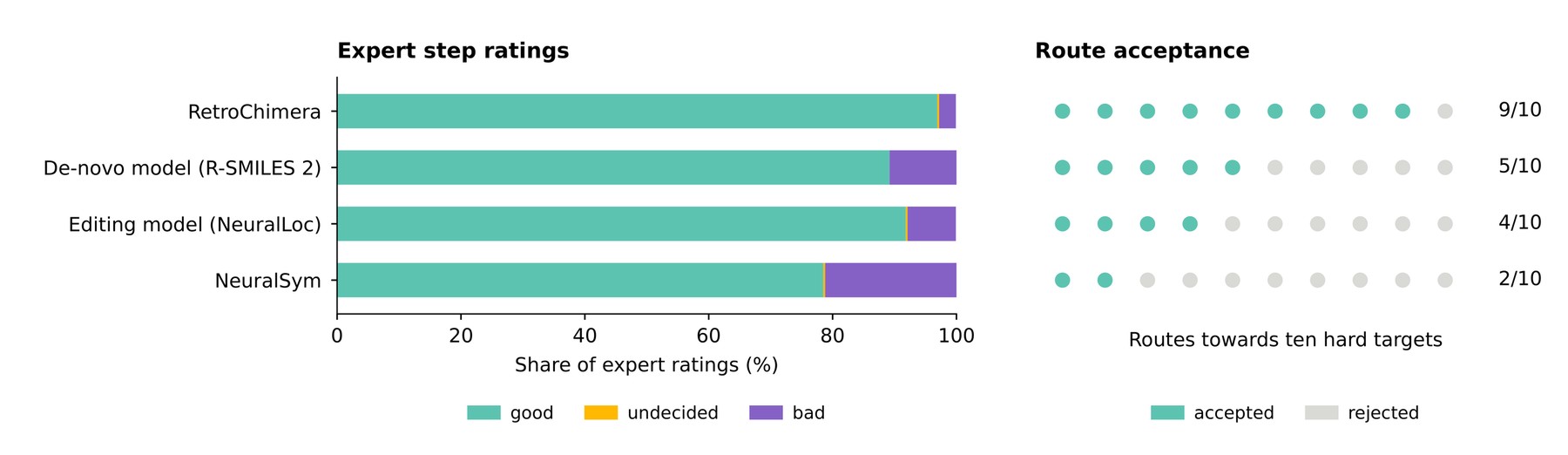
Figure 3: Expert assessment of multistep synthesis routes. Left: Ratings of individual reaction steps. Right: Complete routes accepted or rejected for ten challenging targets. RetroChimera succeeded on nine targets, versus five for the de novo model, four for the editing model, and two for NeuralSym, a strong baseline model.
Source: microsoft.com
That result matters because retrosynthesis systems are not judged only by whether they can produce an answer. They must produce routes that experts consider plausible enough to pursue. RetroChimera’s advantage, as presented here, comes less from one model mastering every reaction than from making disagreement between two imperfect models useful.
I think that is the more interesting design choice. The paper’s practical claim is not that free generation or reaction templates have won; it is that their blind spots can be ranked against each other.
Open access, unresolved constraints
The model is published on GitHub under the MIT license and is available through Microsoft Foundry. Instructions for using the checkpoint are provided in the GitHub repository. The developers are asking the chemistry community to test it on different target molecules and expose where it succeeds or fails.
What I’d want to know is how often those preferred predictions translate into routes that can actually be executed in the lab. The reported evaluations establish that chemists like RetroChimera’s choices, and that the system can cover rare reaction types. They do not, in the supplied results, establish how much laboratory work is saved per successful route.
That distinction will shape the model’s value in closed-loop systems that plan, perform and check synthesis. Open weights make those systems easier to build, but practical synthesis still decides whether better ranking becomes faster discovery.
Daily AI news
Every day we pick what actually matters in AI and explain it plainly — no hype, no filler. Subscribe if you want to follow where the industry is going.
Only what matters — every day
Follow on X