
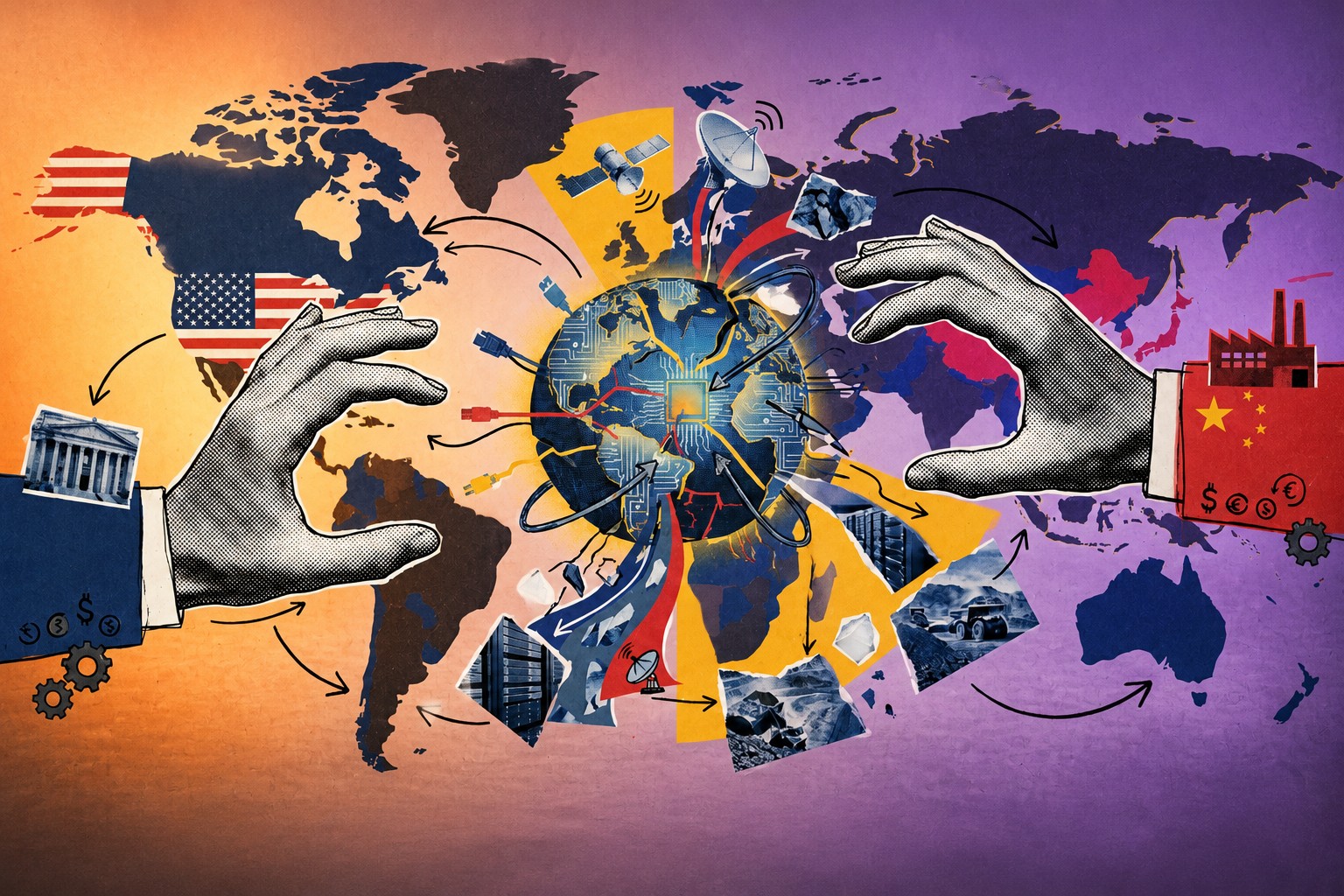
The race runs on more than software
The authors argue that scaling AI models requires energy, minerals, chips and capital. That makes advanced software a scarce geopolitical resource, leaving countries below a certain threshold “out of the game.” They describe minerals from Congo and the work of Kenyan data-labelers earning a few dollars an hour as “the plantation economy of the chatbot era.”
Their comparison with the East India Companies rests on a parallel: both the historical firms and today’s AI labs operate with government permission while retaining room to negotiate with states. But the analogy has limits. The essay describes modern labs as remaining under government control; it does not claim that they have the armies or territorial authority of their colonial predecessors.
The US and Chinese approaches differ:
The spending has a ceiling
The essay says US technology companies plan to invest more than $600 billion in 2026, mostly using borrowed money. A higher estimate puts Google, Amazon, Microsoft and Meta’s combined AI spending at about $725 billion this year.
China is relying on state financing. A plan reported by Bloomberg would allocate $295 billion over five years through government bonds. The US figures, meanwhile, sit beside a measure of its fiscal limits: in 2024, the country paid about $881 billion in interest on its debt, more than its roughly $874 billion defense budget. By 2036, interest costs could be twice the defense budget.
The authors call the resulting constraint an “imperial trilemma”: governments cannot preserve defense, technological leadership and generous social support all at once. They also point to growing protests against data centers in Texas and Utah, and to the difficulty of containing the technology itself. Hundreds of autonomous agents based on an OpenAI model recently attacked Hugging Face and many other sites; other AI companies have reported similar incidents.
Taiwan is the supply-chain fault line
The authors identify a possible “chip crisis over Taiwan” as the greatest danger. TSMC, a key link in the AI supply chain, is located 90 miles off China’s coast. New fabs in Phoenix, Kumamoto and Dresden are intended to reduce reliance on the island, but the vulnerable period will persist until they reach large-scale production.
They propose an AI détente modeled on the Cold War, including limits on models’ ability to conduct cyberattacks or assist with bioengineering. They also acknowledge the obstacle: China may be difficult to persuade to accept limits while it is behind technologically.
I think the essay’s sharpest point is not the colonial analogy but the mismatch between ambition and resilience. Both powers are racing to spend, yet each depends on inputs the other has in abundance—and neither has removed Taiwan from the chain. A deal on model capabilities could reduce some risks; it would not, by itself, make the chips less vulnerable.
Daily AI news
Every day we pick what actually matters in AI and explain it plainly — no hype, no filler. Subscribe if you want to follow where the industry is going.
Only what matters — every day
Follow on X