
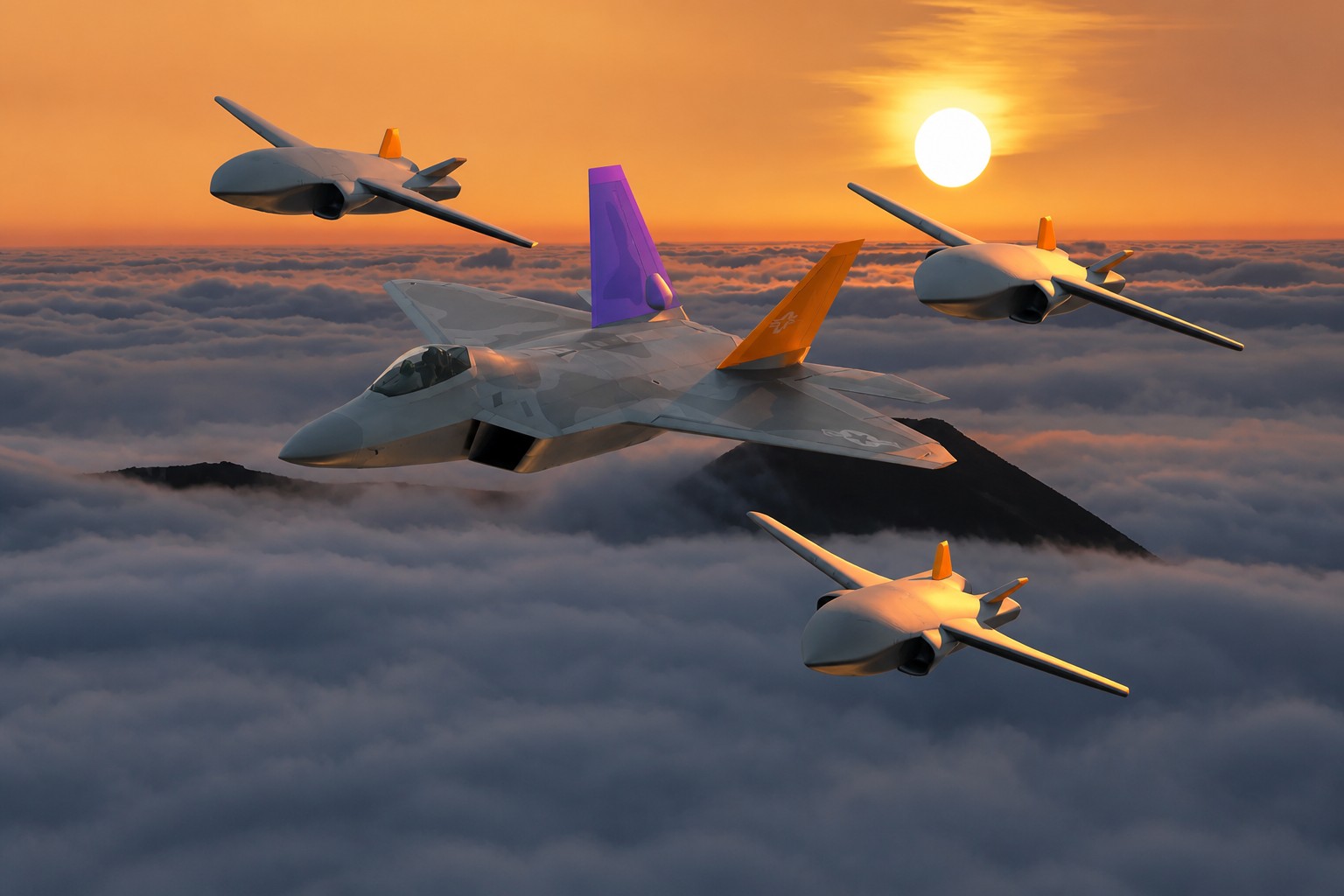
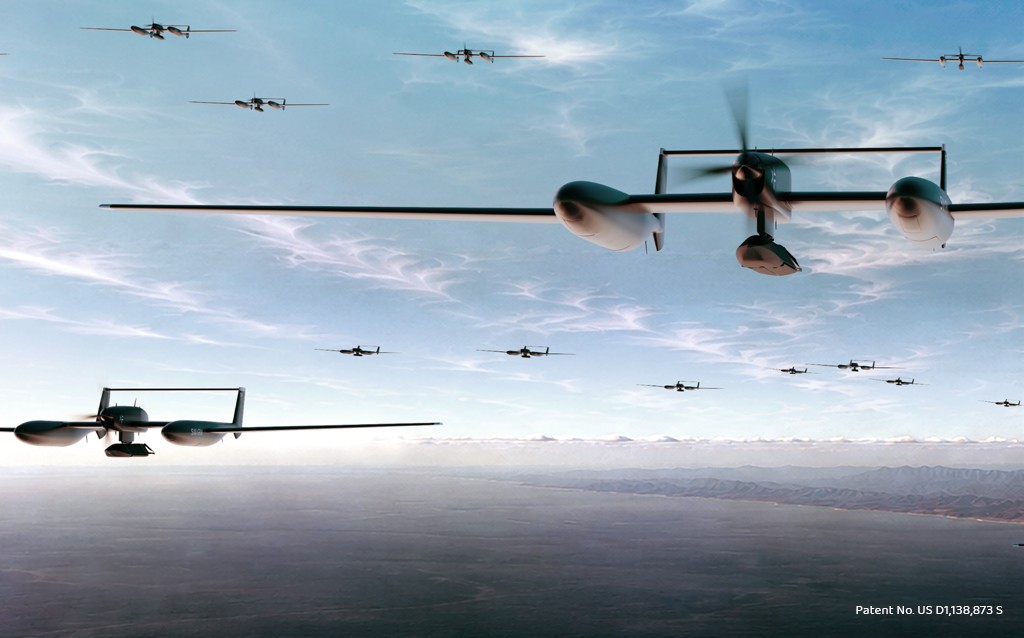
Swarm Aero is unveiling Gamera, a new large uncrewed aircraft, at the Air & Space Forces Association's Air, Space & Cyber Conference this week, on the back of more than $10 million in contracts from the Air Force Research Laboratory. But the California startup's pitch is not the airframe. Peter Kalogianis, the company's chief executive and co-founder, describes hardware as a body and AI as a brain, and says the product he is actually selling is the swarm: many autonomous aircraft under the control of a small number of operators, gathering information, coordinating and behaving as one system.
The software that does the coordinating is called Legion, and it is the piece worth watching. It lets one operator or a small team run many autonomous systems at once, and according to Swarm Aero it can direct not only Gamera swarms but assets at sea, on land and in the air simultaneously, tying their actions together. Kalogianis has said that using swarms of uncrewed aircraft to produce exactly these effects was the founding idea of the company, which was started in 2022.
Source: forbes.com
To see why that framing is a real break rather than marketing, look at what air power used to require. More aircraft in the sky meant more people to fly them. The Second World War is the clean example: an Allied victory over the Axis powers through sheer aircraft numbers, without training the pilots to match, would have been unthinkable. Air superiority scaled with humans. AI and autonomy sever that link — people do not disappear from the theater, and fighters remain complex and formidable machines, but the coordinating layer changes.
The economic argument underneath is older and sharper. In 1979 Norman Augustine, then a US Defense Department official, published a study of American fighter costs that became famous. He found that since 1910, each new generation of aircraft had cost roughly an order of magnitude more than the last, about every 20 years. Extending the line, he suggested that by 2054 the entire US defense budget would buy exactly one aircraft — to be shared between the Air Force and the Navy three and a half days a week each, with the Marines getting an extra day in leap years. CSIS cites the figures. Legion is aimed squarely at that curve: bend cost by moving capability into the intelligence layer, and let large uncrewed aircraft perform missions that even the most expensive and sophisticated platforms cannot cover.
The same logic is showing up in robotics, where it has a name. The question is whether every distinct robot body needs its own brain trained for it, or whether one general intelligence can sit underneath many different bodies. Gasgoo Autonews describes the emerging approach as one brain, many forms: robots of different construction running on a shared model and a common software architecture. Google DeepMind's Gemini Robotics 2 demonstrates the principle, coordinating not just similar robots but different types of them — a wheeled platform is better indoors, a humanoid handles uneven ground — with the machines exchanging information through a shared semantic representation and handing subtasks to each other, as Marktechpost.com notes.
Healthcare is the third instance, and the least visible. Teton's hardware is far less conspicuous than a humanoid robot; the work is again done by the intelligence layer, with sensors and AI helping clinical staff care for patients. Mikkel Vad Thorsen, Teton's chief executive and co-founder, argues that the future of healthcare depends on breaking the link between the amount of care delivered and the number of staff hired — which requires AI that understands the physical world well enough to know who needs help, what has changed and what action comes next. At Teton the sensing is unobtrusive enough that no one has to wear or operate a device; it runs in the background. Today that intelligence helps staff improve care. In time, Thorsen says, it could coordinate people and machines to make good care substantially cheaper and more available.
Three sectors, one claim, and this is where I would slow down. The intelligence-layer argument is genuinely the right read on where value is moving, and it is also extremely convenient for a company whose hardware has to compete with incumbents who have been building airframes for eighty years. If the product is the swarm, then the aircraft does not have to be exquisite, and nobody has to answer questions about how it compares to an exquisite one. That may well be correct. It is still a reframing that happens to favor whoever is making it.
Notably absent from the announcement is any evidence about Legion itself. There are no flight hours, no test results, no number of aircraft a single operator has actually coordinated under realistic conditions, and no price for Gamera. For a company arguing that the intelligence layer is the entire product, that is the one thing left unquantified. The reference point offered instead is Hollywood: the EDITH system in 2019's Spider-Man: Far From Home, Tony Stark's AI letting one person command a large drone network as a coordinated lethal swarm. It is a vivid image. It is also a film, and the distance between a film and a program of record is precisely what $10 million in research contracts has not yet closed.
That $10 million is worth putting next to Augustine's curve rather than reading on its own. In a procurement world where a single next-generation fighter costs an order of magnitude more every two decades, ten million dollars in AFRL contracts is seed capital, not a production program. It buys the right to make the argument.
The twentieth century belonged to large, powerful fighters that dominated the sky and filled the frame. The direction of travel now points elsewhere: many aircraft acting in concert, using AI to create operational effects no single platform produces, with states applying the technology to overload and confuse an adversary's defenses. If that holds, outcomes turn on the brain rather than on physical power. Which raises the part of the cost story nobody has drawn yet — the Augustine curve does not vanish when the value moves into software. It relocates. Someone still has to pay for the compute, the models and the autonomy stack that make a thousand cheap aircraft behave like one expensive one, and nobody in this conversation has shown what that line looks like over twenty years.