
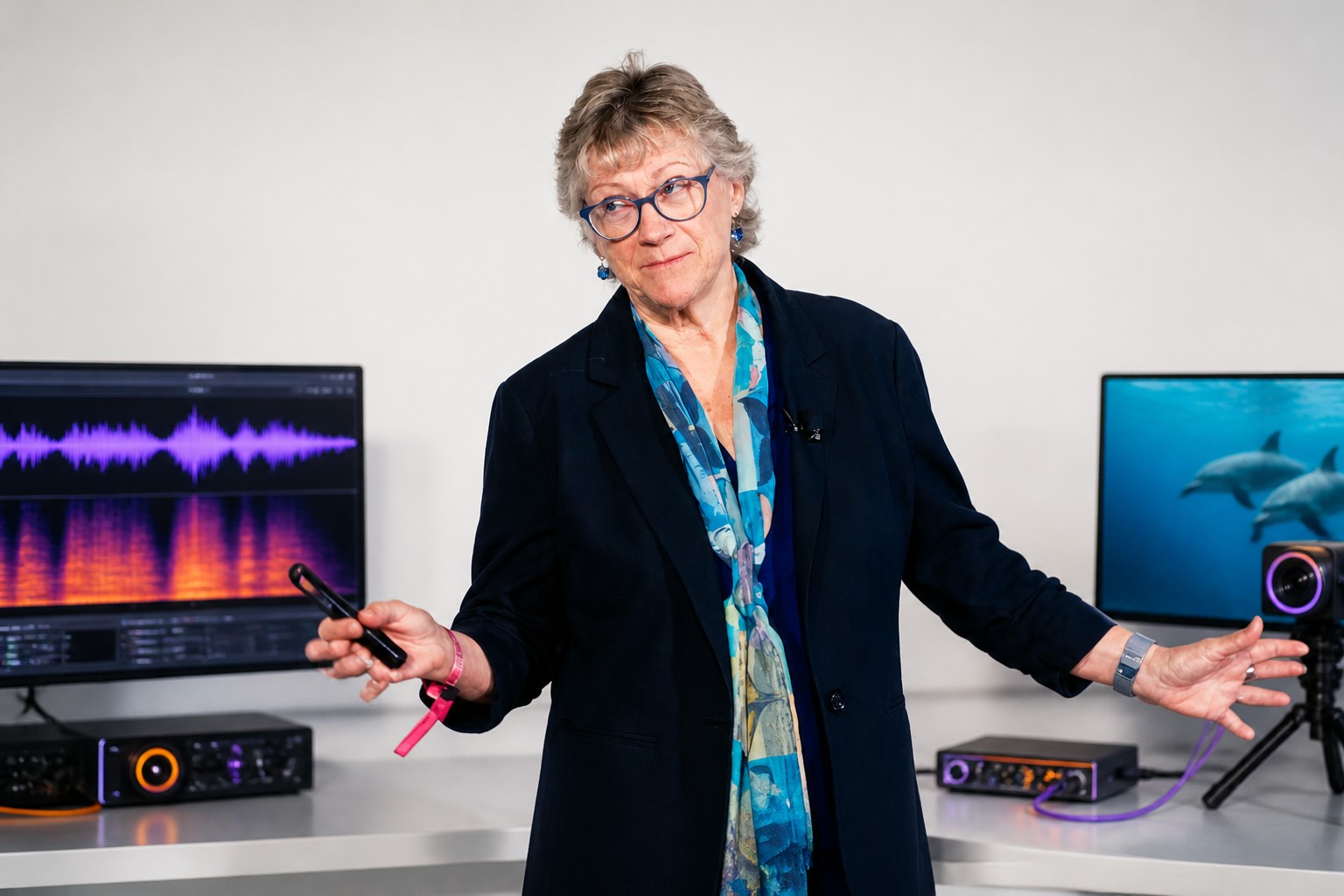
Researcher Denise Herzing, founder and director of the Wild Dolphin Project, is working with scientists from Georgia Tech and Google DeepMind to use AI to find patterns in dolphin sounds and behavior. Her team has collected many hours of audio and video recordings and is already testing whether dolphins respond to sounds played underwater. A full-fledged conversation is still a long way off: researchers still need to understand what the signals mean in dolphin culture and how to distinguish understanding from imitation.
AI helps researchers recognize dolphin signals
From observation to finding patterns
Herzing began studying how marine mammals communicate in 1985. During a trip to the Bahamas, she observed Atlantic spotted dolphins and heard their distinctive clicks and whistles. Forty years later, she says AI is helping her team analyze their acoustic signals.
At the WIRED World Fair, Herzing said the researchers are working with a large archive of video and audio recordings. Together with scientists from Georgia Tech and Google DeepMind, they are trying to identify structure in the dolphins’ “language,” though a full translation remains out of reach. AI makes it possible to search the data for recurring patterns—Herzing called it a new tool she had been waiting for.
How the team tests the dolphins’ responses
The team also tried to establish a two-way exchange of signals. To do so, the researchers prepared a wearable computer for underwater use that plays dolphin sounds. The signals represented objects, such as a scarf, and parts of the environment—in particular, sargassum, a type of seaweed.
The researchers then acted out scenarios: one played the sound associated with a scarf while the other interacted with the object. Afterward, the scientists observed how the dolphins responded.
But responding to a familiar signal does not prove that an animal understands what it is for. Herzing stressed that distinguishing understanding from imitation is especially difficult in the wild. She said studying dolphins in a sanctuary or another controlled setting could help clarify the difference.
A conversation is still a long way off
Herzing’s team has already found patterns in the signals, but much about what dolphins communicate with one another remains a mystery. People have made significant progress in understanding these animals’ social hierarchy and behavior, but that is not yet enough to hold a full-fledged conversation with them.
Even if researchers gather data and describe the structure of the signals, they will still need to find out what those signals mean in dolphin culture. Herzing believes this will require a separate line of research.
Trying to understand dolphins may help people think more deeply about their own relationship with the planet. When Herzing asks people what they think dolphins would say to a human, the most common answer is something like: “Why are you destroying our ocean?” The researcher says this response reflects how people themselves see the world.
Dataist’s take: AI helps researchers look for structure, but it does not reveal the meaning of the signals on its own; that requires taking dolphins’ behavior and social lives into account. So the immediate task is not to translate a conversation, but to test whether the animals actually understand the signals rather than simply reproduce them.
Daily AI news
Every day we pick what actually matters in AI and explain it plainly — no hype, no filler. Subscribe if you want to follow where the industry is going.
Only what matters — every day
Follow on X