
The British government is testing whether AI training can move young people off the NEET rolls. In a newly opened community centre called Vault, across from Preston bus station, a publicly funded pilot is running three-week AI bootcamps for 70 people aged 16 to 24 who are not in education, employment or training, or at risk of falling into that category. Graduates get access to apprenticeship places reserved by JD Sports, Heinz and the IT firm Agilysys. Nearly a million young people in the UK are NEET — a little over one in ten of their age group.
Inside, an instructor works through a laptop exercise with five participants, a demonstration of why AI models need data without errors. He asks whether everything is clear, and the group nods. That is the texture of the intervention: a short course, in one room, for a handful of people at a time.
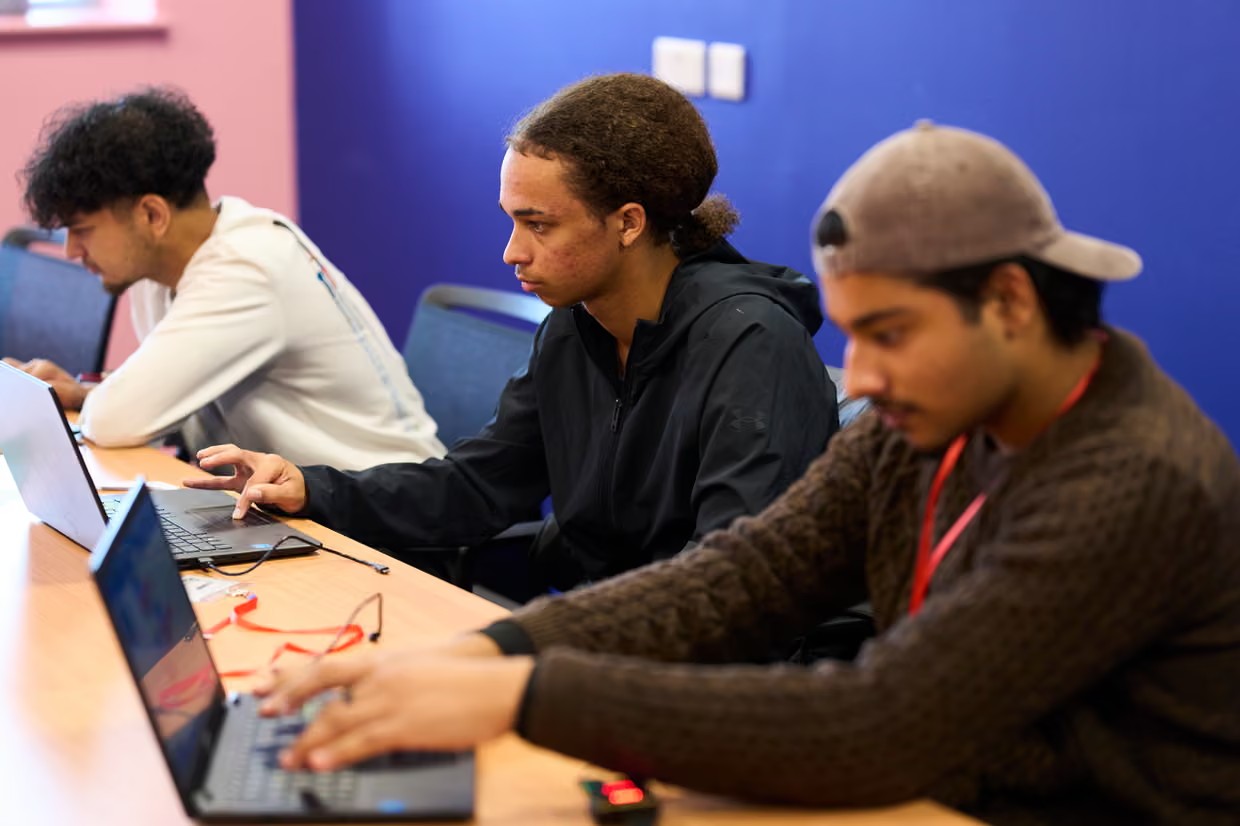
The pilot's three-week bootcamps are open to 70 young people classified as NEET or at risk of becoming so
Source: theguardian.com
Over three weeks, participants are meant to learn to build AI-based tools, understand how companies use the technology, and work with it responsibly. Two apprenticeship tracks follow: one for entry-level content creators, preparing them for marketing roles that use AI, and one for IT support staff, handling user tickets with AI skills attached. A graduate who lands a place joins an organisation that needs those competencies and already has an AI-related role on its books.
Lauren Monks, who heads IN4 Group, the company commissioned to deliver the programme, says it will narrow the distance between what young people can do and what employers need, raise productivity, and embed AI inside organisations.

"This is an opportunity to close the gap, raise productivity and embed AI in organisations," says Lauren Monks
Source: theguardian.com
The participants are more measured than the pitch. Khudeja Rafique, 18, from Burnley, expects the technology to be useful to her whatever profession she ends up choosing. Remi Simms, 17, is interested in the content-creator apprenticeship and says the Preston course changed how he sees AI — he understands better how it works and can now imagine working alongside it.

Remi Simms, 17, says the Preston course gave him a "better understanding" of AI
Source: theguardian.com
Set the programme against the problem it is attached to and the arithmetic turns uncomfortable. Nearly a million young people are NEET; this pilot has 70 places and lasts three weeks. That is a research sample, not a labour-market intervention, and it should be described as one. Alan Milburn, the former Labour cabinet minister, warned in a recent report that without government action Britain faces a "lost generation" of young people outside education and work. His proposals run far wider than AI courses — he calls for reform of the welfare system, among other things — and the same report notes that the employment schemes launched by successive governments have failed to solve the problem.
There is a sharper tension in the design. The two apprenticeship tracks are entry-level content production and IT support, at a moment when the whole anxiety about AI and employment is that routine junior work is the first thing to go. So far that anxiety has concentrated on the graduate market, where systems are expected to absorb the tasks once handed to junior staff in banking, consulting and law. Whether the same pressure reaches work that does not require a degree is genuinely unknown: Bouke Klein Teeselink, who researches AI and the future of work at King's College London, says there is not yet data precise enough to compare what is happening in graduate and non-graduate markets. Routing NEET young people into two of the more automatable entry-level job families reads like a bet that fluency with the tool outlasts the task it was meant to perform.
Klein Teeselink's own framing is the honest one. He thinks the pilot could help work out how to draw more young people into employment, and he names the two things that will decide whether it did: the quality of the AI teaching, and whether the new hires make a real contribution to company productivity. He hopes it is rolled out in a way that lets the government answer both. That is a study design, and a reasonable thing to spend public money on — as long as nobody sells it as a remedy.
The diagnosis does not quite match the prescription either. Chris Goulden, deputy chief executive of Youth Futures Organisation, which studies routes into work for young people, does not think AI is behind the rise in NEET numbers at all. He attributes the post-COVID increase mainly to mental health problems and a slowing economy, and argues that Britain needs more apprenticeships and better vocational guidance for children who are not heading to university. He is not dismissive of the technology — it moves every day and will touch a large number of occupations, he says — and his case for teaching it is conditional: if AI is removing the first rung of the ladder, young people should at least be handed the thing that removed it. He calls that part of preparing them for the future.
Nothing in the announcement says how many apprenticeship places the three named partners are actually holding, or what becomes of the participants who finish the three weeks without one. For a cohort defined by having already fallen out of education and work, the gap between a course ending and a job starting is the part that determines whether any of this worked, and it is the part with no number attached to it.

Hamid Muhammad-Asif, 16, says he would be happy with an apprenticeship as a content creator or an IT support specialist
Source: theguardian.com
In Preston the cohort is ready for the next stage. Hamid Muhammad-Asif, 16, from Blackburn, says either track would suit him: content creator or IT support. He will find out which of them, if either, has room for him. The government will find out something else — whether three weeks of AI training is enough to change an employer's mind about hiring a 16-year-old who has been out of work. Only the second question scales, and the pilot is not sized to answer it.