
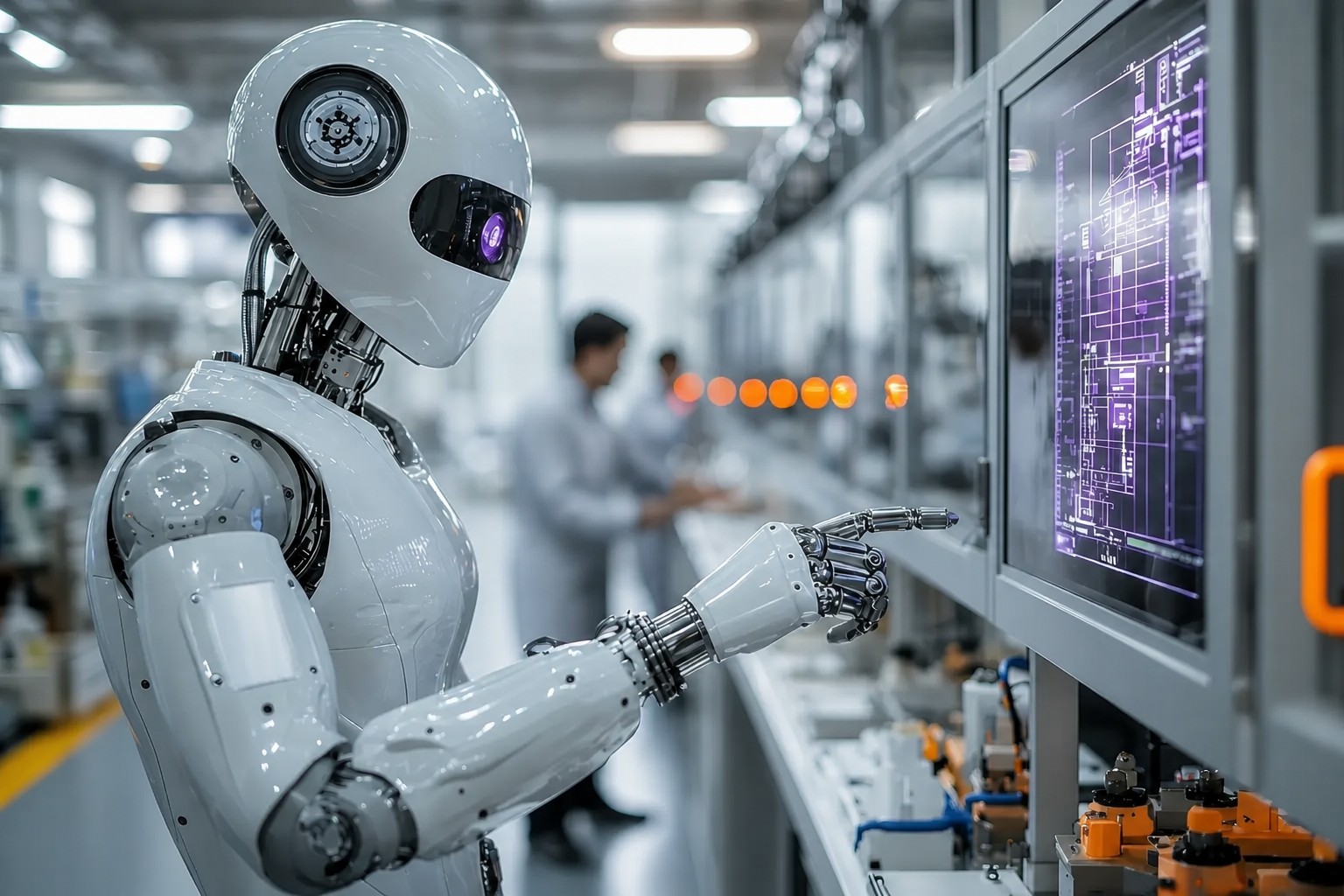
The case for humanoid robots now rests on two numbers instead of a promise. BMW's Spartanburg plant has, by available accounts, already built 30,000 cars with humanoid robots involved in the work, and Unitree sells its G1 for roughly $13,000 — cheap enough that the machine is no longer the expensive part of the idea. Against those sits the figure the field keeps repeating: a billion humanoid robots by 2050. The distance between a few industrial pilots and a billion units is where every question that matters lives.
Start with why the shape matters at all, because the shape is the entire argument. A machine with arms, legs and hands can move and manipulate objects roughly the way a person does, which means it can in principle do physical work that previously required a person. More importantly, it does not require the world to be rebuilt around it. Homes, factories and workplaces are full of stairs, doors, shelves, tools and machines designed for human limbs. A wheeled arm needs an environment adapted to it. A humanoid, in theory, walks into a building made for people and picks up the tools already there.
That theory is old. What changed is the software. The same advances that produced systems answering questions and generating images now let robots interpret instructions, make decisions and adapt to physical surroundings. AI helps a humanoid hold its balance, walk over uneven ground, grip objects and coordinate its limbs. Language models can help it parse a task, reason about a problem and choose the next step. The field calls this embodied AI: intelligence leaving the screen and acting on the world.
Today almost all the working humanoids are industrial. Manufacturing is the clearest case — the BMW deployment in Spartanburg. Hazardous environments are the second: machines that tolerate high heat, toxic fumes, chemicals and nuclear radiation, which is part of what Tesla has said Optimus is meant for. Warehouses and logistics are the third, moving containers and parcels without fatigue, which is what Amazon has been testing.
Then there are the demonstrations, which deserve to be separated from the work. One humanoid recently set a world record with a jump of nearly eight meters. Another beat Usain Bolt's time over 100 meters at the World Humanoid Robot Games in Beijing. These are impressive and they are athletics. A record set in a controlled setting says something about actuator power and control loops and almost nothing about whether a machine can stand at a station for eight hours and not damage a part or a person.
The builders divide into recognizable camps. Tesla is applying its batteries, AI and mass-production experience toward making Optimus the default humanoid for homes and businesses. Figure AI built Figure 03 for factories and production lines and is now developing models for the home. Boston Dynamics has Atlas working on Hyundai production lines, and it can swap its own battery — a small detail with large consequences, since it removes the human from the duty cycle. Apptronik works with manufacturers including Mercedes-Benz and Jabil, testing Apollo 2 in industrial settings. Unitree, in China, sells the cheap end: the G1 at around $13,000.
The engineering problems that remain are not incidental. The human body is extremely complex, so a machine meant to reproduce what it does has to be complex too. Fine motor control, balance on uneven ground or while carrying heavy loads, and coordinating several limbs at once all demand difficult engineering and substantial computation. Connecting millions of these machines would require new investment in data centers, batteries, energy-efficient processors and more compact AI models. Safety is a distinct problem: unlike a machine tool fenced into its own cell, a humanoid moves among people and has to notice a dangerous situation and respond correctly. The cameras and sensors it needs to navigate create privacy and cybersecurity exposure of their own.
Here is what I think the numbers actually say. The interesting figure in this story is $13,000, not a billion. A billion units by 2050 is the kind of projection that circulates without an owner attached to it, and it does no work except to make the category feel inevitable. The $13,000 price is checkable, and it points at the real bottleneck: if a humanoid body already costs less than a used car, then hardware is not what is holding the field back. Control software, reliability and the cost of keeping millions of these machines thinking are. That reframing also makes the BMW figure worth reading carefully — 30,000 cars built with robots involved is a claim about participation, not about robots building cars, and the difference between those two sentences is most of the remaining work.
The question nobody is asking loudly enough is who trains the thing. The consumer version of this story assumes a general-purpose machine you teach to do your chores, replacing separate appliances for cleaning, cooking, gardening and security. Teaching is the hard part. Every household task is a different object, a different surface, a different tolerance for failure, and the material on offer is quiet about where that training data comes from, who pays for it, and what happens when the robot in your kitchen needs a connection to a data center to know what a wine glass is. The battery and the data center are named as engineering problems. The training pipeline is not named at all.
Assume the machines keep getting better and cheaper anyway. They move from factories and industrial spaces into homes, schools and hospitals. The comparison people reach for is the car — families buying or leasing a humanoid the way they bought a vehicle, with the twist that as populations concentrate in cities, fewer households need a car and more might want something that does the housework and provides company. Some people will turn to robots for friendship, companionship and possibly love, which brings its own social consequences. Freed from chores, the argument goes, people get more time for creative work, rest, relationships and strategic decisions.
None of this happens at once, and the early phase is the ugly one. The first effect of cheap humanoids is likely to widen the gap between rich and poor: whoever buys first gets the advantages and the lifestyle improvement, and everyone else waits. Then society has to decide who captures the wealth these machines produce, and whether a company replacing workers with an army of humanoids carries any obligation to cushion the result. Acceptance runs on the same fault line — whether workers read these machines as useful help or as rivals, and whether we hand over the care of the sick, the elderly and people with disabilities.
That is the tension worth holding onto. The industrial deployments are slow, supervised and reversible, and they give everyone time to argue. A $13,000 body on an open market is neither slow nor supervised. The technology will reach households on a consumer purchasing timeline, and the questions about who benefits are on a legislative one, and those two clocks have never once run at the same speed.