
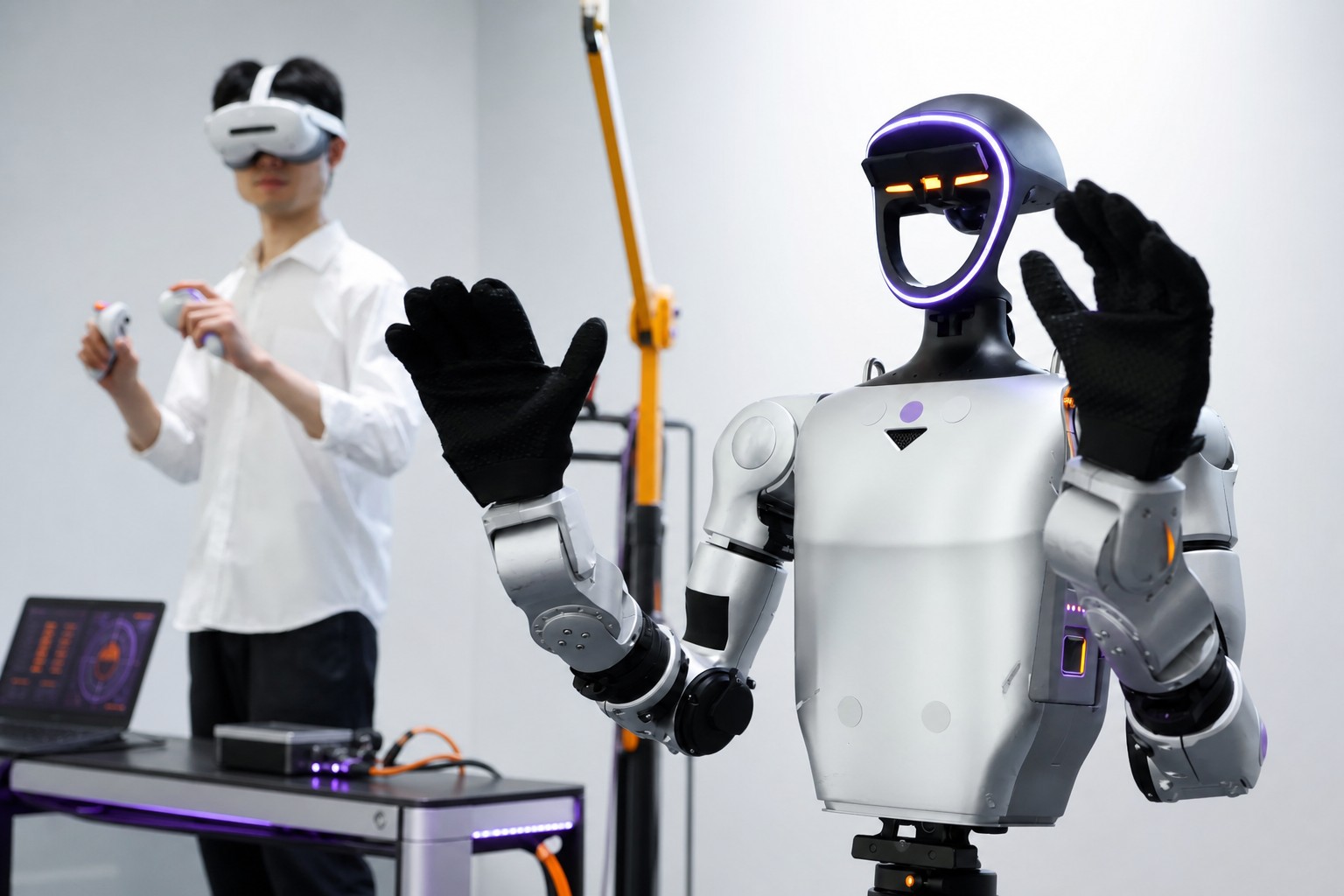
Unitree lost close to half its market value this week, days after an IPO on the Chinese exchange often compared to Nasdaq valued the humanoid maker at $66 billion. Analysts tie the fall to something the industry does not actually dispute: robot bodies keep improving, while the machines still lack the knowledge and skill to do work that produces economic value. A week earlier, 1,500 people had gathered at the Actuate conference to discuss that exact gap, and left without closing it.
Actuate is run by Foxglove, which sells tooling for managing and visualizing the data that physical AI models train on. By the organizer's count the event has tripled in size since it started in 2023. The attendance is the cheerful part. At the booth of Avala, another physical AI infrastructure vendor, the pitch was a call to solve the "robotics data crisis" — a fair one-line summary of what the conference was really about.
The crisis is a shortage of good training data. General-purpose robots able to handle arbitrary tasks remain distant, and even end-to-end training aimed at specific tasks has not yet produced products with dependable commercial results. So the field is running the frontier labs' playbook: find or manufacture more diverse datasets, experiment with different training regimes, hunt for reinforcement learning setups that pay off.
Harry Mellsop, who founded Antioch to build simulation tools for model developers, places physical AI in the "GPT-2 era" — the OpenAI model that predated ChatGPT. Reaching the next stage, in his account, takes more data and more compute, particularly GPUs optimized for ray tracing, which is what realistic simulation runs on.
Autonomous vehicles are further along, for two structural reasons. Self-driving companies can harvest relevant data from cars that humans are already driving. And an autopilot's central task is to avoid contact, whereas a robot's task is usually to make contact and manipulate something.
Much of the tooling in robot learning came straight out of the AV industry — Foxglove itself was founded by former employees of Cruise, General Motors' self-driving program. Now the car companies increasingly expect their machine-learning investments to carry them into competition with humanoid makers. Tesla is already testing that with Optimus. Wayve, an autonomous-driving company, and the ride-hailing service Uber have each opened robotics labs focused on humanoid forms, run as research projects.
Wayve CEO Alex Kendall argues cars are the right starting point: manipulation robotics today sits roughly where self-driving was five years ago. He expects the data, simulation and model-operations infrastructure to be shared, with the simulator's world model needing its own fine-tuning. Across robot types he expects more in common than different, though each physical embodiment will still need its own adjustments. He also thinks it premature to commit to a single hardware platform, since sensors and components are improving quickly and a genuinely general model should depend less on any particular machine.
Théophile Gervet, CEO of Genesis AI, disagrees. His company is vertically integrated around humanoids and raised a $105 million seed round this year, and he argues the field is far too early for a strategy that builds a general brain first and picks hardware to match. There is, in his view, considerable value still available from co-designing the hardware and the AI together.
The deployment record supports the narrow end of that argument. Gritt builds solar power plants. Agility puts robots into industrial facilities. Bedrock operates excavators autonomously. General-purpose humanoids are, for the most part, still in the lab.
Gervet's framing is that customers do not want a general robot that works with 80% accuracy. Companies attempting to cover many scenarios at once, without vertical specialization, create no value. The inverse risk is real as well: build a narrow industry solution on top of a GPT-2-level foundation and a competitor arriving with a GPT-4-level system can displace it.
Industry-specific bets also return something besides revenue, which is real-world data. It may be too narrow to advance a general model, but it is enough to build a robot that is useful. Bedrock CTO Kevin Peterson said the company started with excavation to work through the problems of "real-world manipulation", and plans to build an intelligence layer spanning several kinds of construction machinery.
Handling that data is its own difficulty, particularly the volume of visual and lidar streams. This week Foxglove released a product built on Nvidia's open Cosmos world model that lets engineers retrieve data with complex natural-language queries and then construct evaluations and simulations from it. The stated goal is faster triage and debugging, so model teams can get through more iterations.
Be precise about who is doing well here. Foxglove, Avala and Antioch sell instruments to companies that have not yet shipped a robot with dependable commercial results, and the conference tripling in three years measures the health of the supplier layer rather than of the thing being supplied. That is not a criticism of the tools; every industry builds its instruments first. But the most visible growth in physical AI right now is growth in the cost of trying.
The GPT-2 analogy also has a hole nobody on stage appears to have poked at. GPT-2 became GPT-3 by scaling on a corpus that already existed — the internet had been written long before anyone needed it for training. Robotics has no equivalent. Its corpus must be manufactured: teleoperated, simulated, or harvested from whatever machines are already deployed. That is precisely why the loudest complaint at the conference was about data and the most concrete product launches were about generating and searching it. "GPT-2 era" implies a known road to the next stop. What this industry has is a known destination and no road.
The 80% figure deserves a second look too, because it appears twice in the same conversation pointing in opposite directions. Gervet says customers will not accept a general robot that works with 80% accuracy, and also says physical AI becomes real when a robot handles a basic physical task out of the box at roughly 80% reliability or better. Both can hold at once — a consumer forgives what a construction site will not — which suggests that "reliable enough" in robotics is not a number at all. It is a customer.
That makes the industry's favourite question, the timing of its ChatGPT moment, harder than it sounds, because the people building the models do not agree on what the moment would be. Sam Altman recently said physical AI's ChatGPT moment could arrive in a few years. Kendall notes that the largest robot deployment in the world is still household vacuum cleaners, and thinks the moment has to interest consumers rather than investors, who are interested enough already. His example is autonomous driving with no need to watch the road, in a car whose hardware costs no more than $1,000; Wayve licenses models to automakers chasing exactly that, and Kendall expects a business worth several billion dollars to fund a genuinely general embodied model.
Gervet pictures the break differently: a robot that works out of the box, addressed in natural language and asked to do something basic — push or pull an object, close a laptop, clear a table — at roughly 80% reliability or better with no additional configuration.
Foxglove CEO Adrian McNeil expects no single moment at all. ChatGPT's success was distribution, zero to something like a million active users in very little time, and nothing in the physical world propagates that way. He would rather see robotics get its Apple II or IBM PC: an affordable home robot you can buy that starts doing things that are useful and interesting.
Three definitions, three companies, three different decades. A licensing business inside cars, an 80%-reliable general manipulator, an affordable machine in a living room — they imply different products and different customers, and the industry's capital has been raised against all of them simultaneously. Unitree's investors were never asked to choose. They priced a humanoid maker at $66 billion and then cut it nearly in half within days, on no new information about what the robots can do — only a market arriving, late, at the conclusion the conference had already reached.