
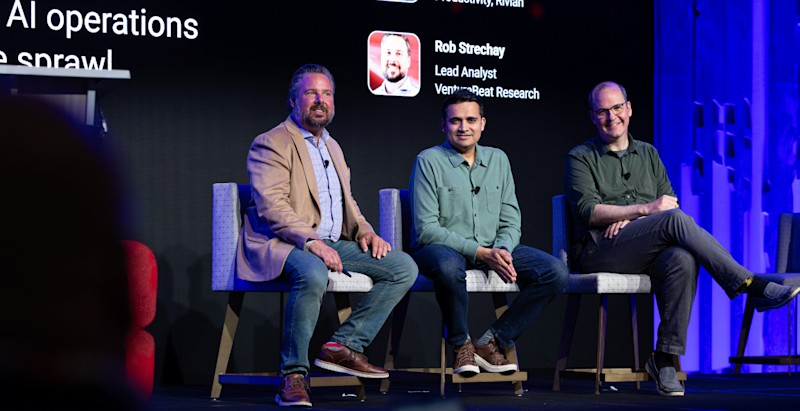
VentureBeat has named Rob Strechay, until now managing director and chief analyst at theCUBE Research, as its first lead analyst and a founding member of VentureBeat Research. The publication is building the hire around an audience it says it already has — the directors, vice presidents, CIOs and CTOs who evaluate, buy and deploy enterprise AI — and around a claim that news coverage alone no longer answers the questions those people bring to work. Strechay starts with four beats: cloud infrastructure, modern data infrastructure, platform engineering with DevOps orchestration and observability, and the intersection of AI and enterprise security.
The reasoning VentureBeat offers is that the questions have changed. After a period of experimenting with generative AI, organizations are moving to production use and want to know how to run environments with solutions from multiple vendors, where the security gaps open up in agent pipelines, and how to fix the infrastructure utilization problems that keep driving costs up. Those are not questions a news story answers. They are questions a survey and a methodology answer, and VentureBeat says the gap is exactly what the new research arm is for.
Strechay is not a new name to the operation. In May he published an analysis of enterprise GPU utilization, on the compute sitting idle inside AI infrastructure, and he went through VentureBeat's "AI Infrastructure and Compute" survey in detail before it ran. His background runs nearly three decades as a practitioner, product leader and industry analyst: leadership roles at several startups including Zerto, then Amazon Web Services, where he worked on building a new analytics service, then enterprise infrastructure roles, senior analyst at Enterprise Strategy Group, and finally managing director and chief analyst at theCUBE Research and SiliconANGLE, where he interviewed executives and tracked cloud, data and AI infrastructure.
That last line is the one worth pausing on. Strechay is moving from one media company with an analyst practice attached to another media company that is building one. This is not a reporter becoming an analyst; it is an analyst changing which publication's data he works from. VentureBeat is hiring a category that already exists, from a competitor that already proved it exists.
The existing research spine is VB Pulse, a set of monthly surveys covering five areas of enterprise AI adoption: agent orchestration, agent reliability and evaluation, agent security and identity management, AI infrastructure and compute, and context layers including retrieval-augmented generation. Strechay's infrastructure emphasis is meant to fill in underneath all five.
The June orchestration report, built on a survey of 145 companies, found that two thirds of them had not settled on a single vendor and kept fallback options in their model strategy. How useful that turned out to be became clear after Anthropic's Claude models went down in June.
145 companies in the survey; two thirds kept vendor fallbacks.
The video series is the other half of the plan. VB In Conversation is being relaunched with Strechay as host, and the stated shift is away from broad industry overviews toward system architecture, the real obstacles in deployment, and the state of backend infrastructure — with architects and product leaders behind enterprise AI systems as guests, and episodes meant to show which tools hold up under production load. It will run on VentureBeat's site and its YouTube channel; Strechay's written analysis will run on the site. Strechay said VentureBeat has assembled an audience of enterprise system builders and technology buyers, and that he wants to use empirical metrics and VentureBeat's own data to help companies and developers make grounded decisions about platforms and infrastructure during a period of large-scale change in enterprise technology.
Here is my read. The two-thirds number is the most interesting thing in the announcement, and it is doing quietly damaging work for the vendors VentureBeat covers. Two thirds of 145 enterprises refusing to commit to one model provider is usually written up as prudence. It is more honest to call it distrust priced in as architecture: buyers built the fallback before the outage, not after, which means they never believed the uptime story in the first place. The Claude outage in June did not teach them anything; it confirmed a bet they had already placed. A research practice that keeps producing numbers like that will be more useful to readers than to the companies whose products it measures — and that is the structural tension inside every vendor-adjacent analyst shop, including the one Strechay is leaving.
Which leads to what the announcement does not say: who pays for VentureBeat Research. There is nothing here about whether the surveys are subscription-funded, sponsored, or free, nothing about sample construction beyond the count of 145, and nothing about what happens when a VB Pulse result is unflattering to an advertiser. For a news outlet, that question is a footnote. For an analyst practice selling objectivity to CIOs as the product, it is the whole thing. Strechay's own stated pitch — empirical metrics, VentureBeat's own data — only carries weight if the reader knows who commissioned the data.
The bet VentureBeat is making is that enterprise buyers will pay attention to infrastructure research from a publication rather than from a research firm. It is a reasonable bet, because the buyers are already reading the publication. It is also the point at which the publication starts competing with the firms whose analysts it quotes.