
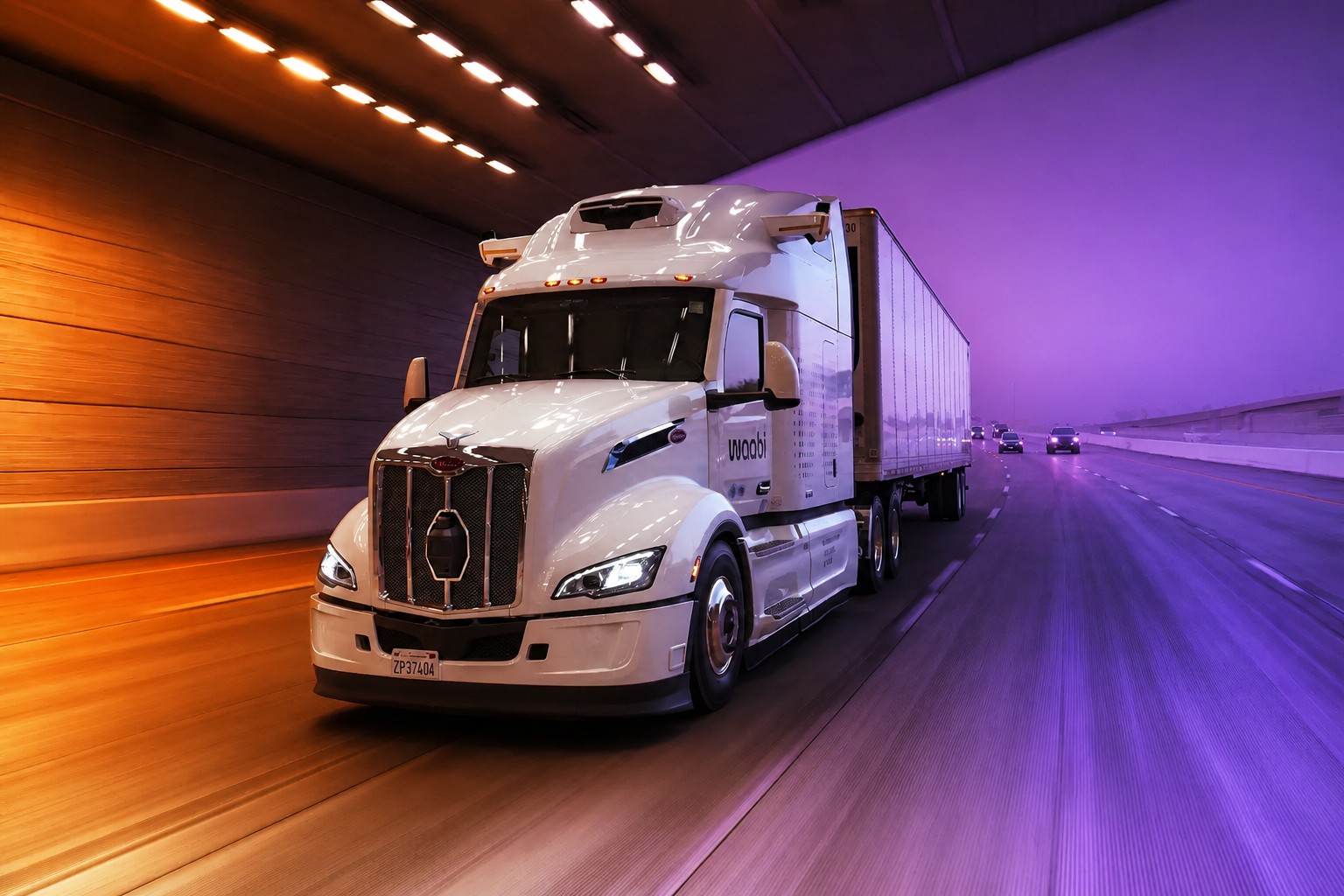
Waabi says its test truck covered about 300 miles from Dallas to San Antonio without prior simulation, training runs or safety-driver intervention. The claim matters because autonomous trucking has typically depended on detailed maps and extensive preparation before a vehicle reaches a new road. If the result holds beyond a single run, Waabi is arguing for a different deployment model: send the truck where the customer needs it, rather than only where the system has already been trained.
A road the truck had never seen
The test truck drove roughly 300 miles on the highway between Dallas and San Antonio. Before the trip, Waabi says the route was:
A safety driver was behind the wheel, but never had to take control, according to Raquel Urtasun, Waabi’s founder and CEO, who spoke to Forbes. Urtasun said the truck completed the route safely and confidently despite never having seen a single lane on that road before.
The system did not require new data, engineering changes or another training cycle. The run lasted 4.5 hours at an average speed of 60 miles per hour.
The preparation gap
Most autonomous trucking systems are built around advance preparation: detailed maps, large-scale simulation and repeated exposure to the routes a vehicle is expected to drive. Waabi’s test is designed to show that its approach can handle an unfamiliar highway without that pipeline.
That would put pressure on the current rollout strategy used by competitors, including Aurora, which is gradually deploying autonomous freight operations on familiar, well-studied roads.
Waymo, described by the source as the industry leader in autonomous driving, spends weeks or months mapping and simulating future trips before launching robotaxis in a new city. The company also suspended its own autonomous trucking program several years ago.
Tesla is expanding its robotaxi program in Austin and other cities while saying its AI does not need high-definition maps or lengthy training for new routes. Based on the description in the source, however, Tesla’s system relies substantially on remote operators to help prevent problems.
The contrast is straightforward:
What Waabi is building
Waabi was founded in 2021 by AI specialist Raquel Urtasun. From the start, the company has pursued a general-purpose driving system intended to adapt to unfamiliar situations in a way comparable to the human brain, making safe, reasoned decisions from the information available to it.
Waabi is working with truck manufacturer Volvo. The company expects to begin installing its technology on newly designed autonomous trucks in the first quarter of 2027.
With support from Uber, Waabi raised up to $1 billion from investors this year, including:
Urtasun’s argument is that freight logistics change constantly: customer delivery locations move, so an autonomous truck should go where customers send it instead of forcing them to choose routes the system has already prepared for.
I think that is the more important claim than the 300-mile figure. A single successful trip demonstrates that the system can manage one unfamiliar route. It does not yet show how often the capability works, how it performs across a fleet, or what operational limits appear outside this test.
What I’d want to know is whether Waabi can repeat the result without adding a hidden layer of preparation around every new destination. The company’s planned 2027 truck deployment will test not only whether the AI can drive an unknown road, but whether that flexibility can become a dependable freight business.
Daily AI news
Every day we pick what actually matters in AI and explain it plainly — no hype, no filler. Subscribe if you want to follow where the industry is going.
Only what matters — every day
Follow on X