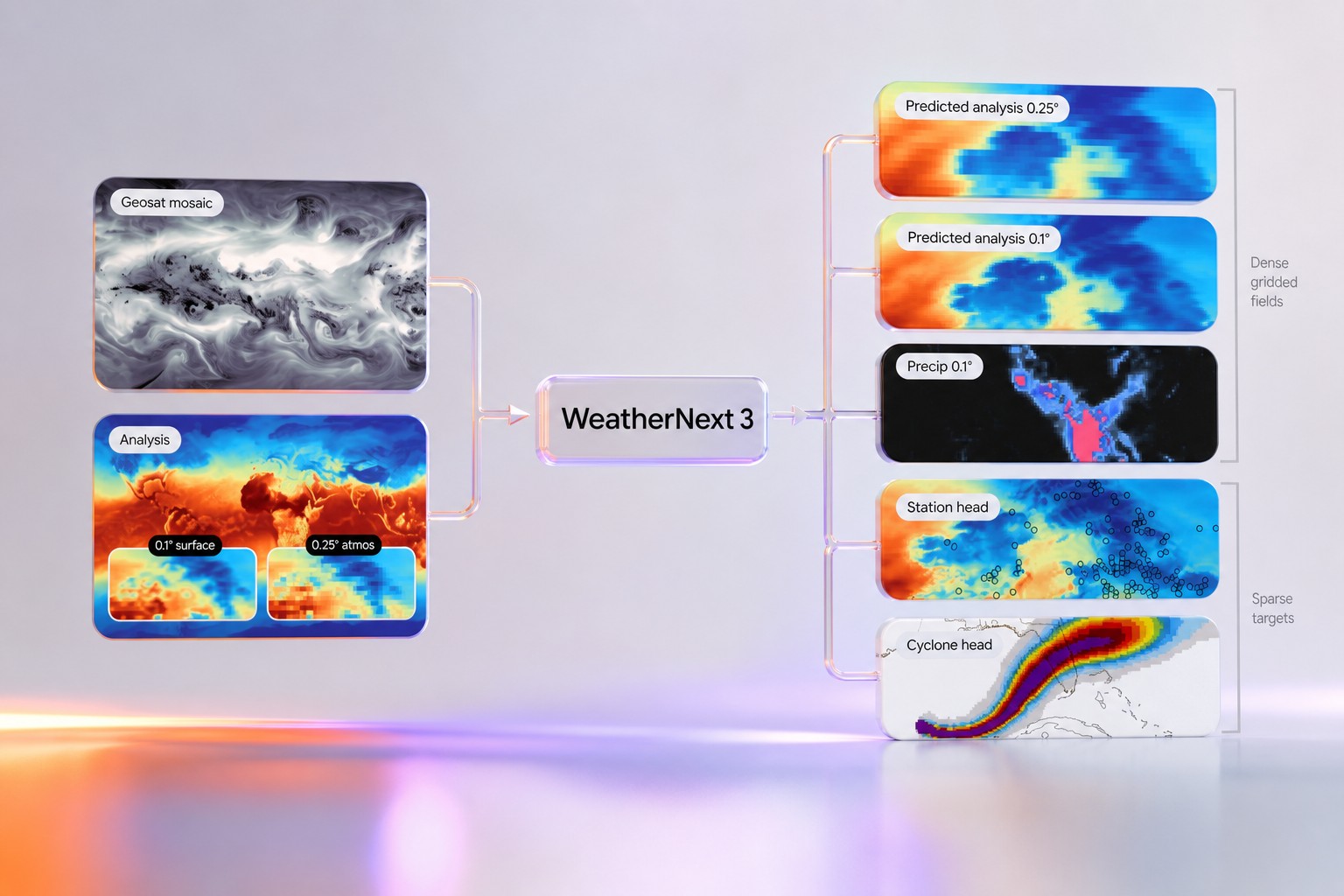
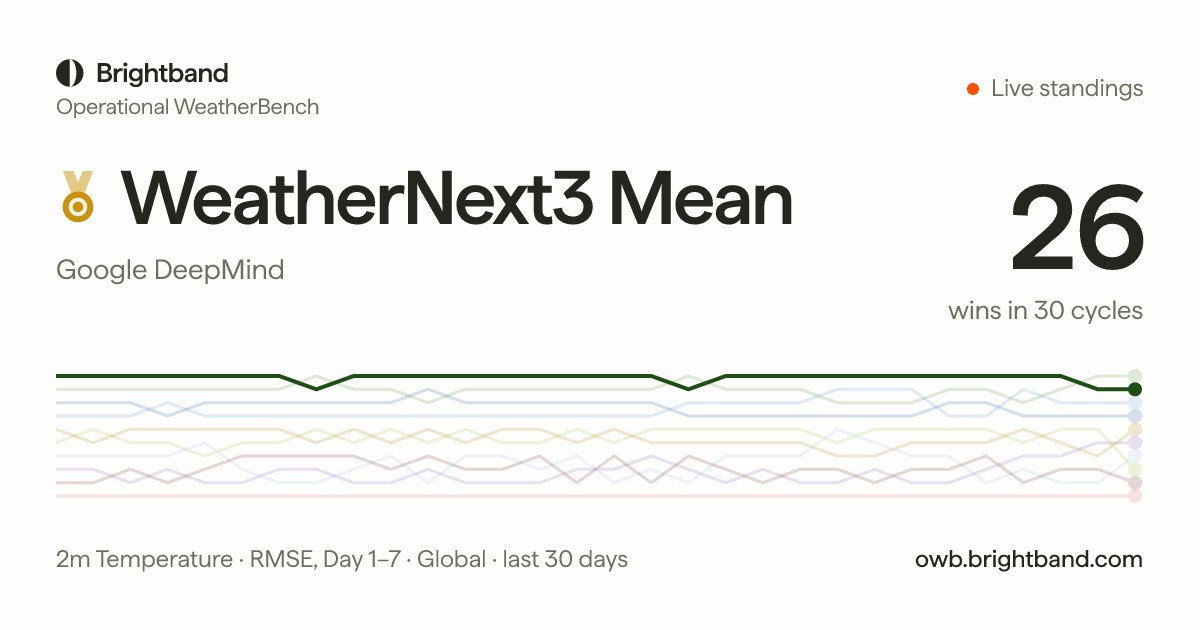
Google is putting a new forecasting model, WeatherNext 3, behind the weather data users see in Search, Google Maps and Gemini, and making it available to customers and researchers on its cloud platforms. On Operational WeatherBench — a forecast comparison tool built by Brightband that scores how accurately systems predict temperature, wind speed and humidity — it posted the best result among leading models, beating deep-learning systems from Google itself, Microsoft, Nvidia and the European Centre for Medium-Range Weather Forecasts, as well as the conventional forecasts of the US National Weather Service and ECMWF. Samier Merchant, a senior staff engineer at Google, says it is the first time core meteorological variables will feed a large number of Google products directly.
Source: techcrunch.com
Most weather forecasts still come off government supercomputers that solve, step by step, the mathematical equations describing atmospheric physics. Those systems have become very accurate, and they remain expensive and comparatively slow. The opening came when ECMWF released more than half a century of weather data produced by that kind of machine; deep-learning researchers then started building models that forecast far faster at comparable accuracy. Ferran Alet, who leads a DeepMind research group, frames the task as approximating noisy physics from incomplete data under limited compute, by finding patterns across large volumes of observations — the atmosphere is chaotic, and small differences in starting conditions compound.
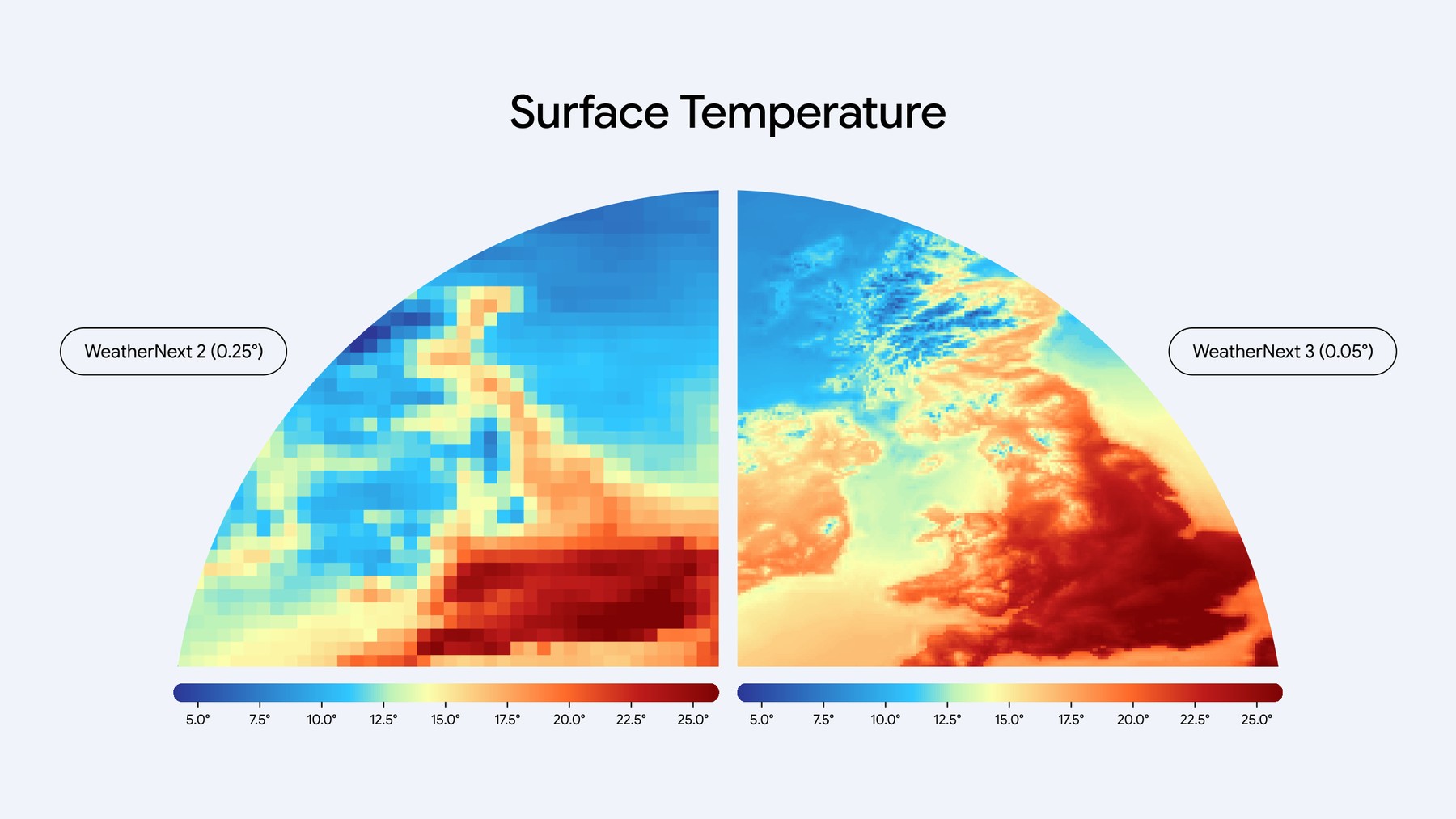
Three weaknesses have followed AI weather models throughout: they often forecast for too coarse an area, 15 to 25 square kilometers; they handle rain badly; and they depend on prepared datasets produced by national meteorological services. WeatherNext 3 is aimed at all three. It forecasts key variables down to 5 km resolution, its rain estimates are 60% better than WeatherNext 2's, and forecasts can now be pulled every hour instead of the standard six.
Source: techcrunch.com
The gains come from specific engineering choices. The model is 2.4 times larger in parameter count than its predecessor, and the team changed the objectives its decoder heads are trained against to get more useful outputs. Most weather models emit values averaged over a three-dimensional grid; DeepMind had previously tuned its system to render cyclone tracks, and in this version it also trained the model to forecast for individual weather stations. Daniel Rothenberg, an atmospheric scientist at Brightband, describes that as moving the forecasting task closer to its end product — the model can predict, hour by hour, what the station at Denver airport will record.
The higher update frequency comes from data, not architecture: WeatherNext 3 ingests satellite observations at one-hour intervals. Feeding raw observations to a model, rather than the analysis products prepared by meteorological supercomputers, can improve accuracy, but unformatted data is technically hard to work with. Google calls WeatherNext 3 the first AI model to use raw observations directly for a high-resolution global forecast. WindBorne's weather unit disagrees, saying its WeatherMesh 6 model already takes raw data from the company's own network of weather balloons and other sources. Google's response is that WeatherNext 3 delivers higher resolution worldwide. Both models still rely on national meteorological datasets, and full direct assimilation will take more work.
That last exchange is the weakest part of the announcement, and it is weak in a revealing way. Two of the three named weaknesses were answered with numbers — 5 km, 60%, hourly. The third, dependence on government-prepared data, was answered with a claim of priority that the claimant itself qualifies two sentences later. Notably absent is any figure for how much of WeatherNext 3's input is genuinely raw. And the 60% rain improvement, the most quotable number here, is measured against Google's own previous model, not against the operational forecasts it beat on Brightband's benchmark.
The benchmark result is the justification; the product routing is the event. A model that is fast and cheap to run is worth more to Google as infrastructure sitting under billions of weather-adjacent queries than as a research paper, and Alet says as much — Google wants to give users useful information, and many user queries touch the weather one way or another. Merchant's framing, that core meteorological variables will drive a large number of products for the first time, describes a utility being plumbed in, not a paper being published.
Beyond Google's own surfaces, the shift to transformer architectures in meteorology has been quietly as consequential as the attention going to large language models. European and American weather services already use AI models in their forecast products. The speed and low cost of such systems could matter most in poor regions, where accurate forecasting is out of reach because good sensors and supercomputers are expensive; Bill Gates has named AI weather forecasting as one of the technology's important benefits, pointing to higher crop yields in developing countries. Alet adds that higher-resolution wind, rain and cloud forecasts would make renewable energy projects more reliable.
Which leaves the dependency nobody is pricing. Every model in this race, Google's and WindBorne's included, is trained on and still leaning against data pipelines run by national weather agencies — the same agencies whose forecasts these models now outscore. Direct assimilation of raw observations is the escape route, and by Google's own account it is not finished. Until it is, the fastest forecasts in the world sit on top of public infrastructure that no one in the private race is paying to maintain.