
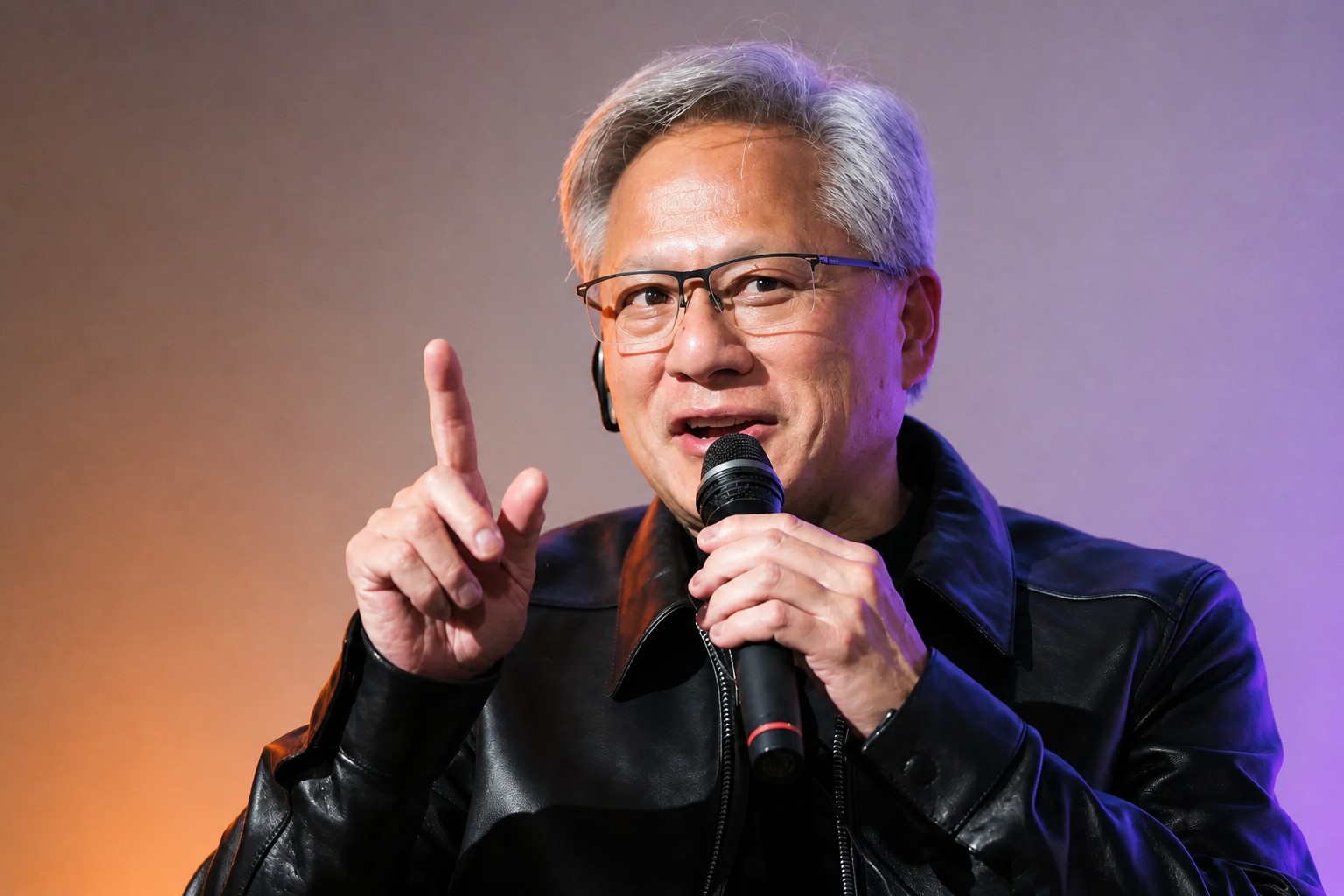
Nvidia’s board has launched an independent investigation after CEO Jensen Huang told employees he had cheated on his wife. His alleged relationship was with Megaspeed executive Alice Huang, whom US authorities consider a Chinese spy who passed information to Beijing. The board said it has so far found no evidence that government or corporate secrets were leaked, and Huang remains in charge. Jeffrey Sonnenfeld, a professor at the Yale School of Management, puts Huang’s chances of keeping his job at roughly 50–50: much depends on the investigation’s findings and whether it can be shown that Nvidia’s chief was misled.
Jeffrey Sonnenfeld puts Jensen Huang’s chances of keeping his job at 50–50
In late October, a spokesperson for the Chinese Embassy in Washington called the allegations baseless. No one has been charged. According to media reports, US intelligence officials informed President Donald Trump of their concerns a year ago. Senior Trump administration officials, whose names have not been disclosed, told The New York Times they doubted Huang had been unaware all this time that Alice Huang was gathering information for China. When Trump was first briefed, officials did not believe Huang knew, the newspaper reported. It is not known whether that view has changed.
Reputation and a “credit balance”
Sonnenfeld, senior associate dean for leadership at the Yale School of Management and founder of the Chief Executive Leadership Institute, knows Huang, who has taken part in the institute’s summits for business leaders. Sonnenfeld is sympathetic to Nvidia’s chief and believes he can rebuild his career, but puts the likelihood of that outcome roughly even with the chance that he will step down.
Before the scandal, Huang was respected and trusted in the technology industry, Sonnenfeld said. Now, however, his conduct looks extremely imprudent. In the professor’s assessment, any other Nvidia employee in a similar situation would have been fired. Even if Huang was merely naive, the carelessness itself may have undermined trust in him.
One factor that could work in Huang’s favor is what social psychologists call a “credit balance.” Psychologist Edwin Hollander introduced the concept in a 1958 paper: people are given greater freedom to act within a group if they demonstrate competence and follow its rules. Huang has been accumulating this credit since 1993, when he co-founded Nvidia. But it can run out if a mistake appears self-serving or violates norms that matter to the group. Here, that group includes Nvidia’s board, roughly 42,000 employees required to follow security rules, and, more broadly, the US government, which restricts the company’s exports.
Why it would be hard to replace Huang
According to Sonnenfeld, there are few direct parallels to this situation. Executives who weather personal scandals often continue their careers at another company. Former HP CEO Mark Hurd, who led the company from 2005 to 2010 and brought it to the top of its industry by revenue, resigned after submitting inaccurate expense reports that concealed his personal relationship with a contractor. About a month later, Oracle hired him. Huang cannot make the same move: Nvidia is his company.
It is also unclear who could replace him from within. Large companies usually have management hierarchies, but Huang has said he kept Nvidia’s structure as flat as possible: about 60 people report directly to him. His children also work at the company and are sometimes named as possible successors. If Huang leaves, discussions about candidates are sure to begin in the coming weeks. In a crisis, boards sometimes look outside the company for a solution; Sonnenfeld mentioned former Google CEO Eric Schmidt as one possibility.
Nvidia’s financial ties complicate the situation
Nvidia is not only the largest supplier of chips for the AI boom, but also one of the key sources of funding for its infrastructure. The company has invested in hundreds of small startups, as well as OpenAI, Anthropic, xAI, CoreWeave and Nebius. In August, Nvidia signed preliminary agreements with Apollo, BlackRock, Blackstone, Brookfield, Goldman Sachs and KKR. The agreements envision raising more than $500 billion over time to develop infrastructure. Huang has said Nvidia could provide up to a quarter of that sum. Many saw the deals as an attempt to spread risk. But a leadership crisis at the center of such a system could turn a single disruption into a chain reaction.
What the board needs to find out
Huang has already faced criticism in recent months for supporting sales of advanced chips to China. In January, at the World Economic Forum in Davos, Anthropic CEO Dario Amodei, whose company has received investment from Nvidia, compared such sales to supplying North Korea with nuclear weapons.
Nvidia’s independent directors — everyone on the board except Huang — now need to determine whether the company’s technology reached China and how. That will also require examining Nvidia’s relationship with Megaspeed. The Singapore-based cloud company grew out of a Chinese gaming business and became Nvidia’s largest chip buyer in Southeast Asia. According to an October 2025 report by The New York Times, Megaspeed bought about $2 billion worth of chips. This raised questions about whether the company was helping China bypass US export restrictions by reselling chips or giving Chinese customers remote access to them. After the newspaper’s report, an Nvidia spokesperson told The Hill that the allegations had been thoroughly reviewed and disproved last year.
Nvidia said Huang will remain in charge for now. He is due to appear at a closed-door briefing for three House committee chairs on November 18. The day before, on November 17, Nvidia will report its latest financial results. Sonnenfeld expects Huang may keep his job while handing some day-to-day decisions to other executives.
Huang does not have shares with special voting rights that would let him cement control of Nvidia. Sonnenfeld generally supports dual-class shares, which give founders additional authority, and considers Huang’s success without such a structure a strong argument against it. But if Huang had shares of that kind, removing him would be harder.
Corporate security and trust in the industry
The story could become an important moment in the debate over how technology companies protect their secrets. Sonnenfeld says the industry follows security requirements far less rigorously than defense contractors, where procedures govern access to classified information.
The arrest of an OpenAI engineer last month points to the same problem. He was accused of hiding a recording device behind a television in a conference room used by executives. OpenAI said it found no evidence of access to model weights, source code or customer data. Even so, the case shows how vulnerable technology companies can be to people who have gained access to them.
Sonnenfeld hopes the investigation will clear Huang of suspicions that he knowingly helped anyone, and allows that he may keep his job. But the decision about the company’s leader will not rest only with Nvidia’s board and employees: its customers and partners will also have to make their own judgment. Indirectly, the issue affects millions of Americans who hold Nvidia shares in 401(k) retirement plans.
Dataist’s take: The investigation concerns two issues at once: a leader’s personal responsibility and the security of technology companies whose products and investments are tied to China. The board has so far found no evidence of leaked secrets, but specific conclusions are still to come. And because Nvidia plays a central role in financing AI infrastructure, the effects of the crisis could extend beyond the company itself.
Daily AI news
Every day we pick what actually matters in AI and explain it plainly — no hype, no filler. Subscribe if you want to follow where the industry is going.
Only what matters — every day
Follow on X